
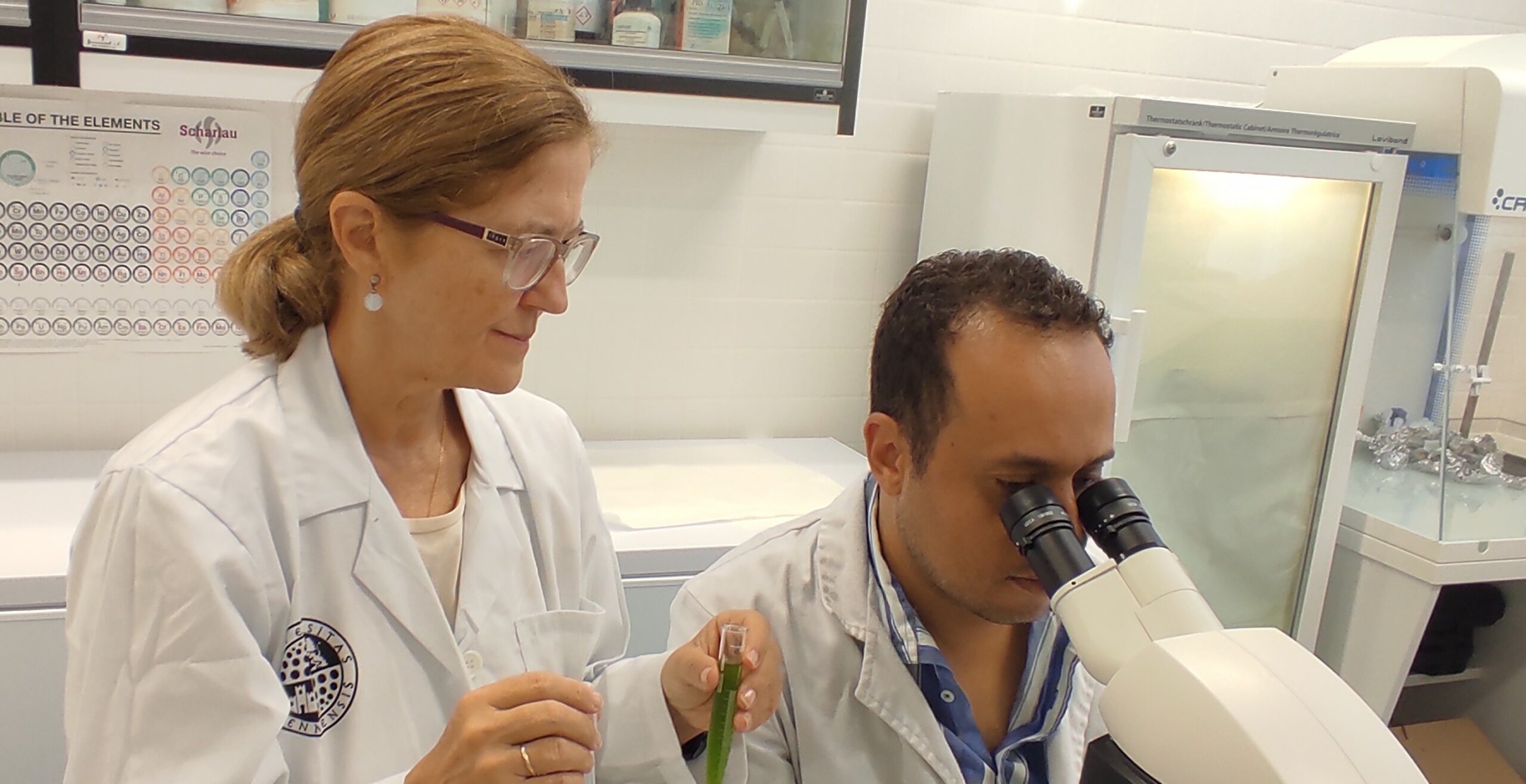
A research team from the University of Jaén (UJA), in Spain, has demonstrated that the microalga Neochloris oleoabundans can successfully treat wastewater generated by olive mills while producing nutrient-rich biomass with strong potential for use in aquaculture.
The findings, published in Engineering in Life Sciences, show how this robust species can convert one of the olive industry’s most problematic effluent into high-value raw materials suitable for animal feed, biofertilisers and bioenergy production.
The researchers worked with two olive-mill wastewater streams – olive washing water and oil washing water – combined with secondary-treated urban wastewater from the sewage treatment plant in Mengíbar. This blend helped balance the high organic load and phenolic compounds typical of olive mill effluents with essential inorganic nutrients such as nitrogen and phosphorous. The resulting medium provided optimal conditions for the growth of Neochloris oleabundans, a microalga known for thriving in harsh environments and utilizing contaminants as nutrient sources.
The microalga delivered remarkable results in both depollution and biomass productivity. According to the scientific paper, the culture achieved reductions of up to 94 per cent in nitrates and nitrites, 66 per cent in phenolic compounds, and more than 93 per cent in chemical oxygen demand (COD) – levels that render the treated water suitable for agricultural reuse or environmentally safe discharge. Alongside this, the harvested biomass reached exceptionally high nutrient levels. Up to 56 per cent carbohydrates, 51 per cent lipids and 49.5 per cent proteins.
These figures are significantly higher than those typically obtained in conventional microalgal cultivation and open new opportunities for application in the aquaculture sector. The lipid fraction, naturally abundant in Neochloris oleoabundans, is particularly valuable for energy-dense aquafeeds or for producing renewable biofuels used in aquaculture operation. The protein content – close to 50 per cent – positions this microalga as a competitive alternative to plant-based and other microalgal protein sources, while the carbohydrate proportion offers additional functional potential for larval and juvenile diets.
The experiments, conducted in one-litre photobioreactors, revealed that the microalga not only tolerates olive will wastemater but can achieve competitive growth rates even under initially toxic conditions. The study confirmed that combining olive mill and urban wastewaters mitigates the inhibitory effects of phenolic compounds and support more stable growth, particularly during the early stages where organic overload typically limits microalgal performance.
For the aquaculture industry, the work represents a compelling example of circular-economy principles in action. A highly polluting agricultural waste stream can be transformed into a resource capable of generating functional ingredients and regenerated water suitable for aquaponic systems or agriculture linked to aquaculture production. Researcher Mª Lourdes Martínez-Cartas emphasises that this approach can extend beyond the olive sector, providing valuable knowledge for designing treatment and valorisation systems compatible with modern aquaculture.
The project now aims to scale the process to real operational conditions during the olive oil production season, to validate performance using larger volumes and under natural variability. According to the authors, such systems could create new business opportunities parallel ot agricultural and aquaculture activity, reducing the environmental burden of effluents while increasing the supply of sustainable ingredients in a sector increasingly dependent on alternative protein and lipid sources.
Funded by the Andalusian Regional Government through FEDER funds, the research marks a milestone in integrating microalgal bioprocesses with major agro-industrial sectors. Its potential application in aquaculture offers an innovative pathway to enhance sustainability, reduce costs and advance towards more circular and resilient production models.
Rererence:
Fahd Mnasser, M. Lourdes Martínez-Cartas, Sebastián Sánchez. Production of Bioproducts from Wastewater Treatment Using the Microalga Neochloris oleoabundans. Engineering in Life Sciences. https://doi.org/10.1002/elsc.70032
Related

Latest In-depth
-

Bacteriohages in aquaculture: What should we know?
Phage therapy – a natural alternative to antibiotics – is gaining ground in aquaculture