
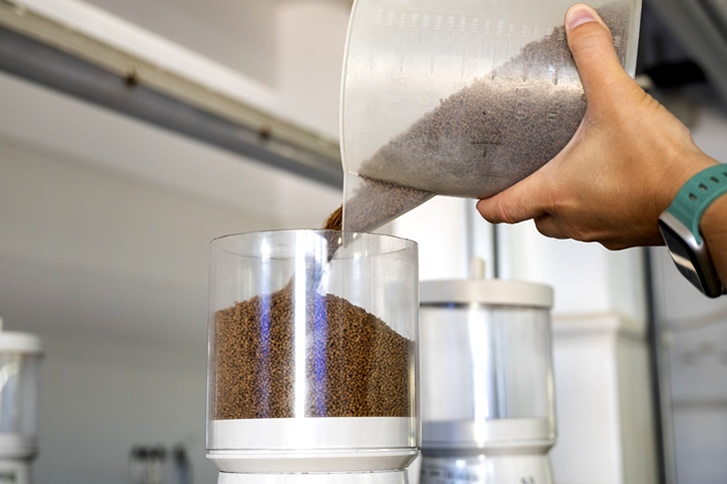
For years, the aquaculture industry has been tackling the primary challenge of its expansion: a reliance on marine ingredients that restricts growth due to finite availability and cost volatility.
Historically, fishmeal and fish oil have formed the core of feed; however, the solution to this bottleneck has been the diversification of raw materials. Today, this transition is moving from mere promise to operational reality across several sources.
Insects, microbes, poultry by-products, agriculture waste, and new plant-based sources, among others, are making a strong entry into commercial formulations, proving their efficacy in the grow-out of various species. Nevertheless, the strategic question the sector must ask is not simply whether these ingredients work, but what new type of dependency they are creating.
By reducing pressure on extractive marine resources, aquaculture is externalising its dependence onto supply chains beyond its control.
Poultry by-products, for instance, are tied to the fluctuations of the meat sector. Insect meals, whilst promising, still face corporate instability, scalability bottlenecks, and high energy costs. Meanwhile, agricultural by-products remain at the mercy of the climate, crop yield, and global markets that are highly sensitive to geopolitics.
Added to this is the nutritional challenge. Replacing protein is only one part of the equation; replicating the lipid profile – specifically the Omega-3 fatty acids, EPA and DHA – provided by wild fish remains a critical hurdle, forcing the sector to rely on other emerging and costly sources, such as microalgae.
Consequently, we have created a more complex system where production risk is distributed, but not eliminated.
The illusion of circularity and cross-sector competition
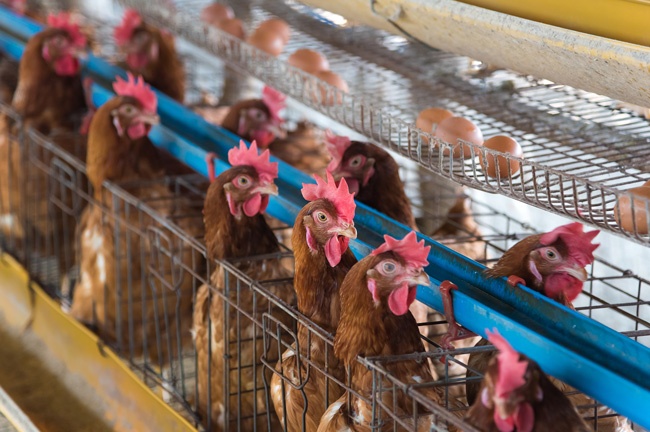
The drive to shift from a linear to circular model – transforming waste into high-value raw material – carries side effects. Aquaculture now competes directly for these resources with giants from other sectors: energy (biofuels), fertilisers, the booming pet food market, and even human nutrition.
Furthermore, we must remain critical: not all circular alternatives are automatically more sustainable. Some ingredients may simply displace the environmental impact (a higher water or carbon footprint) rather than reducing it, resulting in a sustainability that is more narrative than reality. This is an unacceptable risk in a context where markets and certification schemes demand quantifiable evidence, not just good intentions.
The new strategic imperative
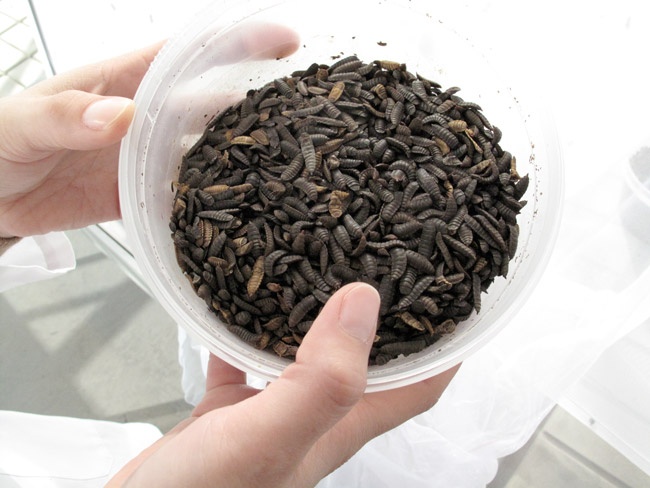
In this landscape, diversification fulfils its primary function by reducing the risk associated with a single critical resource, but it introduces a new reality: aquaculture has moved from a reliance on sea quotas to a dependence on multiple, volatile external production systems.
The focus for aquaculture firms can no longer be solely on R&D for better formulation. The future lies in securing stable, traceable, and competitive access to these new raw materials through long-term alliances, vertical integration, or predictive supply models.
Those who fail to proactively manage this logistical and strategic complexity will simply have traded one familiar problem for several that are far harder to anticipate.
Related


Latest news
-

What to look for in aquaculture at Seafood Expo Global 2026: technology, data and new suppliers
Barcelona, 10/04/2026 |
-
-
Peru cuts anchovy quota by 36% for 2026, adding pressure to marine ingredients market
Lima, Peru, 8 April 2026 |
EVENTS
-
21AprTue, 21 Apr - Fri, 24 AprGran Via - Fira Barcelona - Barcelona