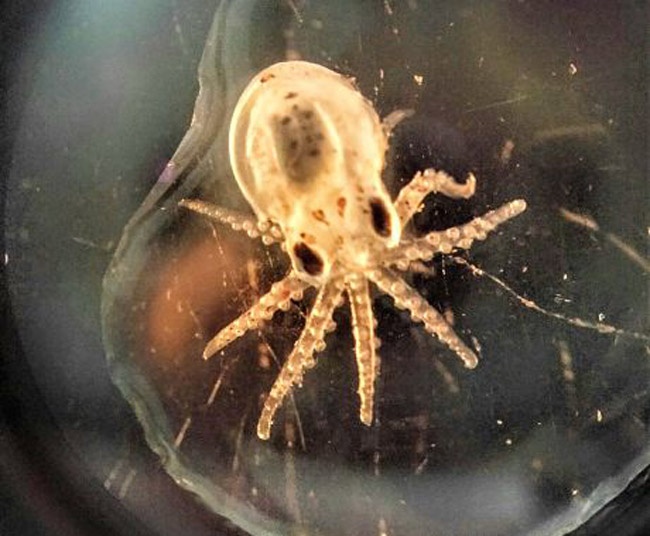
 Paralarva of octopus | Centro Oceanográfico Vigo (CSIC)
Progress towards sustainable octopus aquaculture has reached an important milestone with the launch of a project to breed octopus larvae in captivity, led by Octolarvae, a subsidiary of Grupo Profand. This project, to be carried out in new facilities in Meira (Moaña), aims to establish the biological and technical bases necessary to make octopus aquaculture an economically viable and environmentally sustainable reality.
Breeding octopus in captivity has long been a major challenge for the scientific community. Completing the biological cycle of the octopus under controlled conditions is crucial to reducing fishing pressure on this resource, which has seen demand soar in recent years.
In 2017, an alliance was formed between the Ecobiomar group of the Marine Research Institute (CSIC) and the fishing company Armadora Pereira, later taken over by Grupo Profand. Now, with the creation of Octolarvae, the most critical phase is expected to begin: the breeding and feeding of octopus larvae in a controlled environment.
The project, which is expected to take five years to complete, will involve the construction of a 350 square metre experimental facility, with specific tanks for each stage of the octopus's development. Microalgae, artemia and phytoplankton will be cultivated to feed the larvae - one of the main challenges the scientists hope to solve.
The importance of this project lies not only in the potential reduction of fishing pressure but also in its contribution to the sustainability of the fishing sector. The octopus is a species of great commercial value, and successful aquaculture could alleviate the impact of overfishing on wild populations. Furthermore, it would position Spain as a leader in aquaculture innovation, with a focus on sustainability and scientific research.
Grupo Profand, Spain's second largest fishing multinational, is leading this initiative with the support of CSIC, combining business expertise with scientific rigour. With a turnover of €930 million in 2023 and around 3,500 employees, Profand continues to expand its aquaculture activities, including species such as sea bass, gilthead sea bream and Vannamei shrimp.
Meanwhile, other projects, such as Nueva Pescanova in the Canary Islands, are aiming to produce octopus in captivity on a large scale, which could be a game changer for the global seafood industry. For now, however, Octolarvae is focused on research and experimentation, laying the groundwork for a future where captive octopus farming becomes a viable and sustainable alternative.

Latest news
-
Ectoparasite pressure may be silently undermining performance in gilthead seabream and European seabass
Co-cultured study reveals physiological impacts with direct implications for health planning and production efficiency
-
Strong demand, limited production: Italian aquaculture calls for regulatory reform and clearer labelling
Pordenone, Italy, 23 February 2026 |
-