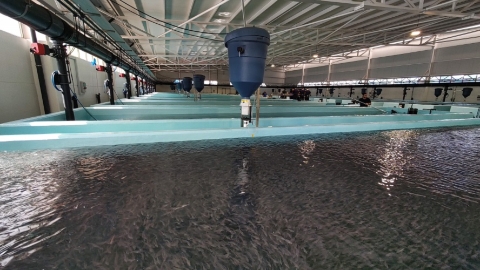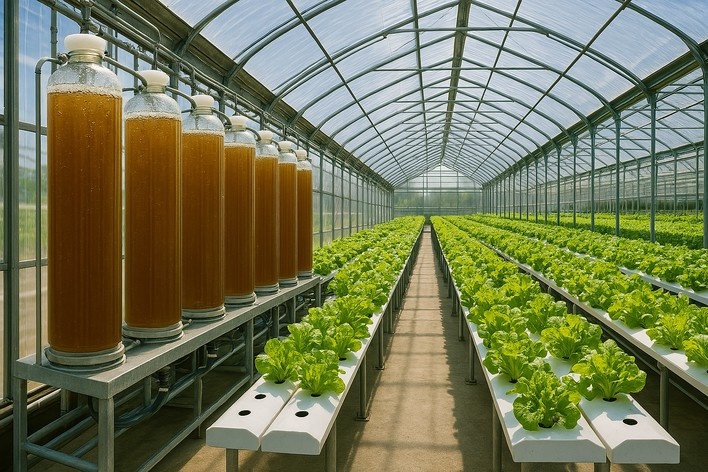
Integrated algae-based aquaculture has been discussed for years as one of the sector’s most promising sustainability pathways. What has been missing, however, is evidence that these systems can work beyond controlled trials.
This is precisely the gap that the European INNOAQUA initiative is beginning to address, with its key issues to be examined in an online technical webinar organised by the European Aquaculture Society on Wednesday, 11 February 2026, from 08:30 to 11:30 CET.
The focus is not on concepts or future promises, but on pilot-scale and near-commercial production systems already operating in Europe and Southern Asia.
According to the EAS information, the focus is not on concepts or future promises, but on pilot-scale and near-commercial production systems already operating in Europe and Southeast Asia, where algae are integrated as a functional component of the production system.
Much of the algae debate in aquaculture has traditionally revolved around feed – replacing fishmeal improving lipid profiles or adding functional compounds. INNOAQUA deliberately moves away from that framing.
In the systems presented, algae are treated as infrastructure that help to recover nutrients, contribute to water quality stability, and, in some cases, generating secondary value streams alongside fish or shrimp production.
This reflects a broader shift already underway in parts of the sector: sustainability gains are increasingly expected to come not from changing single inputs, but from redesigning how farming systems operate as a whole.
The diversity of pilot cases – spanning salmon and microalgae in Northen Europe, shrimp-based IMTA-RAS in Southern Asia, and land-based fish-macroalgae systems in the Mediterranean – illustrates both the versatility of integrated approaches and the complexity involved in adapting them to different species, climates and production goals.
What makes these examples relevant for producers is the scale at which they are being tested. The system discussed go beyond proof-of-concept trials and into pilot or pre-commercial operation, where theoretical advantages meet operational reality.
At this level, the key questions change quickly. It is no longer just about biological feasibility, but about system stability over time, management intensity, monitoring and control requirements, and sensitivity to species choice and local conditions.
Experiences shared by partners such as NORCE and Universiti Putra Malaysia point to a central trade-off: integration can improve efficiency and environmental performance, but it also increases operational complexity.
One of the strengths of the discussion is its realism. While pilot results are encouraging, it is clear that upscaling remains the main bottleneck. Integrated algae-based systems introduce challenges that conventional farms do not face such as tighter system control, more complex biological interactions, and higher demands on technical expertise.
Economic performance is still an open question. While algae can improve nutrient efficiency and environmental performance, robust cost-benefit data at full commercial scale are not yet available, and profitability remains highly dependent on local conditions and system design.
These approaches are not designed for every farm, at least not in the short term. Their relevance is currently highest for RAS and semi-closed systems, producers under increasing nutrient discharge pressure, high-value or innovation-driven operations, and companies already investing in digital monitoring and advanced system control.
For low-margin, extensive production models, adoption is likely to remain limited until complexity, costs and management requirements can be significantly reduced.
INNOAQUA does not claim to have solved integrated aquaculture. What it demonstrates instead is something arguably more important for the sector: that combined algae–animal systems can be operated in practice, and that the discussion has moved from concept slides to operational experience.
For aquaculture professional, the takeaway is straightforward. Integrated algae-based production is no longer a futuristic idea – but neither is it a plug-and-play solution. Its future will depend less on biological breakthroughs and more on engineering choices, management capacity and economic realism.
Algae are not the answer to everything. But they are increasingly part of the system-level toolbox shaping what aquaculture may look like next.
📅 Save the date | Technical webinar
Algae-based innovation for next-level combined aquaculture production
- Organiser: European Aquaculture Society
- Framework: EU Horizon Europe INNOAQUA project
- Date: Wednesday, 11 February 2026
- Time: 08:30 – 11:30 CET (Brussels time)
- Format: Online webinar (Microsoft Teams)
- Registration: Free, registration required
- More details at: https://events.teams.microsoft.com/event/3b119a43-db34-46f2-830e-91eb67019928@a4ab8958-2a3d-40c0-ae21-d3c85612711f

Latest news
-
A webinar examines how algae-integrated aquaculture is moving from concept to pilot scale
Brussels, 23 January 2026 |
-
-

Artificial Intelligence in aquaculture: where we really are in 2026
China, 21 January 2026 | What fish behaviour recognition can already deliver – and what still remains experimental