

Until very recently, artificial intelligence was the domain of specialists. It was a field shaped by a handful of highly focused teams, producing genuine advances, but with applications that were still limited and, in many cases, experimental.
In just a few years, however, AI has shifted from technological promise to buzzword. In aquaculture, as in many other sectors, merely invoking artificial intelligence is often enough to dress up projects, attract media attention or reinforce innovation narratives – even when the real-world impact is marginal. Let us be clear: using the “artificial intelligence” label without changing processes, improving decisions or creating tangible value for the sector is nothing more than IA washing, much as “Aquaculture 4.0” once was.
The first symptom of AI washing is linguistic. Texts abound that refer to “intelligence models”, “AI-based tools” or “decision-support systems”, yet carefully avoid explaining what the algorithm actually does, what data it uses or why it performs better than established approaches.
In many cases, what lies behind the supposed AI are statistical techniques that have been known for decades, expert-defined heuristics or simple threshold-based alarm systems. Where there is no machine learning, there is no adaptation – and without adaptation, there is no artificial intelligence.
Moreover, without data, there is no AI that works. Systems that perform well under ideal conditions often fail in the complex, noisy reality or a commercial farm. Aquaculture is not a laboratory, and models that cannot cope with variability, missing data or operational constraints rarely survive beyond pilot trials.
Computer vision is perhaps the area most prone to AI washing. Impressive videos and accuracy figures obtained in experimental tanks may look convincing, but once these systems face production environments – with turbidity, biofouling, high stocking densities, overlapping fish and stress - their performance frequently collapses or drops below the level that once justified their cost.
So which AI does work? The kind that genuinely enables change: systems that phenotype thousands of fish without invasive sampling, detect health issues before they become visible, optimise feeding based on actual behaviour, or integrate predictive outputs into commercial planning.
Ultimately, distinguishing useful AI from AI washing is straightforward. They key question is simple: which decision does this AI change – and does it improve that decision compared with the methods that were already available?

Latest news
-

“AI washing” in aquaculture: when artificial intelligence changes nothing
By Alejandro Guelfo, 2 February 2026 |
-
-
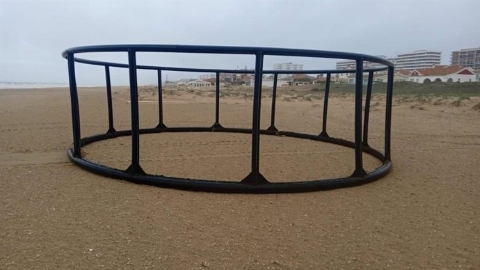
Three offshore fish farming cages from Portugal wash ashore in southern Spain after Storm Kristin
Punta Umbría, Spain, 30 January 2026 |
