As Mediterranean waters warm, thermal stress is becoming a structural production constraint in marine aquaculture. In species such as European seabass (Dicentrarchus labrax), temperatures approaching 30°C compromise growth efficiency, metabolic balance and ultimately farm performance.
Results recently released via the newsletter of CTAQUA suggest that diet formulation may play a strategic role in mitigating these effects. The findings stem from the THERMOBASS project, commissioned by the innovation network of APROMAR (Spanish Aquaculture Producers’ Association), and focused on evaluating nutritional strategies under sustained high-temperature conditions.
“We studied the performance of feed formulations with different fat levels and the inclusion of the prebiotic inulin, in order to identify nutritional strategies that favour growth and better physiological adaptation of fish to high temperatures,” explained José Cabello, Head of Experimental Development at CTAQUA.
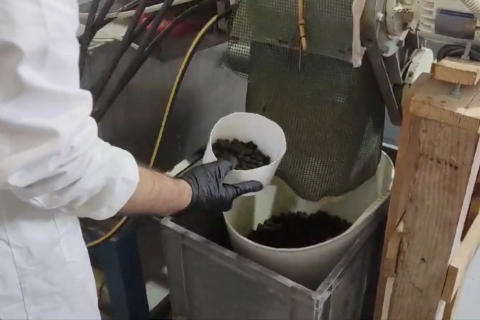
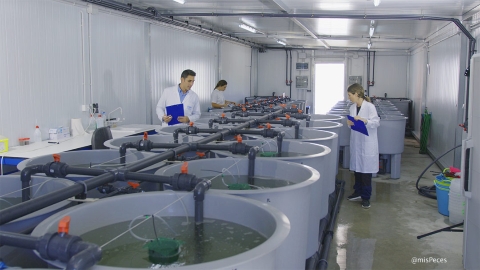
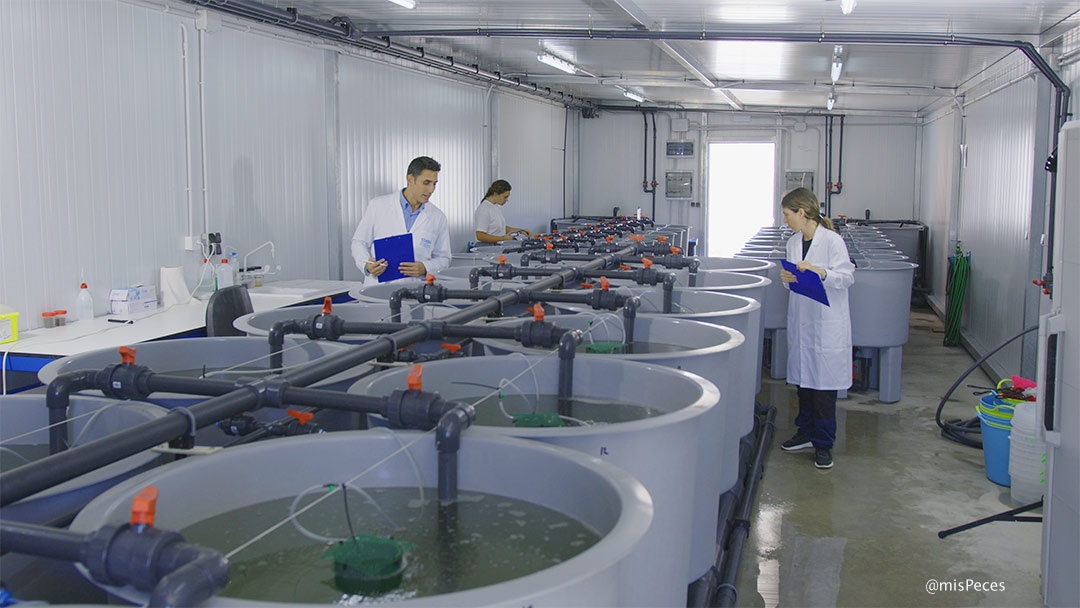
During a 12-week trial, seabass were maintained at 30°C in experimental systems, simulating a chronic thermal stress scenario. Productive parameters including survival, weight gain, specific growth rate (SGR) and feed conversion ratio (FCR) were monitored, together with innate immunity indicators, physiological markers associated with stress and metabolism, histopathological analysis and final fillet composition.
“High-fat diets tend to be associated with poorer growth, whereas formulations with more balanced fat levels offer better productive performance,” Cabello noted. “In particular, the low-fat diet including 0.5% inulin recorded the best results, with a higher growth rate and significant differences compared to the high-energy diet.”
The study also confirmed that sustained thermal stress triggers metabolic alterations in seabass. According to CTAQUA, inulin inclusion may help control increases in plasma cholesterol and triglycerides and support adaptation to oxidative stress. Histopathological evaluation of liver and intestine revealed no severe lesions or clinically relevant alterations, and final fillet composition did not differ significantly between dietary treatments.
From a European strategic perspective, the implications extend beyond a single experimental trial. Climate projections indicate that Mediterranean production areas will increasingly operate near upper thermal thresholds during summer. Under these conditions, nutritional formulation becomes a resilience lever rather than a marginal optimisation factor.
If validated at commercial scale, climate-adapted feed strategies could form part of a structural response to warming waters across southern Europe, particularly in seabass and seabream-dominated systems.
The project is part of APROMAR’s 2025 Production and Marketing Plan and is co-financed by the European Maritime, Fisheries and Aquaculture Fund (EMFAF). However, its strategic value lies in highlighting a central question for European aquaculture: how to sustain biological performance and economic efficiency under new climatic baselines.

Latest news
-
-
-
RAS-farmed greater amberjack meets organoleptic quality benchmark
El Puerto de Santa María, Spain, 26 February 2026 |