Mediterranean shellfish aquaculture could face severe disruption by mid-century as rising sea temperatures and ocean acidification sharply reduce survival and growth of farmed bivalves, with mussel farming at risk of collapse and oyster production significantly weakened.
That conclusion emerges from a long-term experimental study published in Earth’s Future, which set out to quantify how climate change may translate into concrete production losses for the aquaculture sector.
The research focused on Pacific oyster (Magallana gigas) and Mediterranean mussels (Mytilus galloprovincialis), the two most widely farmed bivalves in the region, and exposed them to environmental conditions projected for 2050, 2075, and 2100.
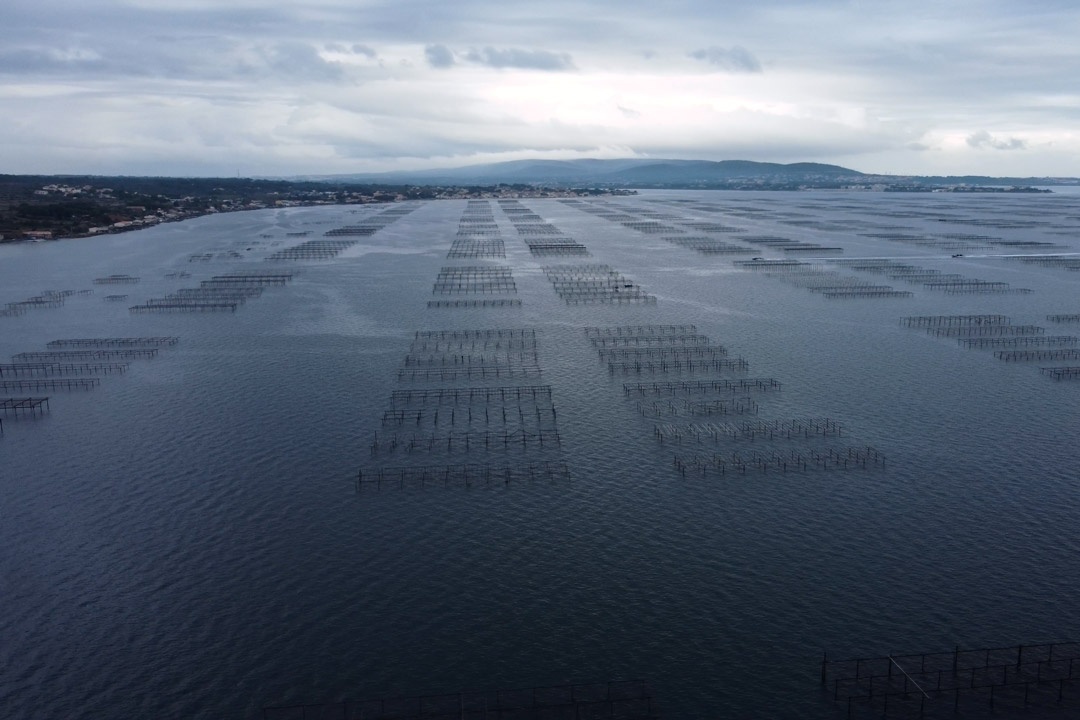
Crucially, the experiment departed from conventional laboratory approaches. Instead of short trials under stable, food-rich conditions, the animals were followed for 14 months under ecologically realistic settings in the Thau Lagoon in southern France. Temperature, pH, oxygen and food availability fluctuated naturally, closely reflecting what shellfish experience on Mediterranean farms today.
Against this backdrop, the most immediate concern arises for mussel farming. Even under present-day conditions, the study recorded around 40% summer mortality in Mediterranean mussels, a level that farmers in the Thau Lagoon already report as typical. When future warming was applied, the situation deteriorated rapidly. Under the conditions projected for 2050, summer mortality was almost total, with similar outcomes observed for 2075 and 2100.
The researchers attribute this pattern primarily to temperature stress. Mediterranean mussels have an upper thermal tolerance of around 25ºC, a threshold that summer temperatures in the lagoon now regularly exceed. In the experiment, even the relatively modest warming projected for 2050 was enough to push mussels beyond this limit. As a result, the authors warn that mussel farming in the Mediterranean “could be severely compromised by mid-century”.
Oyster, by contrast, showed greater tolerance, though the study makes clear that this resilience has limits. Survival remained relatively high under present-day conditions and under the 2050 and 2075 scenarios, averaging around 84%. However, under the 2100 scenario, survival declined to 77%, with the risk of mortality significantly higher than under current conditions.
More striking than survival were the effects on growth. Oyster exposed to conditions projected for 2100 showed a 40% reduction in mass increase compared with those grown under present conditions, alongside substantially reduced shell growth. These differences became apparent at the onset of the reproductive season and peaked around sexual maturity, a critical phase for farm productivity.
This slowdown in growth was accompanied by a measurable decline in physiological condition. At the beginning of the reproductive period, oyster in the 2100 scenario showed a 29% reduction in condition index and a 45% reduction in carbohydrate reserves, indicating lower energy availability for both growth and reproduction.
Reproductive performance was also affected. By late June, when oysters in the Thau Lagoon normally reach maturity, the proportion of ripe individuals fell sharply form 93% under present conditions to 44% under the 2100 scenario. While sex ratios remained unchanged, oocytes produced under future conditions were smaller, and early development of offspring was impaired.
These effects extended into the next generation. Parental exposure to warming and acidification reduced fertilisation rates and hatching success and increased the proportion of abnormal larvae. Under the 2100 scenario, fertilisation dropped from 88% to 57%, while hatching success declined from 40% to 10%.
However, the study also identified a degree of compensation at later stages. When larvae were reared under standard hatchery conditions, subsequent development and juvenile production were broadly similar across scenarios. The authors caution, nonetheless, that these early life stages were raised under controlled conditions with abundant food, and that longer exposure under realistic farming conditions may reveal further impacts.
Taken together, the findings offer one of the clearest experimental signals to date that climate change is no longer a distant risk for Mediterranean shellfish aquaculture. While oyster farming may remain viable, albeit with reduced performance and higher costs, the outlook for mussel production appears far more precarious. The authors conclude that their results “urgently call for the development of adaptation strategies in the Mediterranean”, underlining the need for anticipatory action by producers and policy-makers alike.
Reference:
Pernet, F., Richard, M., Brodu, N., Villeneuve, R., Di Poi, C., Urrutti, P., et al. (2025). Long‐term exposure of bivalves to ocean acidification and warming under ecologically‐realistic conditions reveals risks for aquaculture by 2050 in the Mediterranean. Earth's Future, 13, e2025EF005992. https://doi.org/10.1029/2025EF005992

Latest news
-
-
Storm Kristin causes severe damage to Portuguese aquaculture
Portugal, 3 February 2026 | The Centre region and the Algarve have been affected, according to the Portuguese Aquaculture Association
-