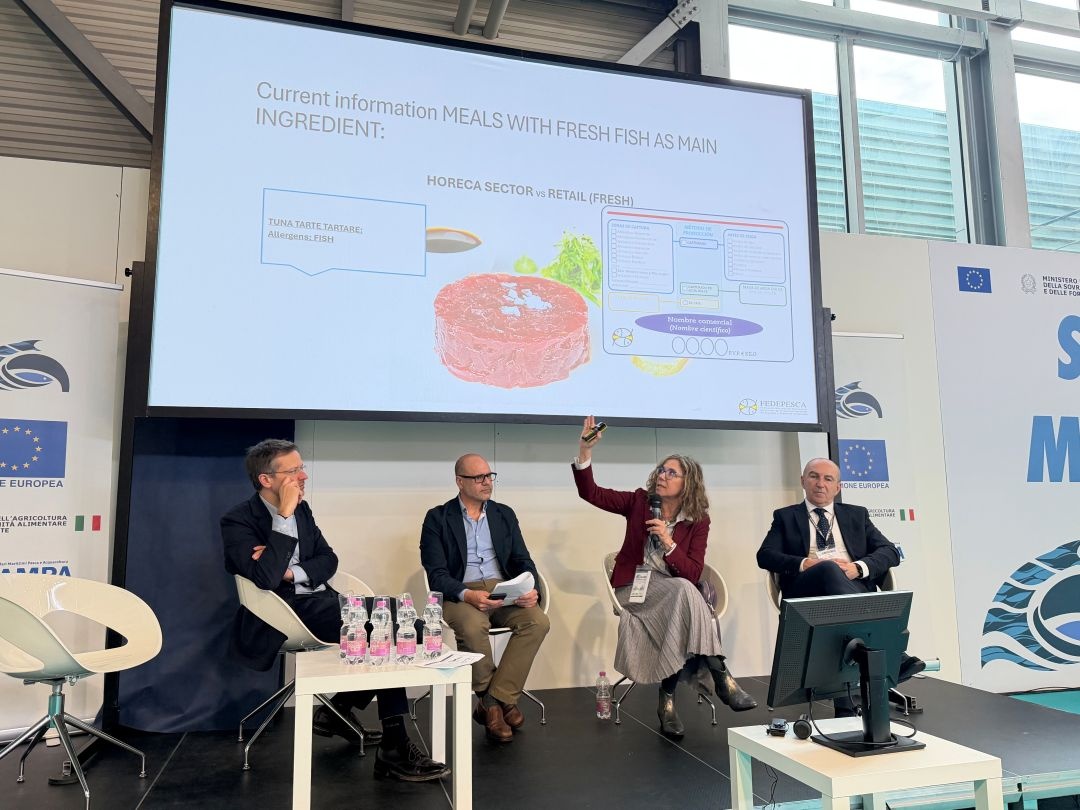
The origin of fish served in restaurants and the issue of mislabelling in the Ho.Re.Ca. channel were at the heart of a bilateral debate between Italy and Spain held yesterday during Aquafarm 2026, Italy’s leading exhibition dedicated entirely to aquaculture and the seafood value chain.
In the international setting of Pordenone, two of Europe’s largest seafood markets — both with per capita consumption exceeding 30 kg annually — addressed a topic that goes beyond consumer information and increasingly shapes sectoral policy and competitiveness. The recent FAO report on seafood mislabelling has reignited discussion around market transparency and the position of European production within a highly globalised supply chain.
The issue is far from marginal. More than 50% of fish consumed in Italy is eaten outside the home, where the indication of species, origin or production method is not always clear. At this final stage of the value chain, much of the added value of domestic production is either reinforced or diluted.
The session, moderated by Alejandro Guelfo, editor of misPeces, brought together José Manuel Fernández Polanco, Professor of Applied Economics at the University of Cantabria; María Luisa Álvarez Blanco, Managing Director of FEDEPESCA; Matteo Leonardi, President of the Associazione Piscicoltori Italiani; and Federico Pinza, President of the Italian Marine Aquaculture Association.
A shared structural reality emerged during the discussion: both Italy and Spain rely on imports for more than 75% of their seafood consumption. Although national production is recognised as strategic and of high quality, it remains insufficient to meet structurally high domestic demand.
One of the central points of the debate was the regulatory asymmetry between retail and foodservice. María Luisa Álvarez Blanco underlined that consumer information requirements are currently stricter in the retail sector than in the Ho.Re.Ca. channel, describing this imbalance as inequitable. She also noted that processed seafood products, produced under controlled industrial conditions, could comply with information requirements comparable to those applied to fresh products.
In this context, strengthening transparency in the restaurant sector is framed not only as a consumer protection measure, but as an economic instrument capable of influencing purchasing decisions, stimulating investment and reinforcing Mediterranean competitiveness. In a market heavily dependent on external supply, improving information at the point of consumption may also contribute to advancing food sovereignty and consolidating the strategic role of European aquaculture.
Aquafarm 2026 once again confirmed its position not merely as a technological showcase, but as a strategic forum where the future direction of the European aquaculture value chain is actively debated.

Latest news
-
-
Experts from Italy And Spain address seafood mislabeling at AquaFarm 2026
Pordenone, Italy, 19/02/2026 |
-

Sea Eight advances industrial-scale sole RAS expansion with 1,400-tonne capacity projected at El Musel
Gijón, Spain, 17 February 2026 |