
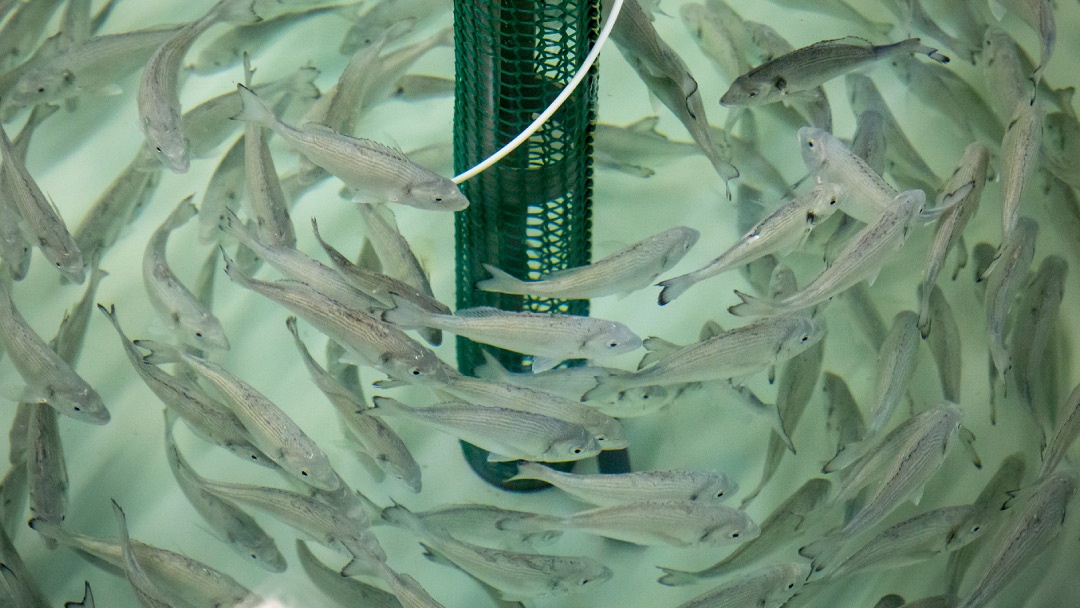
Replacing fishmeal with alternative ingredients such as mussel meal may not be environmentally more sustainable. At least, this is the conclusion of a study conducted by researchers from UiT – The Arctic University of Norway, IIM-CSIC, CCMAR and other European institutions, using the European Union’s Product Environmental Footprint (PEF) methodology.
Although this assumption is often taken for granted within the scientific community, it has rarely been questioned to the point of systematically analysing the shifting of impacts across environmental categories.
The study, published in Aquaculture, assesses the environmental footprint of producing gilthead seabream (Sparus aurata) juveniles fed diets in which fishmeal is partially or fully replaced by mussel meal derived from aquaculture side-streams.
The results show that this substitution not only fails to reduce environmental impact, but actually increases it across several key categories. In terms of climate change, replacing 50% of fishmeal raises the footprint by around 6%, while full substitution increases it by approximately 12%.
Beyond CO2 emissions, the largest increases are observed in categories such as mineral and metal resource use, human toxicity and water use. This points to a phenomenon known as burden shifting, where reducing impact is one indicator leads to increased pressure on others that are less visible but equally relevant.
One of the study’s most significant findings is that the main environmental hotspot is not the ingredient itself, but the energy consumption during the juvenile rearing phase in flow-through systems. Electricity – particularly linked to water pumping – can account for up of 80% of the total impact in several categories.
This finding reopens the debate on the real weight of early production stages in the overall environmental footprint. Traditionally, attention has focused on the grow-out phase, but this study shows that the juvenile stage may have a proportionally higher impact due to its high energy intensity.
From a production perspective, the use of mussel meal showed no significant differences in growth, feed conversion or survival compared to conventional diets, reinforcing its technical viability – but not necessarily its environmental advantage.
The study also highlights a structural limitation of this type of ingredient: the large amount of biomass required to produce mussel meal. Due to its high water and shell content, around 20 kg of mussels are needed to produce just over 1 kg of meal, which constraints its environmental efficiency.
Even so, the authors underline the strategic value of these by-products within a circular economy framework, as the allow the valorisation of currently discarded biomass. However, they warn that this approach should not be mistaken for an automatic reduction in environmental footprint.
Overall, the findings suggest that sustainability in aquaculture cannot be assessed solely based on the origin of feed ingredients. Factor such as energy use, system efficiency and the distribution of impacts across categories are critical.
Reference:
Andreas Langdal, Edel O. Elvevoll, Luís T. Antelo, Xosé Antón Álvarez Salgado, Rita Colen, Sofia Engrola, Ida-Johanne Jensen. Product Environmental Footprint (PEF) of a case study on gilthead seabream (Sparus aurata) juveniles fed side-streams from farmed blue mussel. Aquaculture, 2026, 743965, ISSN 0044-8486

Latest news
-

Digital twins in aquaculture are advancing fast, but remain far from commercial farms
Portugal, 6 April 2026 | The technology promises to optimise production and reduce risks, but the gap between laboratory performance and real-world deployment remains critical
-
Replacing fishmeal with mussels does not reduce environmental impact in seabream juvenile farming
Norway, 6 April 2026 | Partial and total substitution increases impacts in key categories, while energy use during the juvenile stage emerges as the main environmental hotspot
-

EU Vision 2040: FEAP warns it is the “last real chance” to reverse decades of stagnation in aquaculture
Brussels, 2 April 2026 | Fort the sector the real root causes of stagnation are a restrictive regulatory framework, particularly in environmental policy