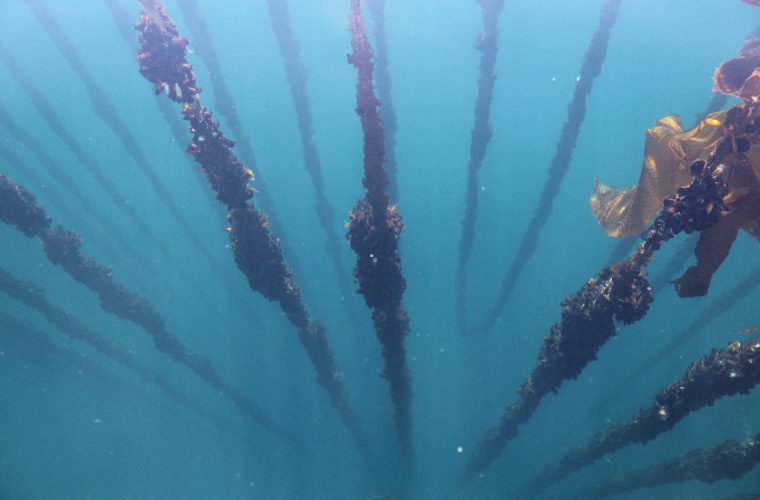
The planning framework underpinning mussel farming in Galicia may require revision following new scientific evidence on water circulation and ecosystem dynamics. A study published in Marine Policy by researchers from the Instituto de Investigaciones Mairnas (IIM-CSIC), Uxío Labarta and Diana Zúñiga, argues that current carrying capacity models used in the region should be reconsidered.
Galicia is the world’s third largest mussel producer, with a long-term average of around 250,000 tonnes per year since the 1970s, although output declined to 178,000 tonnes in 2022 and 2023. The production system, based on suspended rafts, depends on the balance between installed biomass, filtration rates, plankton availability and water renewal within the rías (coastal embayments).
A key finding of the study is that many carrying capacity models have been built on a simplified assumption of linear water flow through mussel rafts. However, in situ measurements show that the interaction between currents, mooring systems and suspended ropes generates significant turbulent flows, including vertical and lateral mixing.
This turbulence redistributes food practices throughout the water column and challenges traditional depletion-based models that assume unidirectional circulation. The authors introduce the operational concept of a “clearance zone” – a three-dimensional water volume influenced by both mussel filtration and turbulence – which requires recalibration of biomass estimates and chlorophyll depletion metrics.
The research also highlights that increasing rope density raises hydrodynamic drag, reduces internal current velocity and may limit food supply to adult mussels. In practical terms, installed biomass and production do not scale proportionally.
Moreover, the Galician rías do not function as a homogeneous system. Differences in residence time, upwelling intensity and freshwater inputs imply that ecological carrying capacity should be assessed at the scale of each embayment -and even each farming polygon – rather than applied uniformly across the region.
Galician mussel productivity is tightly linked to seasonal wind-driven coastal upwelling, which determines phytoplankton availability – the primary source of assimilable carbon. Any alteration in wind intensity duration or seasonality could affect food quality, absorption efficiency and overall bioenergetic balance.
The study stresses that future carrying capacity models must incorporate climate-related uncertainty, including potential changes in wind regimes and the increasing frequency of marine heatwaves affecting the entire water column.
Among the measures proposed are the integration of long-term wind, river discharge and wave datasets; continuous oceanographic monitoring (temperature, salinity, oxygen, chlorophyll); and the periodic depletion studies to refine sustainable biomass thresholds.
The authors conclude the carrying capacity is suspended mussel aquaculture should no longer be treated as a static parameter derived from simplified hydrodynamic assumption. Instead, it should be approached as a dynamic management tool, regulatory updated to reflect real circulation patterns and evolving climatic conditions.
In a context of production decline and environmental uncertainty, the Galician case may offer broader lessons for upwelling-dependent shellfish systems worldwide.
Referencia:
Uxio Labarta, Diana Zúñiga. Mussel culture carrying capacity: Learning form the past to face the future. Marine Policy Volume 187, 2026, 107061. https://doi.org/10.1016/j.marpol.2026.107061

Latest news
-
Science challenges current carrying capacity models in Galician mussel farming
New CSIC study calls for dynamic biomass calculation based on real hydrodynamics and climate variability
-
Middle East tensions add cost pressure to Mediterranean aquaculture
Spain, 3 March 2026 |
-