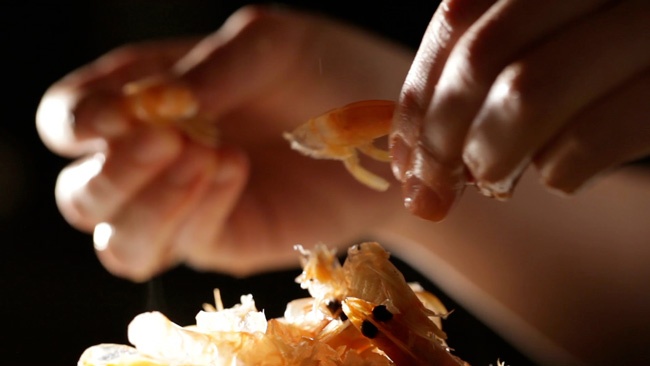
The use of shrimp hydrolysate as a palatability enhancer represents a technically robust and strategically relevant option for modern marine fish aquafeed, according to a recent study led by scientists from Symrise Aqua Feed, Institut Agro–INRAE–Ifremer and Jeju National University.
The research shows that, when applied at low doses as a liquid top-coating, shrimp hydrolysate enables fish to maintain or even improve growth, feed efficiency and health while significantly reducing fishmeal inclusion, even under farming conditions that involve repeated handling stress.
These findings were demonstrated in a feeding trial with juvenile red seabream (Pagrus major), a key carnivorous species in East Asian aquaculture. Fish were fed diets in which fishmeal levels were reduced by half and compared with conventional formulations. When the low-fishmeal diets were supplemented with shrimp hydrolysate, feed intake increased, growth rates improved and feed conversion ratios declined, restoring performance to levels comparable with — and in some cases exceeding — those achieved with higher fishmeal inclusion.
Beyond zootechnical performance, the study highlights important effects on fish health and welfare. Diets with reduced fishmeal can act as a chronic nutritional stressor, even when growth performance appears satisfactory.
The researchers observed that fish fed low-fishmeal diets without supplementation exhibited elevated muscle cortisol levels, weakened immune responses and significantly lower survival following a bacterial challenge with Edwardsiella tarda. These effects were particularly pronounced under repeated net-chasing stress, designed to mimic commercial farming conditions.
When shrimp hydrolysate was added to the diets, stress markers were reduced, antioxidant capacity improved and resistance to bacterial infection increased. This indicates that palatability enhancement does not simply stimulate feeding behaviour, but also helps fish better cope with dietary and husbandry-related stressors.
The underlying mechanism is linked to the nutritional characteristics of shrimp hydrolysate. It is rich in free amino acids and small peptides that act as strong feeding stimulants. These compounds enhance feed palatability and help mask the less attractive sensory properties of plant-based ingredients, which often limit feed intake in carnivorous marine species when fishmeal levels are reduced.
From a sustainability perspective, shrimp hydrolysate offers a practical pathway to reduce reliance on wild-caught fish. In the trial, halving fishmeal inclusion already resulted in a substantial reduction in wild fish use, while the addition of shrimp hydrolysate enabled a further decrease by improving feed conversion efficiency. This translated into a lower economic Fish-In Fish-Out ratio, a key indicator used to assess pressure on wild fish resources. Notably, these gains were achieved with a very low inclusion level, applied as a liquid top-coating rather than as a bulk feed ingredient.
The origin of shrimp hydrolysate further strengthens its appeal. It is produced from shrimp processing by-products, such as cephalothorax residues, which would otherwise have limited commercial value. Its use in aquafeeds therefore supports circular economy principles by converting waste streams into functional feed ingredients, aligning with broader industry efforts to improve resource efficiency and environmental performance without increasing feed costs.
Taken together, shrimp hydrolysate emerges as a compelling solution because it addresses several challenges simultaneously: it improves palatability and performance in low-fishmeal feeds, mitigates health and welfare risks associated with plant protein replacement, and contributes to reducing dependence on wild fisheries through more efficient feed use and the valorisation of seafood by-products.

Latest news
-
Shrimp hydrolysate improves efficiency and resilience in low-fishmeal marine feeds
South Korea, 29 December 2025 | Researchers demonstrate that palatability enhancement allows significant fishmeal reduction without negative effects on growth or health
-
Training highly skilled professionals to lead recirculating aquaculture systems
By Alejandro Guelfo, 29 December 2025 | Specialised RAS training is emerging as the key competitive advantage for the years ahead
-