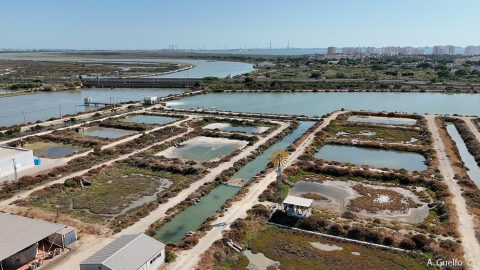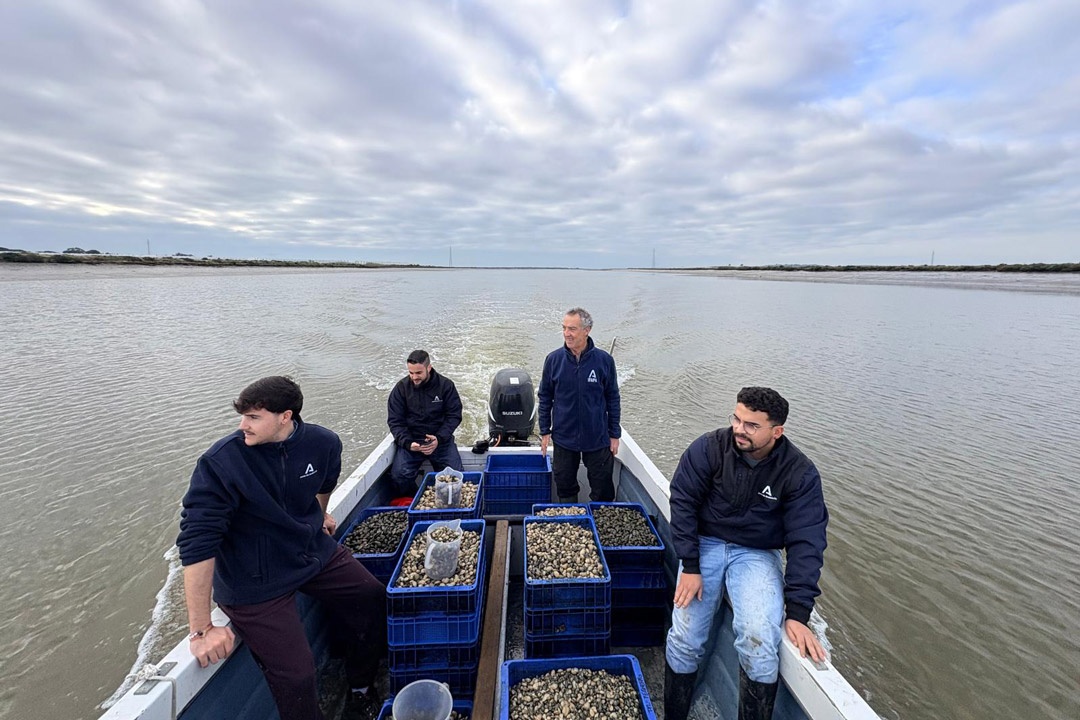
Southern Spain has launched an effort to rebuild the biological foundation of native clam aquaculture through the release of 85,000 specimens of Ruditapes decussatus in the estuary of the River Piedras, in Andalusia.
The action, carried out by the Agua del Pino centre of the Instituto Andaluz de Investigación y Formación Agraria, Pesquera, Alimentaria y de la Producción Ecológica (IFAPA), within the Paraje Natural Marismas del Río Piedras y Flecha del Rompido, is framed under the MOLUSOS project and co-financed by the European Maritime Fishery and Aquaculture Fund (EMFAF). Beyond its regional scope, however, the initiative addresses a structural bottleneck that affects shellfish farming across several Mediterranean countries: the scarcity of reliable seed supply.
The native grooved carpet shell has historically been one of the highest-value bivalve species in Andalusia. Its decline along the coast of Huelva was not primarily market-driven, but the result of a gradual erosion of productive conditions. Limited access to commercial seed and sustained illegal harvesting pressure reduced natural beds to densities that undermined economic viability.
Current surveys in the River Piedras show maximum densities of 1.8 individuals per square metre, a sharp decline from the 22 individuals per square metre recorded in 2000. In practical terms, this marks the difference between a self-sustaining recruitment system and a biologically depleted environment incapable of supporting commercial farming.
Without sufficient natural spawning biomass, hatchery dependence increases, costs rise, and planning becomes uncertain. In this context, rebuilding wild broodstock population is not merely a conservation exercise but an attempt to reconstruct the biological capital upon which production depends.
Restoring recruitment capacity
The strategic objective of the release is to reactivate natural larval supply dynamics, enabling local aquaculture operators to capture spat in their own facilities. If successful, this could reduce reliance on external seed markets and imports, improving resilience and cost predictability.
From a European perspective, the relevance extends beyond Andalusia. Several shellfish-producing regions in Portugal, Italy and France face similar constraints linked to native species. The dominance of the introduced Manila clam (Ruditapes phillippinarum) in parts of Europe has partly been driven by more predictable hatchery production. However, interest in native species is resurging due to market differentiation, ecological considerations and consumer preference for locally adapted stocks.
The Andalusian intervention therefore represents a test case for whether targeted stock enhancement can restore production capacity in native clam aquaculture without relying solely on hatchery expansion.
A question of scale and enforcement
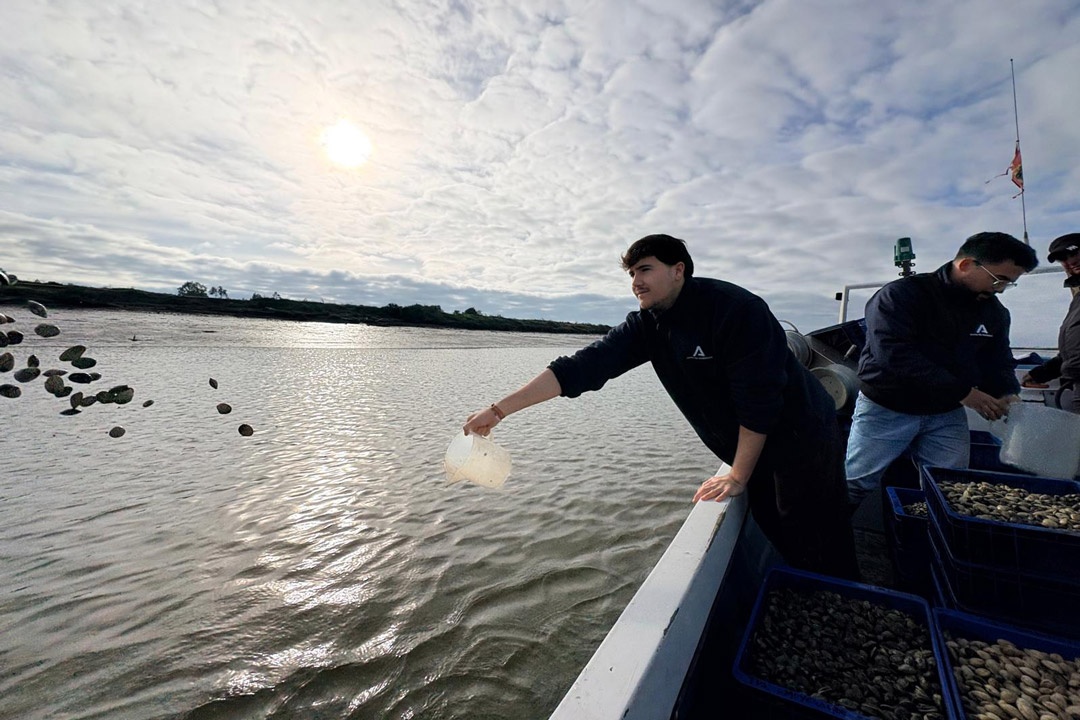
The critical issue now is whether the released biomass can reach densities sufficient to generate a self-reinforcing recruitment cycle. This will depend not only on survival and environmental stability, but also on effective control of illegal harvesting and long-term management continuity.
For European policymakers, the initiative aligns with broader objectives under EMFAF and the Blue Economy strategy: strengthening strategic autonomy in aquatic food production, improving ecosystem resilience and enhancing regional value chains.
Yet the decisive metric will not be the number of clams released, but whether the intervention translates into measurable increases in seed availability and commercially viable farming activity.
In shellfish aquaculture, rebuilding the resource base is equivalent to rebuilding the industry itself.

Latest news
-
Southern Spain moves to rebuild native clam aquaculture by restoring biological capital
Huelva, Spain, 26 February 2026 |
-
-

Governance, not just budget: defence of the EMFAF aligns with European auditor’s warnings
Brussels, 25 February 2026 |