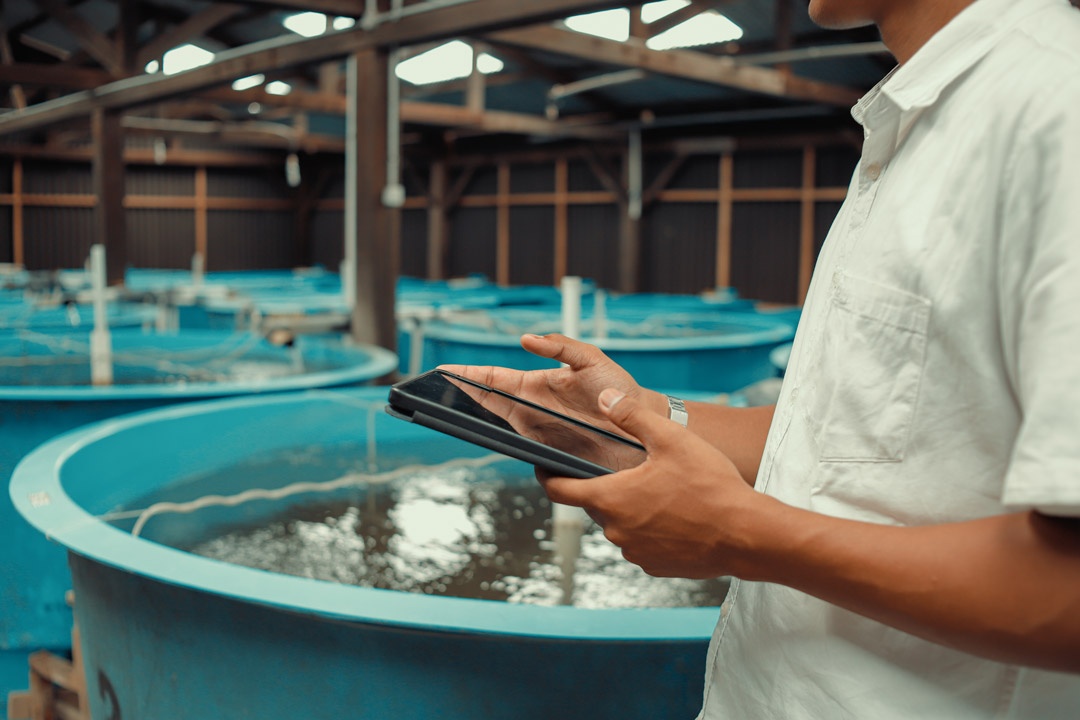
Recirculating Aquaculture Systems (RAS) in Europe are proving to be a viable, highly competitive and sustainable alternative for fish and seafood production. Thanks to these systems, and to a strong financial commitment, the production of turbot and sole has been successfully consolidated. Other species such as greater amberjack (Seriola dumerili), are also showing strong potential for commercial development under recirculating production models.
One of the main advantages of this technology lies in its ability to reconcile production growth, environmental sustainability and social acceptance, three strategic pillars for the future of European aquaculture.
Paradoxically, even though the technology itself is now in a phase of consolidation, the main challenge is neither technological nor financial, but human: there is a structural shortage of training opportunities and of suitably qualified technical staff.
Europe is one of the world’s leading scientific powers in aquaculture and benefits from a well-defined regulatory and investment framework to deploy RAS at scale. However, it has not yet succeeded in building a critical mass of professionals capable of operating these systems with consistency, technical rigour and sound biological judgement. This shortage of skilled personnel is behind many projects whose design, commissioning or operational have failed to achieve the competitiveness required to remain viable.
For years, part of the sector has fallen into the trap of assuming that RAS can be designed, built and then run almost automatically at the push of a button, with little ongoing complexity, placing the human factor firmly in the background.
Reality has shown otherwise. Without extremely precise day-to-day management, based on a deep understanding of the biological, chemical and physical processes that constantly interact within the system, and on the correct operation of each of its components – mechanical filtration, biofiltration, oxygenation, CO2 control, solids management, sensor and automation – business success cannot be guaranteed.
A RAS does not replace knowledge; it demands it. And although this may seem paradoxical, it is in fact entirely logical, as it requires continued investment in training a highly specialised professional profile, combining strong biological knowledge with advanced technical skills in physic-chemical processes.
In this context, even a minor operational error can trigger a cascade of failures with severe production and economic consequences within a matter of hours.
The ideal RAS operator must therefore have a hybrid profile, capable of understanding animal biology and stress responses, interpreting the microbial dynamics of the biofilter, managing complex water quality parameters, operating hydraulic and automated systems, and making rapid decisions based on incomplete or evolving data.
The future of RAS at commercial scale, more than being driven by further technological development, will be defined in classrooms, in hands-on training centres, and in the sector’s ability to attract and retain professionals capable of meeting this new challenge.

Latest news
-

Shrimp hydrolysate improves efficiency and resilience in low-fishmeal marine feeds
South Korea, 29 December 2025 | Researchers demonstrate that palatability enhancement allows significant fishmeal reduction without negative effects on growth or health
-
Training highly skilled professionals to lead recirculating aquaculture systems
By Alejandro Guelfo, 29 December 2025 | Specialised RAS training is emerging as the key competitive advantage for the years ahead
-