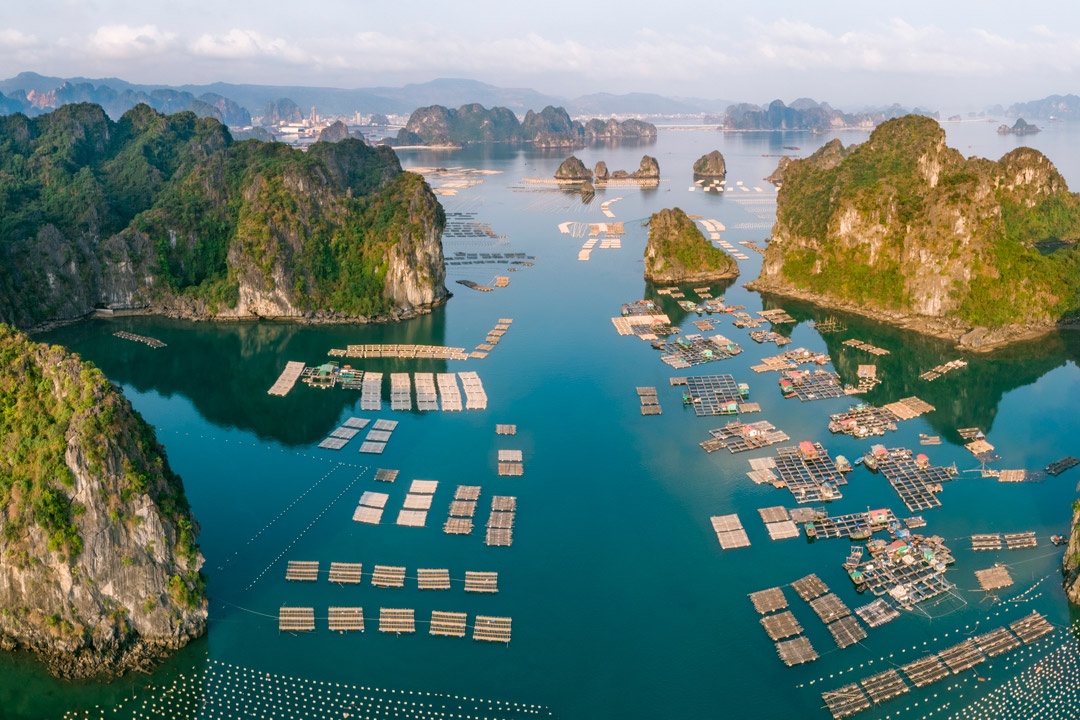
Vietnam is currently the world’s fifth-largest producer of farmed fish and the third-largest seafood exporter, yet it continues to perform poorly in global animal welfare assessments and lacks strong, enforceable welfare legislation.
This contradiction between production scale and welfare governance is examined in a recent study led by Sasha Saugh and colleagues from Vietnamese and international research institutions, including Tra Vinh University and the University of Stirling, focusing on the aquaculture industry in South and South-Central Vietnam—regions that together account for around 90% of the country’s aquaculture production area.
The study identifies weaknesses in Vietnam’s policy and regulatory framework as a central constraint. Although animal welfare legislation exists, it is largely awareness-driven, with low penalties, limited enforcement and a lack of species-specific guidelines aligned with international standards, such as those of the World Organisation for Animal Health. As a result, welfare requirements are seldom applied consistently in aquaculture production, despite Vietnam’s global importance as a producer and exporter of farmed fish and seafood.
At farm level, the research highlights persistent welfare problems linked to handling practices, stocking density and transport. Overcrowding, poor handling during harvesting and stressful transport conditions remain widespread. These shortcomings are reinforced by economic pressures, with productivity, efficiency and profit margins often taking precedence over welfare considerations, particularly among industry stakeholders.
The study also points to a significant gap between expressed concern for welfare and practical understanding. While educators, students and industry stakeholders generally report high levels of concern about aquatic animal welfare, their grasp of core welfare concepts is limited. Familiarity with key frameworks, such as the Five Freedoms of Animal Welfare, is shallow, and welfare is rarely considered across all stages of production, including farming, transport and slaughter. This weak conceptual foundation reduces the likelihood that welfare principles are translated into day-to-day aquaculture practice.
Deficiencies in education and training further compound these challenges. Aquatic animal welfare is inconsistently addressed in tertiary education, often fragmented across subjects rather than delivered through structured programmes. Many educators report uncertainty or dissatisfaction with how welfare is incorporated, while long-standing production-focused teaching traditions, combined with limited resources and training, continue to act as barriers to reform. As a consequence, graduates frequently enter the sector without the skills or confidence needed to apply welfare standards in practice.
Finally, the study highlights a disconnect between market forces and welfare policy. Although students and educators show some willingness to pay modest price premiums for higher-welfare products, industry stakeholders tend to prioritise economic considerations. Without stronger policy signals, enforcement and education that clearly link welfare improvements to productivity, food security and livelihoods, meaningful progress is unlikely.
Taken together, these factors describe a system in which aquatic animal welfare in Vietnam is widely acknowledged in principle but remains weakly governed, inconsistently taught and rarely embedded in everyday aquaculture practice.
Reference
Saugh, S.; Pham, K. L.; Trinh, L.-H.; Duong Hoang, O.; Huynh Kim, H.; Pham Van Day; Nguyen Thi, M.; Zacarias, S.; Chau Thi Da. Assessing Perceptions Toward Aquatic Animal Welfare: A Study on the Perspectives of Educators, Students and Aquaculture Industry Stakeholders in South and South-Central Vietnam. Animals (MDPI), 2026, 16, 26. https://doi.org/10.3390/ani16010026

Latest news
-
-
Vietnamese aquaculture faces major animal welfare challenges
Vietnam, 26 December 2025 | New research highlights the gap between global production leadership and animal welfare governance
-
Farmed fish reshapes Christmas menus
Editor, 24 December 2025 | Seabream, sea bass, rainbow trout and Atlantic salmon stand out as affordable and reliable festive choices