
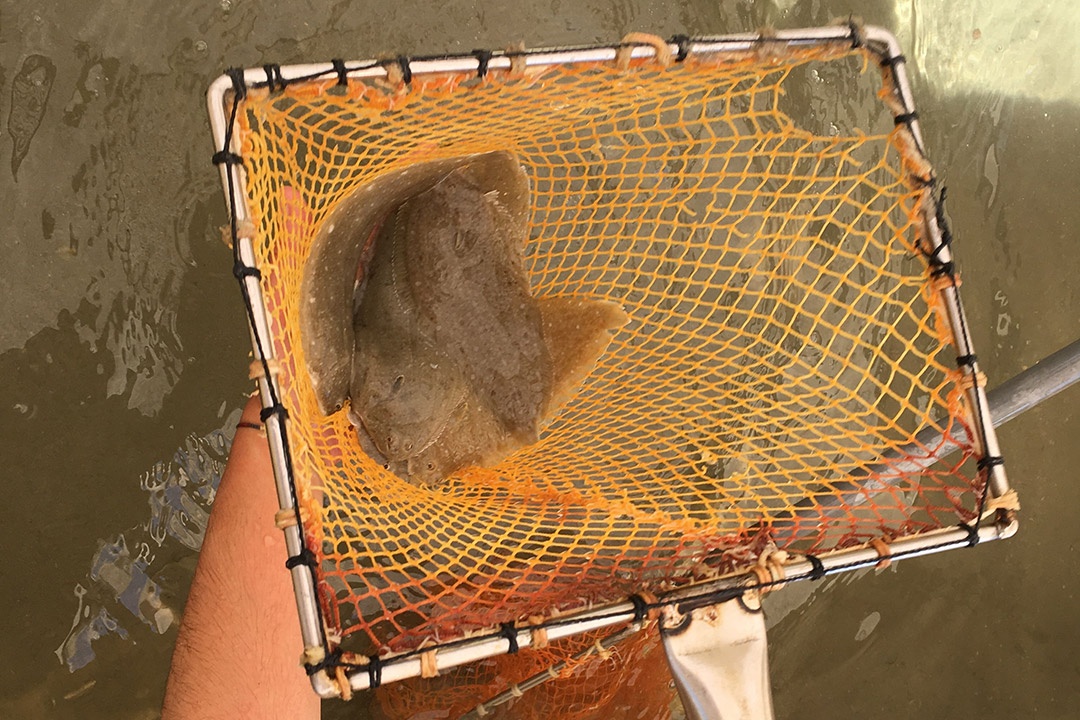
 Lenguados (Solea senegalensis) en tanques de arena | Elvira Fatsini
A two-year study reveals that male sole (Solea senegalensis) reared with a layer of sand reach a more advanced reproductive maturation and show stronger endocrine signals than those kept in conventional tanks, that is, without substrate.
The natural reproduction of F1 sole remains one of the main challenges for researchers and industry alike. Multiple sensory, environmental and hormonal perspectives have been explored to understand the dysfunction, which affects males in particular. “The variability in results shows that this problem does not have a single solution; several strategies will need to be combined,” explains one of the study’s authors, Elvira Fatsini.
Until this dysfunction is resolved, the sector continues to depend on wild broodstock to secure eggs and juveniles, a limitation that constrains long-term industry growth.
The experiment was carried out entirely at CCMAR’s Ramalhete Experimental Station at Portugal, during the Elvira Fatsini research placement, although she is currently at IRTA, Spain.
A group of 1,500 juveniles were monitored from 8 to 27 months of age in collaboration with scientists from IRTA and other institutions. The team compared bare tanks with others containing a 2-cm layer of sand. Fish reared on substrate displayed more advanced stages of spermatogenesis, higher levels of testosterone and luteinising hormone, and greater proportions of spermatids and spermatozoa.
Transcriptomic analyses also revealed strong gene activation in the brain and testes. At 27 months, fish reared with sand displayed overexpression in pathways related to neurogenesis, nervous system development and external stimulus detection. At 15 months, testicular samples showed significant differences in pathways linked to ribosome, oxidative phosphorylation and thermogenesis.
The study, published in Aquaculture, concludes that environmental enrichment “stimulated cognitive development,” an effect that may be closely linked to the improved reproductive performance observed.
“Adding sand is positive for the sole’s natural behaviour and, when combined with factors such as temperature and photoperiod, may benefit both cognitive and reproductive development.” This work, the researcher notes, “demonstrates that early physical enrichment promotes future spermatogenesis, although we still need to assess its impact on gamete quality and progeny.”
It is important to highlight that Senegalese sole is a key species for Southern European aquaculture, and overcoming the reproductive dysfunction of captive-bred F1 individuals remains essential. Incorporating sand during early rearing stages could be a promising approach, although it remains to be determined whether benefits extend to females as well.
Reference:
Fatsini, E., Ramos-Júdez, S., Chauvigné, F., Cerdà, J., Oliveira, C., & Cabrita, E. (2026). Integrated brain and testis transcriptomic analyses reveal the benefits of sandy environmental enrichment in Senegalese sole male (Solea senegalensis) reproduction. Aquaculture, 613, 743468. https://doi.org/10.1016/j.aquaculture.2025.743468
Related

Latest In-depth
-

European aquaculture self-sufficiency is not a production problem, but a policy coherence issue
Brussels, 28 January 2026 | Is the EU willing to bear the political and commercial consequences of such coherence?