
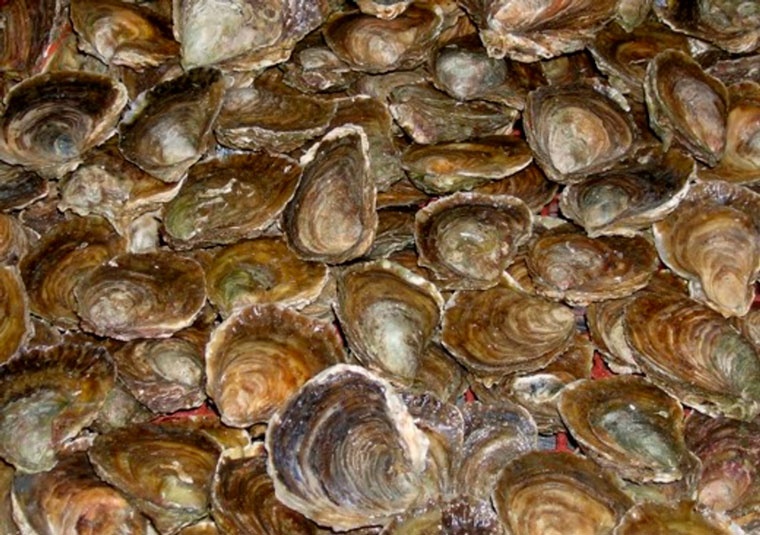
New research on the European flat oyster (Ostrea edulis) in the Adriatic Sea highlights a key operational insight for producers: spat collection success depends on depth and local conditions than on farm location.
The study, based on aquaculture sites along Croatia’s eastern Adriatic coast, provides practical guidance for improving spat collection in a sector still heavily reliant on wild recruitment.
Field trials using spat collectors deployed at multiple depths revealed consistent patterns across sites. The highest spat abundance and biomass were recorded at near-surface (1-2 m) and intermediate depths (6-9 m), while bottom collectors consistently underperformed.
This suggests that relatively simple adjustments in collector deployment could significantly improve spat yields.
Despite similar farming conditions, spat settlement showed strong variability at small spatial scales, even within the same farm. According to the authors, this indicates that fine-scale environmental factors-rather than regional differences-drive recruitment success.
For producers, this reinforces the need for site-specific management and continuous monitoring, rather than relying on generalised assumptions.
The reproductive cycle analysis showed that Ostrea edulis populations in the Adriatic exhibit continuous gametogenic activity throughout most of the year, with a main spawning peak in spring extending into summer, and a secondary event in autumn.
The findings also underline a structural weakness in the sector: in Croatia, flat oyster production still depends almost entirely on wild spat collection. This makes production highly sensitive to environmental variability and recruitment success.
In this context, improving spat collection efficiency-through factors such as optimal depth and timing – becomes a key lever for production stability.
Beyond Croatia, the results are relevant for the wider European sector, where Ostrea edulis is both a commercial species and a priority for restoration initiatives.
The study supports a growing consensus: successful oyster farming and restoration require localised, adaptative strategies, particularly under changing environmental conditions linked to climate change.
Reference:
Ezgeta-Balić, D., Stagličić, N., Šegvić Bubić, T., Bojanić Varezić, D., Arapov, J., Zorica, B., Radonić, I., Jozić, S., Peharda, M., Žuvić, L., Talijančić, I., Bujas, N., Popovič, V. (2026). Reproductive cycle and settlement of the native oyster Ostrea edulis in bivalve aquaculture areas along the eastern Adriatic coast.
Related


EVENTS
-
21AprTue, 21 Apr - Fri, 24 AprGran Via - Fira Barcelona - Barcelona