
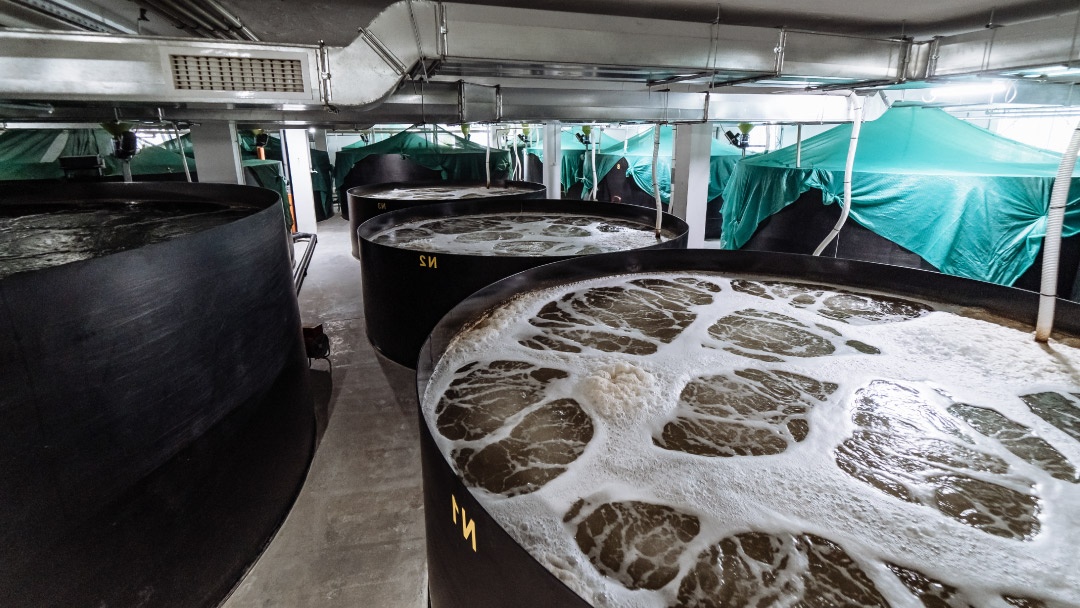
Recirculating aquaculture systems (RAS) have become one of the main tools for moving towards more intensive and controlled aquaculture. However, their high energy consumption and operational rigidity remain two of their main weakness. In this context, the concept of i-RAS (intelligent Recirculating Aquaculture Systems) does not imply a change of system, but rather a technological evolution that introduces a new way of operating.
From a structural point of view, an i-RAS does not differ from a conventional RAS. Both rely on water recirculation, mechanical and biological filtration, aeration, and the control of parameters such as oxygen, temperature, and pH. The difference lies not in the architecture of the system, but in how its day-to-day operational is governed.
In a traditional RAS, recirculation flow rates and aeration are usually set to cover the worst-case scenario maximum biomass, higher metabolic local and greater risk of water quality deterioration. This approach ensures operational safety, but it also means keeping pumps and blowers running continuously, even when real farming conditions do not require it.
By contrast, i-RAS introduces a different logic: adjusting the system to the actual load of the stock rather than to a permanent theoretical scenario. The key shift is the move from fixed parameters to dynamic parameters. Using real-time sensors – for example for ammonia, dissolved oxygen or pH – the system can automatically adjust recirculation flow rates or aeration intensity according to the actual state of the water.
When water quality is adequate, pumping intensity is reduced; when an increase in nitrogen load or a drop in oxygen is detected, recirculation is increased. The result is a more flexible and adaptative system which stops “pumping by inertia” and prioritises energy optimisation over simple maximisation of flow rates.
Beyond the concept itself, this operational shift is already translating into measurable cost savings, particularly in terms of energy consumption. In recent experimental-scale trials with hybrid catfish (Clarias macrocephaulus x C. gariepinus), systems using automatic flow-rate control recorded reduction of around 20-25% in electricity consumption associated with pumping, while maintaining growth, survival and feed conversion ratios equivalent to those achieved under high fixed-recirculation regimes.
These direct savings are complemented by relevant indirect effects, such as reduced wear on pumps and blowers – as they do not operate continuously at maximum power – a lower organic load due to improved feed efficiency, and a reduced need for manual intervention to fine-tune the system. Taken together, these factors point towards an i-RAS that is more energy – and operationally efficient, without compromising production performance.
Another important difference concerns the role of the operator. In conventional RAS, human supervision is essential to detect deviations and make ongoing adjustments. In i-RAS, many of these decisions are automated, reducing dependence on the human factor and improving overall operational stability. In addition, the continuous use of sensors turns the system into a constant source of data, facilitating analysis, traceability and medium – to long-term decision-making.
i-RAS does not replace traditional RAS, nor does it eliminate its challenges, such as upfront investment or technical complexity. It is also not a universal solution for all species or production scales. Nevertheless, it represents a logical evolution at a time when energy costs and operational efficiency are playing an increasingly decisive role in project profitability.
Related

Latest In-depth
-

European aquaculture self-sufficiency is not a production problem, but a policy coherence issue
Brussels, 28 January 2026 | Is the EU willing to bear the political and commercial consequences of such coherence?
EVENTS
-
21AprTue, 21 Apr - Fri, 24 AprGran Via - Fira Barcelona - Barcelona