
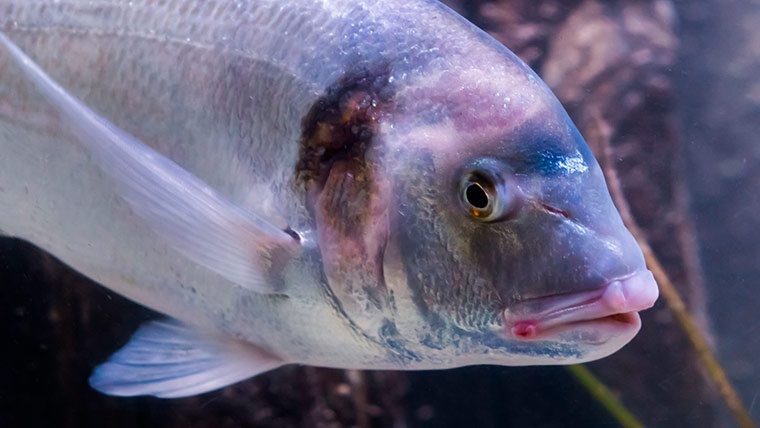
A study recently accepted for publication in Aquaculture reports an efficient and reliable protocol to induce sex inversion and feminisation in gilthead seabream (Sparus aurata), achieving over 95-100% females, compared to the 20-25% natural sex reversal typically observed in this protandrous species.
The research addresses a key limitation in selective breeding programmes for gilthead seabream: the unpredictability of male-to-female sex change, which restricts the number of females available for broodstock formation and family-based selection.
The protocol involves three monthly administrations of three monthly administrations of controlled-release 17β-estradiol implants, applied during the non-reproductive period, at low doses of 0.5-1 mg per kg body weight. Under these conditions, nearly all treated males successfully developed into funcional females.
Importantly for commercial application, the feminised females completed vitollogenesis normally, spawned viable eggs, showed fertilisation rates and larval survival comparable to untreated controls, and maintained reproductive performance over two consecutive spawning seasons.
While a slight reduction in fecundity was observed, egg and larval quality remained within normal ranges reported for the species.
Gilthead seabream is a cornerstone species in Mediterranean aquaculture, yet its protandrous reproductive strategy complicates broodstock planning. By eliminating uncertainty in sex inversion, the proposed protocol allows hatcheries to reliably produce female breeders from selected individuals, improving breeding programmes efficiency and predictability.
According to the authors, the method has already been tested under commercial farm conditions, demonstrating its readiness for practical implementation. The approach may also have potential applications in other protandrous marine fish species.
Reference:
Samiotaki, K., Papadaki, M., Sigelaki, I., Manini, E., Hmida, S., Katharios, P., Ruetten, M., Karapanagiotis, S. & Mylonas, C.C. (2026). Induction of sex inversion and feminization in the protandrous gilthead seabream (Sparus aurata) with 17β-estradiol implants, and its effects on egg production and quality. Aquaculture, Article 743740.
https://doi.org/10.1016/j.aquaculture.2026.743740
Related


EVENTS
-
21AprTue, 21 Apr - Fri, 24 AprGran Via - Fira Barcelona - Barcelona