
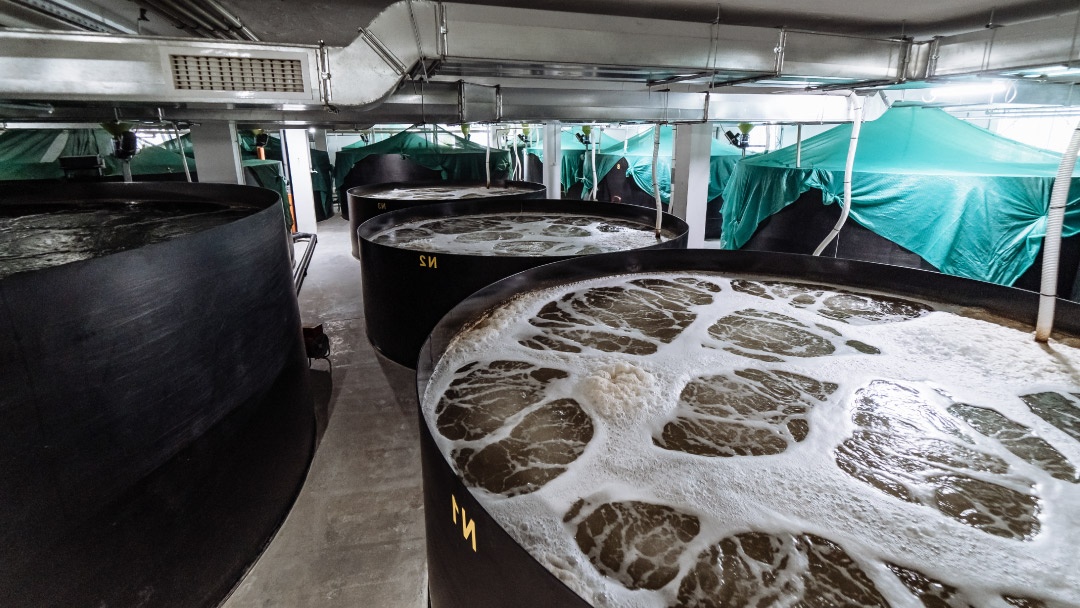
A recent scientific study led by Kaiyang Jiang and Shipeng Dong from the Ocean University of China has analysed the environmental and economic limits of intensive indoor farming of whiteleg shrimp (Litopenaeus vannamei), showing that commonly used production practices can exceed the ecological capacity of these systems. Using an ecosystem-based model, the research assessed how stocking density and management strategies affect shrimp growth, nutrient discharge and profitability.
The study was conducted at an industrialised shrimp facility in Shandong Province, China, where juvenile shrimp were stocked at a density of 880 individuals per square metre. At this density, model simulations showed that total nitrogen and total phosphorus concentrations in discharged tailwater exceeded provincial environmental limits, indicating that the system was operating beyond its carrying capacity.
By progressively lowering stocking density in the model, the researchers identified a carrying capacity of 409 individuals per square metre. At this level, both nitrogen and phosphorus concentrations in the effluent complied with discharge thresholds. However, operating at carrying capacity would substantially reduce production, with shrimp yield falling by 53.5 per cent and economic profit declining by 71.5 per cent compared with current practice. In addition, water use efficiency would worsen, as tailwater discharge per kilogram of shrimp more than doubled.
The nutrient budget analysis showed that feed was the dominant source of environmental pressure. Feed inputs accounted for more than 98 per cent of nitrogen and over 99 per cent of phosphorus entering the system, and a large proportion of these nutrients remained in uneaten feed. This contributed to a high feed conversion ratio and elevated nutrient concentrations in the culture water, rather than being converted into shrimp biomass.
To identify potential mitigation options, the study evaluated several management scenarios. Improving feed quality, reducing the feed conversion ratio from 2.0 to 1.6, led to modest increases in carrying capacity and small reductions in nutrient discharge. Increasing the water exchange rate allowed higher stocking densities and improved economic returns, but also resulted in higher total nitrogen and phosphorus discharge, raising environmental concerns.
The most effective strategy identified was the adoption of tailwater treatment technology capable of removing 60 per cent of nitrogen and phosphorus from effluents. Under this scenario, stocking density could be increased from 880 to 1,193 individuals per square metre while meeting discharge standards. This approach resulted in a 33.5 per cent increase in economic profit, a 26.2 per cent reduction in tailwater discharge per unit of shrimp produced, and reductions of 48.2 per cent and 49.0 per cent in total nitrogen and total phosphorus discharge, respectively.
The authors conclude that higher stocking densities alone do not ensure sustainable or profitable production. Instead, effective control of nutrient emissions is essential for intensive shrimp farming under strict environmental regulations. They argue that ecosystem-based modelling can support both policy decisions and farm management by linking production, environmental performance and economic outcomes within a single analytical framework.
Related

Latest In-depth
-
Alternative Ingredients: real diversification or a new dependency?
Global, 9 April 2026 | We have created a more complex system where production risk is distributed, but not eliminated
EVENTS
-
21AprTue, 21 Apr - Fri, 24 AprGran Via - Fira Barcelona - Barcelona