
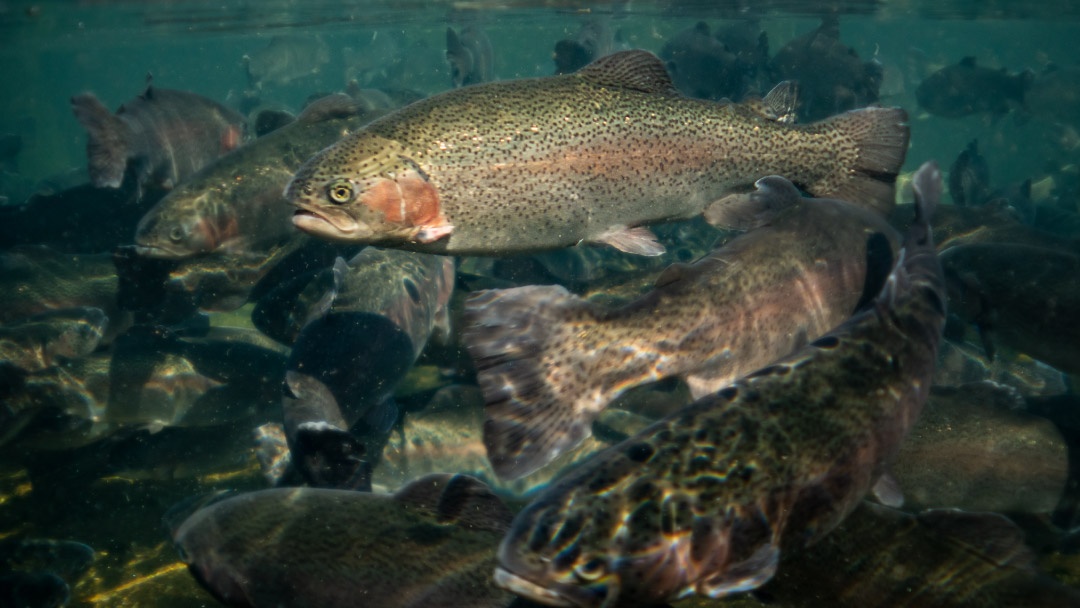
Organoleptic alterations (off-flavour), meaning the presence of compounds responsible for undesirable tastes and odours of environmental or microbial origin, are often treated in recirculating aquaculture systems (RAS) as a seasonal issue linked to summer microbial peaks. However, a year-long monitoring study conducted at a commercial rainbow trout farm producing 3,000 tonnes annually suggests that the challenge is far more structural than seasonal.
Fourteen off-flavour compounds were monitored in inlet water, recirculating water, depuration water and fish flesh. Although water concentrations of geosmin (GSM) and 2-methylisoborneol (MIB) remained within ranges typically reported for commercial RAS operations, MIB accumulation in fish muscle reached up to 1,900 ng/kg during spring and summer – well above established sensory thresholds for rainbow trout. The data reinforces a critical operational reality: acceptable water parameters do not necessarily translate into acceptable product quality.
Depuration, commonly used as the corrective measure, showed limited effectiveness under commercial conditions. After up to 16 days of depuration, only geosmin displayed a statistically significant reduction, while other compounds showed no meaningful difference. Given that depuration is water-intensive and typically associated with weight loss in salmonids, the economic efficiency of relying on prolonged fasting as a remediation strategy becomes questionable.
The study also challenges the assumption that off-flavour pressure is confined to warm months. Several compounds were already present in the inlet water, and methional concentrations peaked during autumn and winter. Although methional did not significantly accumulate in fish muscle due to its low partition coefficient, its seasonal behaviour highlights the influence of environmental dynamics at the intake point. In this case, elevated organic matter and reduced water flow coincided with the observed peaks, suggesting that external conditions can shape organoleptic risk independently of internal RAS microbiology.
Perhaps most revealing was the detection of several compounds in fish flesh that were below quantification limits in water. This finding underlines a strategic blind spot: monitoring water alone is insufficient to guarantee final product quality. Bioaccumulation dynamics, particularly in lipid fractions, can amplify compounds that appear negligible at system level.
Despite continuous application of ozone, hydrogen peroxide and UV treatment, accumulation in fish tissue was not fully prevented. Oxidative treatments help control concentrations but act non-selective and add operational costs, reinforcing the need for upstream risk management rather than downstream correction.
For expanding European RAS operations, the implications are clear. Off-flavour should not be addressed solely at harvest through depuration, but integrated into inlet water management, system design and continuous product-level monitoring. In intensive land-based production, organoleptic stability is not a secondary quality parameter – it is a structural production variable with direct economic consequences.
Related

EVENTS
-
21AprTue, 21 Apr - Fri, 24 AprGran Via - Fira Barcelona - Barcelona