

Integrated Multi-Trophic Aquaculture (IMTA) has been presented for years as one of the most promising solutions for improving the sustainability of commercial aquaculture. The premise is as elegant as it is simple: utilising unexploited nutrients and metabolic emissions from fish to feed other species at lower trophic levels, such as seaweed, thereby closing the loop and enhancing circularity.
However, providing conclusive and scientific proof that this process occurs under commercial open-sea conditions – when currents and dispersion are constant – has always been the primary obstacle to its large-scale implementation.
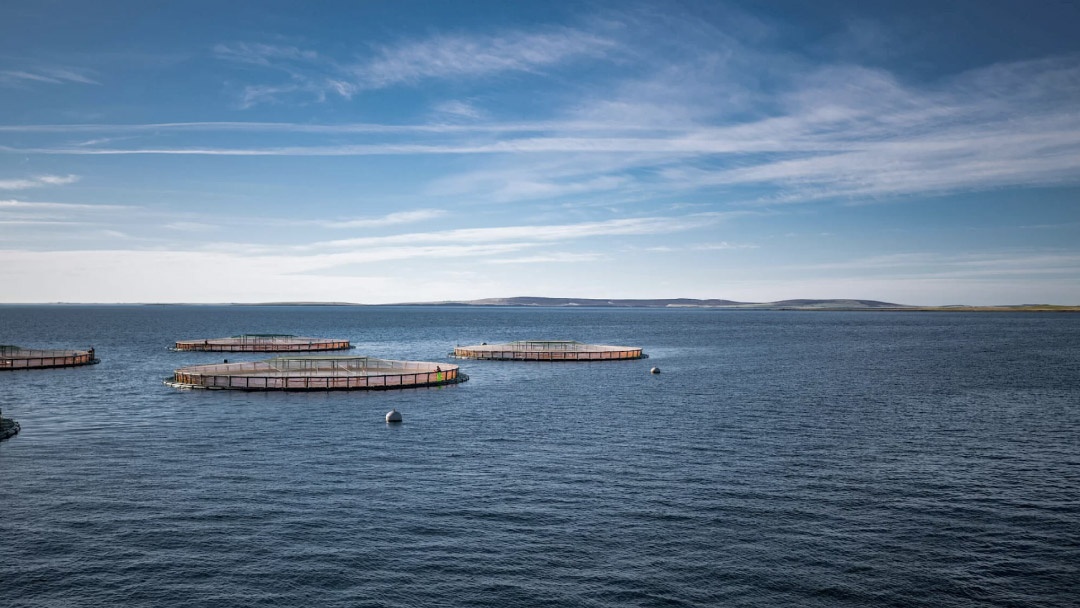
A recent study published in Scientific Reports provides a fundamental piece of this technical puzzle. The research analyses a real-world case in the waters of Bantry Bay, Ireland, where a kelp farm (Saccharina latissima) is situated alongside an Atlantic salmon farm.
What makes this analysis unique is its comparative methodology: the system’s performance was evaluated both before and after the fish entered production, allowing for the establishment of a control baseline – something notoriously difficult to obtain in other field studies.
From a production standpoint, the result is definitive: when salmon are present in the pens, kelp grows significantly faster.
The metrics collected show that the daily growth in blade length increased from 2.18% in monoculture to 2.99% under the influence of IMTA, representing a yield increase of more than 37%.
| Parámetro de Crecimiento | 2023 (Solo Kelp) | 2024 (Kelp + Salmón) | Incremento Relativo |
|---|---|---|---|
| Longitud de lámina (diario) | 2,18% | 2,99% | +37,1% |
| Ancho de lámina (diario) | 1,02% | 1,66% | +62,7% |
| Peso húmedo (Biomasa diaria) | 2,23% | 3,59% | +60,9% |
| Fuente: Elaboración propia basada en Krupandan et al. (2026), Scientific Reports. | |||
The biomass increase is not merely a matter of size; the seaweed exhibited higher growth rates in width and a higher nitrogen content within the tissue.
For the sector, this reinforces the long-standing intuition that integrated systems generate real synergies, allowing what was traditionally considered nitrogenous waste to be transformed into a high-value commercial resource.
A disruptive study tracing exact origins via stable isotope analysis
The disruptive value of the study lies in its attempt to trace the exact origin of this additional growth through stable isotope analysis.
This tool allows researchers to identify the nitrogen “signature” within the kelp tissue and compare it with that of the fish feed and faecal matter.
The models indicate that the isotopic signature of the seaweed changes drastically when the salmon farm is active, showing a clear influence of nutrients derived from fish feed.
In fact, the data reveals that the connectivity is so close that the moment feeding ceases due to the salmon harvest, the nitrogen signature of the kelp rapidly reverts to its natural baseline levels.
However, despite the consistency of these signals, the study introduces a note of technical caution that the sector must consider. While nutritional connectivity is evident, its exact quantification remains imprecise due to the overlapping of environmental nitrogen sources and the high uncertainty of chemical transformation models in the marine environment.
It is not yet possible to determine with absolute precision exactly what percentage of each gram of seaweed comes directly from each kilogram of salmon produced.
The next challenge: quantifying IMTA performance
This lack of millimetric metrics represents a strategic challenge for the industry. IMTA needs to demonstrate not only what it works visually, but how it works and on a quantifiable scale.
Without such technical precision, it remains complex to integrate these systems into current regulatory frameworks, conclusively justify environmental benefits to administrations, or develop robust business models based on ecosystem services or nitrogen credits.
Despite these limitations, the underlying message for European aquaculture is one of well-founded optimism. This study represents one of the closest examples to the sector’s operational reality, observing a positive and measurable interaction between fish and macroalgae in the open sea.
Following this study, the idea is further established that IMTA is no longer just an attractive academic hypothesis, but is beginning to consolidate as a viable operational reality.
The critical next step will be to convert this biological evidence into scientific and regulatory standards that allow the model to be scaled with full economic and administrative backing.
In precision aquaculture, it is not enough for a system to work; it is imperative to be able to prove it with indisputable data.
Reference: Krupandan, A., Falconer, L., Maguire, J. et al. Stable isotope analysis suggests nutrient connectivity between salmon and kelp within a commercial scale open coast integrated multi-trophic aquaculture system. Sci Rep (2026). https://doi.org/10.1038/s41598-026-45539-5
Related

Latest In-depth
-

Spain reshapes its aquaculture: investment, technology and new species in a phase of adjustment
By Alejandro Güelfo, Editor, misPeces | 20 March 2026
EVENTS
-
21AprTue, 21 Apr - Fri, 24 AprGran Via - Fira Barcelona - Barcelona