
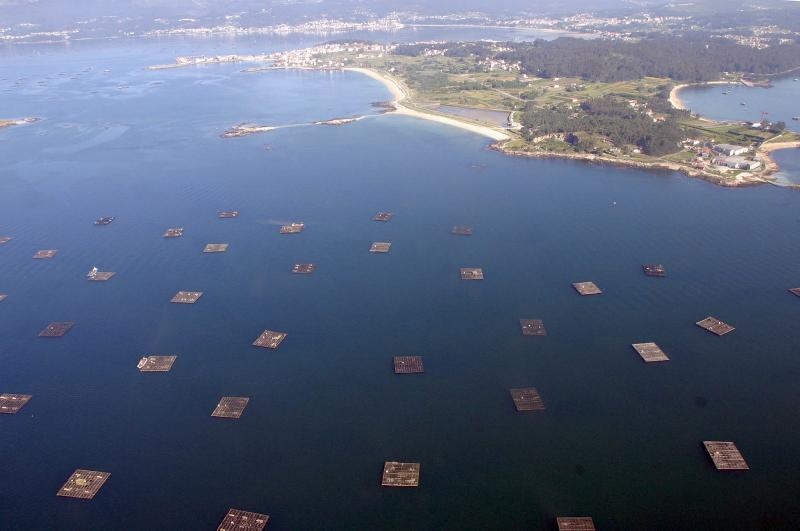
Mussels are widely regarded as one of the most climate-efficient animal proteins. They require no feed inputs and generate comparatively moderate emissions at farm level. However, new research published in Resources, Conservation and Recycling shifts the focus from cultivation practices to the structural design of the value chain.
The study provides the first comprehensive assessment of the Spanish mussel food system and estimates that domestic consumption generates 6.3 kg CO2eq per kilogram of edible meat. Yet the footprint varies significantly depending on product format: pickled mussels reach 8.5 kg CO2equ/kg, compared with 4.1 kg for fresh and 3.6 kg for frozen presentations.
In comparative terms, the system average (6.3 kg CO₂eq/kg) places mussels in a range similar to pork and well below beef, although significant differences emerge depending on product format: while fresh and frozen presentations are closer to chicken and certain white fish species, pickled mussels can even exceed the carbon footprint of some terrestrial meats.
Although Galicia accounts for 99% of Spanish’s production, only 25% of available fresh mussels are consumed directly within the country. The remainder feeds industrial processing or enters international trade flows. Pickled products alone account for 54% of total supply-chain emissions, while 21% of the overall footprint originates from processing activities in third countries.
The findings reframe climate competitiveness in European aquaculture. Mussels’ low-impact farming advantage can be either strengthened or diluted depending on processing intensity, packaging choices and trade configuration. In a policy environment where carbon disclosure and environmental labelling are gaining traction, value-chain governance becomes a strategic determinant.
Rather than challenging mussels’ sustainability credentials, the study highlights a structural opportunity. Reducing reliance on high-impact processed formats and strengthening domestic consumption of lower-emission presentations could consolidate mussels as a genuinely competitive low-carbon protein. The critical variable is no longer only biological efficiency, but supply-chain architecture.
Reference:
Saralegui-Díez, P., Villasante, S., Ospina-Álvarez, A., Ramón, M., & Moranta, J. (2026). The carbon footprint of the mussel food chain in Spain. Resources, Conservation & Recycling, 227, 108742.
https://doi.org/10.1016/j.resconrec.2025.108742
Related


EVENTS
-
21AprTue, 21 Apr - Fri, 24 AprGran Via - Fira Barcelona - Barcelona