
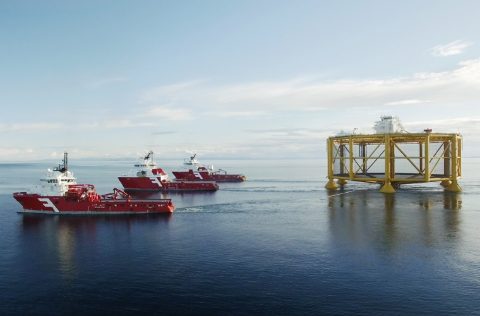
The expansion of aquaculture into the open sea – projects located tens of kilometres offshore, in exposed areas subject to open hydrodynamic conditions – is often framed as an engineering challenge: stronger cages, platforms capable of withstanding severe storms, or even factory vessels.
Yet the real limitation is not steel or structural design. It lies in the digital architecture that underpins these installations – in the continuous and reliable integration of sensors, communications, data analytics and decision-making systems.
This article does not refer to already established coastal offshore farming. It addresses the new generation of projects begin proposed at five-digit production volumes. These initiatives require robust digital architecture if production is to be viable rather than simply an expansion of risk.
On land, Recirculating Aquaculture Systems (RAS) controls its environment. In the open sea, the opposite applies. Current compress netes, waves generate structural fatigue, biofouling alters hydrodynamics, and storms prevent human access. Under such conditions, manual management becomes unworkable. Continuous monitoring, stable data transmission and automated decision-making are not enhancements – they are structural requirements.
The problem is that large-scale offshore aquaculture still rests largely on demonstration projects. Digital twins and artificial intelligence are frequently discussed, yet without long-term validation under real offshore conditions. Without resilient communications and stable energy supply, no algorithm can compensate for structural failure.
So far, rather than a coherent offshore industry with comparable performance metrics, what exists Is a collection of isolated projects. There are no sustained datasets showing measurable improvements in FCR, quantified reductions in mortality, or energy savings per kilogram produced. Only validation across several full commercial production cycles will provide the empirical foundation needed to justify multi-million-pound investments – and the public support that often accompanies them.
An offshore cage may hold hundreds of tonnes of biomass. A net failure is not a technical incident; it is an immediate financial event. In this context, digitalisation is not about efficiency – it is about asset protection.
No project has yet demonstrated, at commercial scale, the fully integrated operation of sensing, transmission, analysis and execution systems. The real proof will come when one of these developments completes a full commercial production cycle without constant human intervention.
Nor are there robust CAPEX studies quantifying the economic value of protected biomass against long-term technological costs.
Costs are not reduced by building larger platforms further offshore. They are reduced through integrated digital management capable of anticipating risk, optimising feeding, minimising losses and enabling real-time, data-driven decision-making.

Related

Latest In-depth
-
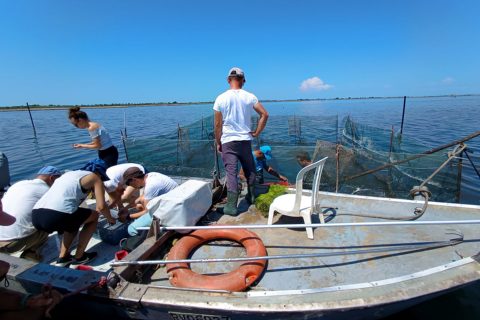
Clams more resistant to heat and Perkinsus: research paves the way for selective breeding
Padua, Italy, 16/10/2026 | University of Padua researchers explain to misPeces the findings presented at Aquaculture Europe 2026 and the steps needed to transfer them to hatcheries. Initial applications could emerge within the next two or three years, although the relationship between resistance, growth and other production traits still need to be assessed