

For decades, fish erythrocytes, or red blood cells, were regarded simply as cells responsible for oxygen transport. However, a research line developed at the Miguel Hernández University of Elche (UMH, Spain) for more than a decade is helping to change that perception in aquaculture and is opening the door to a new generation of vaccine strategies based on fish erythrocytes.
At misPeces, we interviewed researchers María del Mar Ortega-Villaizán Romo and María Salvador Mira from UMH, who explained the role these erythrocytes may play in the immune response of fish, opening a still largely unexplored field for the development of vaccines against viral and bacterial diseases.
Until recently, as Ortega-Villaizán explains, researchers had been overlooking “an important part of the fish immune system”, since erythrocytes could have significant potential to become cellular platforms capable of enhancing antiviral vaccines in aquaculture.
In fish, they are an “active cellular machinery” involved in the immune response
As the researchers explained, the strongest momentum for this work came through an ERC Starting Grant project – one of the most competitive European funding schemes in science – specifically focused on deciphering the role of fish erythrocytes.
Fish erythrocytes differ from those of mammals. In fish, these cells retain their nucleus and maintain transcriptional activity, meaning they possess an “active cellular machinery that allows them to participate in the immune response”, says Salvador Mira, enabling them to respond to different immunological stimuli.
The work carried out by the group – published in high-impact scientific journals such as Frontiers in Immunology, European Journal of Cell Biology and Fish & Shellfish Immunology – and forming part of Salvador Mira’s doctoral thesis, shows that fish erythrocytes activate antiviral defence mechanisms, modulate proteins, communicate with other immune cells and even participate in antigen presentation processes.
This perception has gradually taken shape as scientific evidence has accumulated. In this regard, the researchers acknowledge that for years they faced difficulties publishing some of their work because many reviewers continued to regard erythrocytes solely as oxygen-transporting cells. Over time, however, scientific results have progressively helped break in this long-standing dogma regarding the immunological role of these cells.
The major leap: using erythrocytes as vaccine platforms
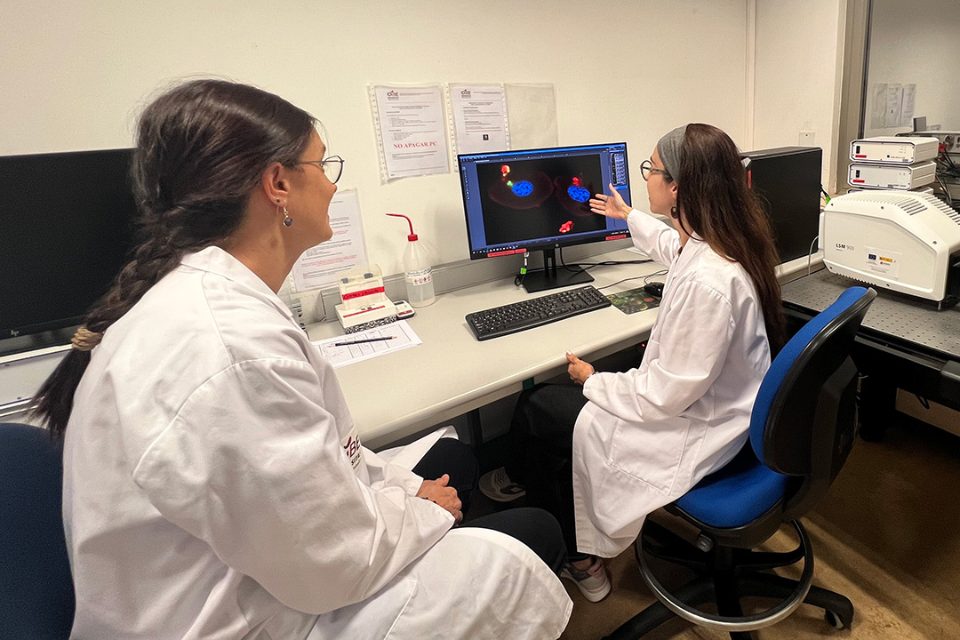
The most innovative aspect of this research line is not simply demonstrating that erythrocytes respond to viruses, but the possibility of using them as cellular targets for vaccines.
One of the group’s most recent studies – also part of Salvador Mira’s doctoral work – explores the development of vaccines specifically directed towards erythrocytes using ligands capable of binding to these cells and enhancing viral antigen uptake.
The strategy aims to exploit the erythrocytes’ own cellular machinery to amplify antiviral responses. “What the propose is selecting those erythrocytes subpopulations that respond best and using them to improve vaccine efficiency,” explains the newly graduated doctor.
Studies conducted so far show that erythrocytes can capture antigens, activate pathways associated with cellular stress and participate in immune signalling and antigen presentation processes.
At the same time, the group is investigating how future vaccines could be directly not only towards erythrocytes themselves, but even towards specific organelles or intracellular pathways involved in antiviral responses.
Rainbow trout, European seabass and international collaboration
Although much of the research has been conducted using rainbow trout as an experimental model, the work is already expanding towards other aquaculture species of interest, including European seabass.
The group is currently working on studies related to nodavirus in seabass, one of the most important viral diseases affecting Mediterranean aquaculture.
According to the researchers, seabass erythrocytes display response patterns similar to those observed in trout, although with differences related to cell size and morphology.
The research line also maintains active collaborations with groups in Norway and South Korea, including international projects focused on fish immunology and blood – and erythrocytes-related biomarkers.
A new way to tackle disease that still needs industry attention
Despite growing international scientific interest, industrial application still appears distant. The researchers acknowledge that, for now, there are no commercial erythrocyte-based vaccines either in aquaculture or in human medicine.
“It is still a field in its infancy,” says Salvador Mira. “Much more research is still needed, as well as further work to translate this into real industrial applications.”
Although some vaccine companies have shown scientific interest in the research line, there are still no active industrial partnerships or specific corporate funding aimed at turning these platforms into commercial products.
Part of the reason is that some of the disease models used in research, such as VHSV, do not currently represent a major sanitary threat for the industry. Nevertheless, the group argues that the platform could be adapted to other viruses with greater production impact in Mediterranean aquaculture.
In any case, the research developed at UMH has already positioned Spain among the most advanced international groups in the immunological study of fish erythrocytes and opens a research line that could eventually transform how vaccines and antiviral strategies are designed in aquaculture.
References:
Salvador-Mira M. et al. (2025).
Viral vaccines promote endoplasmic reticulum stress-induced unfolding protein response in teleost erythrocytes.
European Journal of Cell Biology, 104, 151490.
https://doi.org/10.1016/j.ejcb.2025.151490
Salvador-Mira M. et al. (2026).
Erythrocyte-targeted recombinant subunit vaccine: A novel approach to improve viral vaccines in fish.
Fish & Shellfish Immunology, 168, 110971.
https://doi.org/10.1016/j.fsi.2025.110971
Salvador-Mira M. et al. (2024).
Endoplasmic reticulum stress triggers unfolded protein response as an antiviral strategy of teleost erythrocytes.
Frontiers in Immunology, 15, 1466870.
https://doi.org/10.3389/fimmu.2024.1466870
Salvador-Mira M. et al. (2021).
Immunomodulatory Lectin-like Peptides for Fish Erythrocytes-Targeting as Potential Antiviral Drug Delivery Platforms.
International Journal of Molecular Sciences, 22(21), 11821.
https://doi.org/10.3390/ijms222111821
Related

Latest news
-
Financial model projects a 19.4% internal rate of return for an offshore European seabass farm off France
France, 23 October 2026 | The hypothetical operation would require nearly $40 million investment and produce 5,220 tonnes a year at full capacity. The projected return depends on assumptions that have yet to be tested at commercial scale
-
FEAP calls for binding fish farming production targets in EU's Vision 2040
Brussels, 22/10/2026 | European fish farmers welcome the Commission's plans to simplify aquaculture licensing but call for measurable growth targets, national commitments and a regulatory framework that supports investment
-
A rapid test for tilapia lake virus moves closer to on-farm diagnosis
Thailand, 22 October 2026 | A lateral flow test correctly identifies 60 out of 61 tilapia samples, offering a potential tool for preliminary virus detection, although further validation is needed to establish its ability to identify early-stage infections