

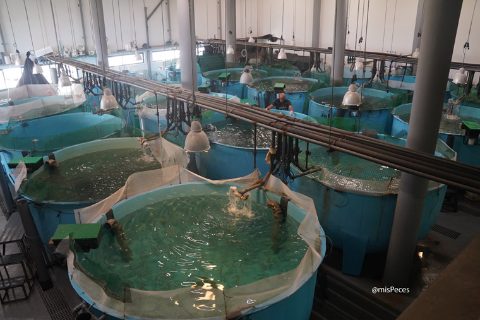
A new study published in Aquaculture Reports, developed by researchers from the Portuguese Institute for Sea and Atmosphere (IPMA), MARE, CIIMAR and SEAentia-Food, uses life cycle assessment (LCA) methodology to analyse the production of one tonne of meagre in a pilot grow-out unit in Peniche, Portugal, from “cradle-to-farm-gate” perspective.
This includes the production of raw materials, energy, water, oxygen, juvenile supply, feed manufacturing, transport and RAS grow-out operations.
According to the authors, this is the first life cycle assessment focused specifically on meagre production in RAS.
The results identify energy consumption as the main driver of the facility’s environmental impact. The production of one tonne of live meagre generated 17,765 kg CO2 equivalent, 61% of which was associated with the energy used in the system.
This dependence is explained by the need to continuously maintain water circulation, aeration, filtration, gas control and an adequate temperature for the species’ growth.
The study also breaks down the electricity consumption of the main equipment. Water circulation pumps accounted for 27% of the system’s total electricity use, followed by the degasser pump at 12%, the foam fractionation or skimmer at 4%, and the office and laboratory air-conditioning system at 3%.
This high energy demand is linked to the thermal requirements of meagre. The species reduces feed intake and slows its growth when farmed below 18ºC. In the pilot facility analysed, the water was maintained at 25ºC using electricity heat pumps.
The authors suggest that future projects should assess whether maintaining tanks at 25ºC is justified from a production, energy and environmental perspective, or whether slightly lower ranges, between 20ºC and 22ºC, could offer a more efficient balance between growth and electricity consumption.
Technical profile of the environmental inventory
| Operational parameter or impact category | Value per tonne of live meagre |
|---|---|
| Carbon footprint | 17,765.41 kg CO2 eq |
| Facility electricity consumption | 47,078.93 kWh |
| Feed used | 1,185.85 kg |
| Seawater input to the system | 1,466.70 m3 |
| Effluents generated | 2,405.55 m3 |
| Juvenile input | 51.26 kg |
| Grow-out mortality rate | 7% |
Feed shifts the impact towards land use
Feed appears as another critical point in the production cycle, although its impact is expressed differently. While feed represented around 6% of the farm’s global warming impact, it accounted for almost 70% of land use impact. This effect is mainly due to the agricultural are required to produce the plant-based ingredients in the formulation, such as cereals and legumes.
The origin of marine ingredients was also found to be decisive. In the baseline scenario, fishmeal and fish oil came from by-products of the canning industry and salmon aquaculture.
When the researchers simulated the replacement of these by-products with fishmeal produced from whole commercial caught fish, the carbon footprint linked to feed production increased by 223%. This result reinforces the role of circular ingredients in reducing the environmental pressure of aquafeeds.
Solar energy, logistics and new environmental trade-offs
The integration of renewable energy appears as one of the main routes to reduce the climate footprint of RAS systems. According to the sensitivity analysis, a scenario with 30% photovoltaic energy would reduce the global warming impact by 13%, while a 100% photovoltaic model would allow a 42% reduction.
However, the researchers warn of possible burden-shifting effects between environmental categories. The full solar self-supply scenario increased freshwater eutrophication by 15%, an indirect impact associated with life cycle of solar panels, including raw material extraction, processing and manufacturing.
Another relevant improvement would be to integrate the hatchery into the grow-out facility itself.
In the pilot case, juveniles were transported by road from Olhão, in the Algarve, to Peniche, accumulating a distance of 4,900 kilometres per tonne of meagre produced. The on-site hatchery scenario eliminated this transport and reduced impacts across all categories analysed, especially global warming.
A cautious reading for industrial scaling
The authors stress that the results should be interpreted with caution. The facility analysed is a pilot unit, also focused on R&D activities and the optimisation of technical protocols, meaning that its operating conditions differs from those of a mature commercial plant designed for maximum productivity and biological efficiency.
Even so, the study provides a relevant conclusion for the development of Mediterranean species in RAS: sustainability will not depend solely on closing water circuits or reducing discharges, but on optimising the entire production system.
Energy efficiency, equipment design, renewable integration, logistical proximity and diets formulated with low-impact raw materials will be decisive factors in achieving land-based meagre production with a competitive environmental footprint.
Reference:
Cacela-Rodrigues, I., Canhão, P., Saavedra, M., Gonçalves, A., Costa, A. P. L., & Almeida, C. (2026). Life cycle assessment of a recirculatory aquaculture system (RAS) – A case study of meagre (Argyrosomus regius) farming. Aquaculture Reports, 48, 103641.

Related

Latest In-depth
-
Clams more resistant to heat and Perkinsus: research paves the way for selective breeding
Padua, Italy, 16/10/2026 | University of Padua researchers explain to misPeces the findings presented at Aquaculture Europe 2026 and the steps needed to transfer them to hatcheries. Initial applications could emerge within the next two or three years, although the relationship between resistance, growth and other production traits still need to be assessed