
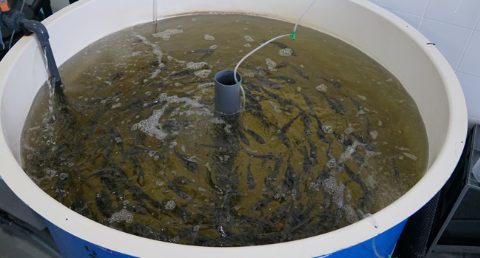
A study carried out on gilthead seabream in RAS suggests that precision feeding could incorporate a new source of information: the sounds fish produce before, during and after feeding.
The research shows that signal processing and artificial intelligence can classify feeding behaviour patterns even in acoustically noisy environments, where pumps, water circulation, oxygenation systems and filters can interfere with detection.
The research proposes a methodology based on hydrophones, Mel spectrograms and machine learning models to distinguish four acoustic classes: background noise, pre-feeding, feeding and post-feeding.
According to the authors, the convolutional neural networking model achieved its best result with two-second audio windows, reaching an accuracy of 99.98% and a macro F1-score of 0.9972.
The practical interest for aquaculture lies in the possibility that these sounds could become a complementary signal to decide when to start, maintain or stop automatic feeding.
In RAS, where feed, water quality, organic load and welfare are closely connected, a non-invasive tool capable of detecting changes in feeding behaviour could provide a new layer of operational information.
The study also notes that overly long windows, such as 20-second segments, reduce performance because they mix several behavioural states within the same acoustic sample.
The results should still be interpreted as a proof of concept under experimental conditions, not as a fully validated commercial solution.
The work was carried out in three tanks of around 200 litres at the Centre of Marine Sciences of the University of Algarve, in Portugal, so its performance will need to be tested with larger biomass, different tank geometries, more species and the noise level found in commercial facilities.
Even so, the study reinforces the idea that precision feeding will not depend on a single technology, but on the integration of cameras, sensors, growth models, automatic systems and, now bioacoustics.
Reference
Domingos, F. P. F., Oliveira, G., Ihianle, I. K., Saraiva, J. L. V. A., Pieddesaux, S.-C., Lotfi, A. & Machado, P. (2026). AI-Driven Behavioural Characterisation of Sea Bream Feeding Patterns in Recirculating Aquaculture Systems. Research Square preprint. https://doi.org/10.21203/rs.3.rs-9393605/v1

Related

Latest In-depth
-
Clams more resistant to heat and Perkinsus: research paves the way for selective breeding
Padua, Italy, 16/10/2026 | University of Padua researchers explain to misPeces the findings presented at Aquaculture Europe 2026 and the steps needed to transfer them to hatcheries. Initial applications could emerge within the next two or three years, although the relationship between resistance, growth and other production traits still need to be assessed