
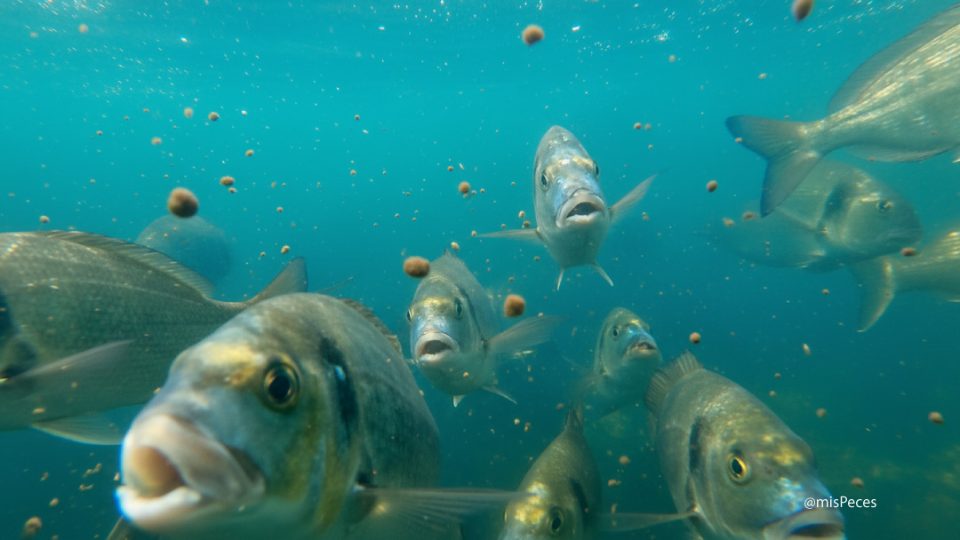
A study published in Results in Engineering shows that computer vision applied to aquaculture feeding is already starting to deliver practical value at farm level. Researchers developed a lightweight model based on YOLOv8n capable of detecting fish feeding behaviour from images, with the aim of supporting more precise feeding systems.
The work addresses a familiar challenge for producers: feed accounts for more than 40% of aquaculture production costs, while traditional feeding methods can generate between 15% and 25% waste.
The key shift is moving from scheduled feeding to feeding guided by biological signals. These systems can identify whether fish are aggregating around the feed, whether feeding activity is increasing, whether splashing associated with intense feeding is occurring or, conversely, whether the feeding response is starting to decline.
In practice, the technology not only helps determine when to feed, but also when to reduce or stop the ration before feed stops being converted into growth and starts being lost in the water.
To train the system, researchers used 5,102 images classified into three states: strong feeding, weak feeding and no feeding. The model does more than simply “see fish”; it attempts to distinguish different levels of appetite and feeding response even under visually challenging conditions involving reflections, light refraction, water movement, splashing and complex backgrounds. In testing, it achieved 92.7% accuracy, 88.8% recall and a 91.7% mAP, while also reducing model size and computational requirements compared with the original YOLOv8n.
For producers, the value lies not only in automating a feeder, but in improving decision quality. With cameras, sensors and AI models, farms can begin to understand which batches are feeding more actively, when appetite changes, which times of day generate the strongest feeding response, how temperature or oxygen affect feeding behaviour, and whether a feeding strategy is producing more growth or more waste.
A recent review published in Aquaculture specifically identifies artificial intelligence as a tool for integrating real-time sensing, predictive analytics and autonomous decision-making in feeding, aeration, biomass estimation, fish health and environmental management.
A full transition to commercial-scale deployment still requires caution, as the study acknowledges that its data were generated under controlled experimental conditions.
The models will need to be validated across different species, production systems, water qualities, lighting conditions and farming scales. Even so, the message for producers is becoming increasingly clear: AI-driven feeding systems in aquaculture should no longer be viewed as an abstract promise, but as an emerging tool for improving observation and feeding precision.
Their value is not in replacing farmer experience, but in providing more objective data to decide when to feed, how much to feed and, crucially, when to stop.
References
Shi, B., Yin, R., He, X., Zhang, C., Jiang, J. & Sun, Y. (2026). Towards a lightweight YOLOv8n for aquaculture feeding detection: Architectural improvements for feature enhancement and computational efficiency. Results in Engineering, 30, 110304. https://doi.org/10.1016/j.rineng.2026.110304
Sen, K., Dey, S., Ganguly, A. & Rajak, P. (2026). Artificial intelligence in aquaculture: Advancing sustainable fish farming through AI-driven monitoring, optimization, and disease management. Aquaculture, 614, 743602. https://doi.org/10.1016/j.aquaculture.2025.743602

Related

Latest In-depth
-
Clams more resistant to heat and Perkinsus: research paves the way for selective breeding
Padua, Italy, 16/10/2026 | University of Padua researchers explain to misPeces the findings presented at Aquaculture Europe 2026 and the steps needed to transfer them to hatcheries. Initial applications could emerge within the next two or three years, although the relationship between resistance, growth and other production traits still need to be assessed