
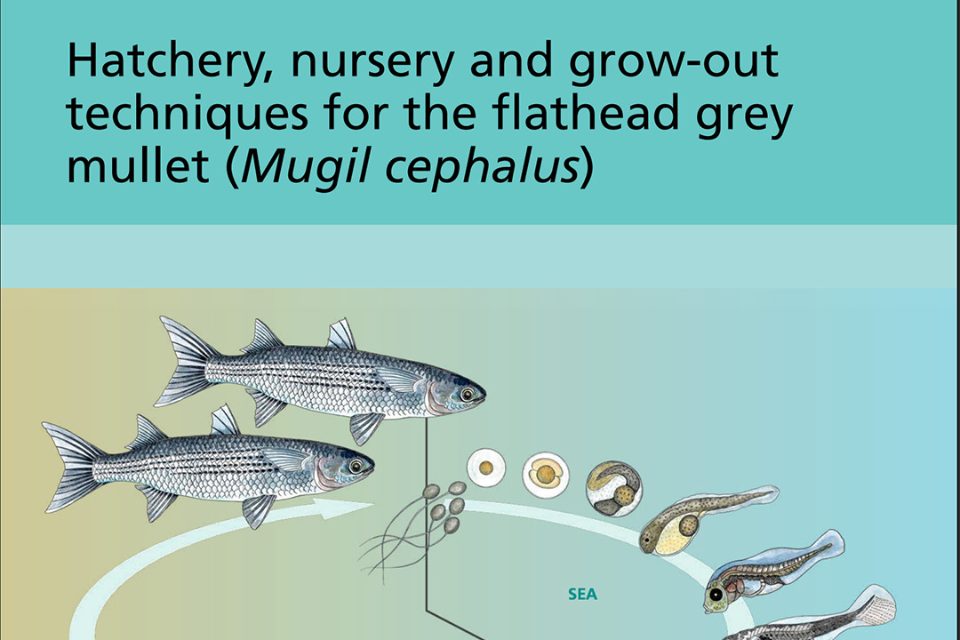
The Food and Agriculture Organization of the United Nations (FAO) has published a new technical manual on the farming of the flathead grey mullet, Mugil cephalus, a low-trophic marine species with potential to contribute to the sustainable diversification of aquaculture.
The document, entitled Hatchery, nursery and grow-out techniques for the flathead grey mullet (Mugil cephalus), is part of the FAO Fisheries and Aquaculture Technical Paper series, No. 699. It brings together scientific knowledge and validated methodologies covering the entire production cycle, form broodstock management and captive reproduction to larval rearing, fry production, nursery and grow-out.
The publication comes at a time when the sector is looking for species capable of combining productive efficiency, lower pressure on marine resources and adaptability to different farming systems. In this context, Mugil cephalus represents several attributes of interest, including its omnivorous feeding habits, into coastal lagoons, semi-intensive ponds or more controlled facilities.
According to FAO, global mullet production reaches 1.07 million tonnes in 2024, of which 400,606 tonnes came from aquaculture, representing 37.4% of the total. However, the commercial development of the species remains constrained by a key bottleneck: dependence on juveniles collected form the wild.
The manual addresses this challenge through practical protocols to improve hatchery-based seed production. It includes criteria for site selection, facility design, live feed production – microalgae, rotifers and Artemia – egg incubation, larval rearing, weaning, juvenile management and health control.
FAO also focuses on broodstock management, a critical stage for closing the species’ production cycle. Although mullet farming has a long tradition in several regions, large-scale commercial production still requires a more reliable supply of seed and more standarised protocols for hatcheries.
From a Mediterranean perspective, the interest in Mugil cephalus is not limited to its flesh. The species is associated with high-value products such as smoked fillet and bottarga, made from salted and dried roe, which has commercial relevance in southern Europe and Mediterranean.
The publication is framed within FAO’s Blue Transformation Roadmap and Guidelines for Sustainable Aquaculture. For the sector, its value lies in transferring experimental knowledge and pilot-scale trials into an operational guide with potential commercial application, at a time when species diversification is once again gaining relevance.
Reference
Vallainc, D., Estevez, A., Ramos, S.J., Concu, D., Carboni, S., Duncan, N. & Lovatelli, A. 2026. Hatchery, nursery and grow-out techniques for the flathead grey mullet (Mugil cephalus). FAO Fisheries and Aquaculture Technical Papers, No. 699. Rome, FAO. https://doi.org/10.4060/cd9536en

Related

Latest In-depth
-
Clams more resistant to heat and Perkinsus: research paves the way for selective breeding
Padua, Italy, 16/10/2026 | University of Padua researchers explain to misPeces the findings presented at Aquaculture Europe 2026 and the steps needed to transfer them to hatcheries. Initial applications could emerge within the next two or three years, although the relationship between resistance, growth and other production traits still need to be assessed