
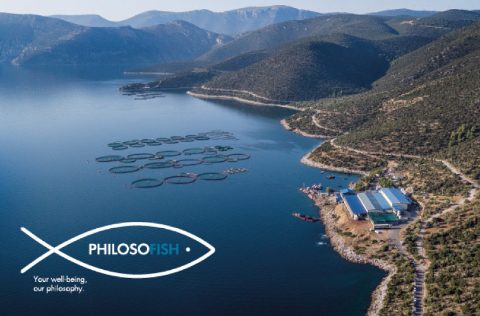
The reorganisation of Greek aquaculture following Cooke Aquaculture’s entry into Avramar is also bringing other significant movements in the sector. Philosofish, one of the groups that took part in the competitive process for Avramar, closed 2025 with a strong financial recovery and is consolidating its position as one of Greece’s leading sea bream and sea bass operators.
According to the company’s financial information, Philosofish recorded a net profit of EUR 5.12 million in 2025, compared with losses of EUR 14.64 million the previous year.
The improvement was also reflected in EBITDA, which moved from a negative EUR 916,000 in 2024 to EUR 14.27 million in 2025. Turnover reached EUR 111.69 million, up from EUR 103.43 million in the previous year.
| Indicator | 2024 | 2025 | Change |
|---|---|---|---|
| Turnover | EUR 103.43 million | EUR 111.69 million | ↑ |
| EBITDA | EUR -0.92 million | EUR 14.27 million | Recovery |
| Net profit | EUR -14.64 million | EUR 5.12 million | ↑ |
| Net debt | Approx. EUR 44.3 million | EUR 39 million | -12% |
| Value-added products | 6% | 18% | Strong increase |
| Average selling price | 2024 baseline | +20% | ↑ |
One of the key factors behind this recovery has been the change in the company’s commercial mix. Philosofish has strengthened its focus on higher value-added products, including fillets, gutted fish and modified atmosphere packaging formats. This category increased from 6% to 18% of total sales volume in just one year, helping to raise the average selling price by around 20%.
The focus on processed products is becoming an increasingly relevant trend in Mediterranean aquaculture, as it responds to changing consumer habits and demand for higher value-added formats.
In this context, according to several Greek financial media, the company signed a strategic agreement in 2025 with a major international salmon producer to supply pre-packed Mediterranean fish to its commercial network.
Alongside its financial recovery, the company has also reduced its debt. Net debt fell by 12% to EUR 39 million, while equity increased to EUR 63.83 million.
The company also completed a EUR 10.41 million capital increase through the capitalisation of a loan from its parent company Diorafish SA and restructured two bond loans worth EUR 46 million, extending their maturity to December 2030.
Philosofish has also strengthened its production position. On 28 April 2026, it completed the acquisition of 100% of DEEP A’ A.E.B.E. Aquaculture, a company that operated a production unit in Euboea leased from Philosofish. The transaction is intended to increase production capacity and fully integrate the unit into the group’s operating model.
The company is also maintaining an active investment agenda. During 2025, it submitted six projects to the Greek programme for productive investments in aquaculture, with an expected subsidy of up to 71%. The planned actions include a central feed storage facility, a central net station and restructuring improvements at several production units.
Philosofish currently operates 21 sites in Greece, four juvenile production centres covering a total area of 17,700 square metres and two processing plants. Its production capacity stands at around 20,000 tonnes per year of sea bream, sea bass, common dentex and other Mediterranean species. The company employs 656 people.
Philosofish’s evolution comes at a time of deep change for Greek aquaculture. Cooke Aquaculture’s operation involving Avramar, competitive pressure from Turkey and the search for greater added value are reshaping the production map of the eastern Mediterranean.
In this context, Philosofish’s recovery shows that profitability will not depend only on volume, but also on the ability to integrate operations, improve the commercial mix and capture more value along the chain.

Related

Latest In-depth
-
Clams more resistant to heat and Perkinsus: research paves the way for selective breeding
Padua, Italy, 16/10/2026 | University of Padua researchers explain to misPeces the findings presented at Aquaculture Europe 2026 and the steps needed to transfer them to hatcheries. Initial applications could emerge within the next two or three years, although the relationship between resistance, growth and other production traits still need to be assessed