
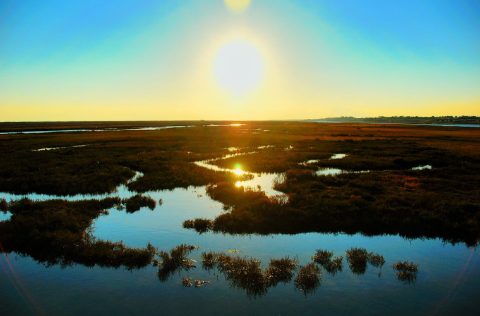
Ria Formosa lagoon, in Algarve (Portugal), one of the pillars of aquaculture in southern Europe, is facing a scenario shaped by two opposing forces: climate change and production pressure.
A recent analysis, led by researchers from the Centre for Environmental and Marine Studies (CESAM) at the University of Aveiro, in collaboration with institutions in Portugal and Spain, indicates – based on numerical modelling – that this system could improve its potential for grooved carpet shell (Ruditapes decussatus) farming over the course of this century.
However, the study warns that the real limit will be in the ecological capacity of the system itself. Projections for the end of the century point to an increase in water temperature that would bring conditions closer to the species’ optimal growth range, particularly in spring.
This shift would support biological development during the most productive periods of the year, suggesting that, in this case, climate change may not act solely as a risk factor, but also as a potential opportunity.
That said, this improvement comes at a cost. The same climate scenario projects a slight reduction in dissolved oxygen and a trend towards acidification – changes which, although moderate, could affect the system’s balance over the medium term.
More critical, however, is the impact of production intensification. When simulating an increase in biomass within existing farming areas, the study shows a progressive deterioration in environmental conditions.
Higher clam densities increase competition for food, reducing the availability of chlorophyll-a, the primary nutritional source of bivalves. At the same time, nutrient levels such as ammonium and phosphates rise in the most exploited areas, compromising water quality.
This combined effect – reduced food availability and increased nutrient loading – points to a decline in production efficiency under intensification scenarios, even under more favourable thermal conditions.
The study therefore reinforces the idea that the growth of aquaculture will not be primarily constrained by climate, but by the system’s carrying capacity.
Although Ria Formosa generally offers suitable conditions for clam farming, much of the lagoon remains at moderate or low suitability levels, shaped by both food availability and hydrodynamic dynamics.
In particular, areas close to the inlets, where currents are stronger, remain poorly suited for aquaculture, highlighting the importance of proper spatial planning.
In this context, the future of aquaculture in Ria Formosa will depend less on expanding production and more on managing it with precision. The challenge will be ot increase efficiency without exceeding ecological limits, using tools such as carrying capacity modelling and planning based on environmental indicators.
Reference:
Pereira, H.; Picado, A.; Alvarez, I.; Sousa, M.C.; Brito, A.C.; Carvalho, D.; Dias, J.M. (2026). From Past to Future: Assessing Ria Formosa’s Suitability for Grooved Carpet Shell Aquaculture. Sci, 8(5), 100. https://doi.org/10.3390/sci8050100

Related

Latest In-depth
-
Clams more resistant to heat and Perkinsus: research paves the way for selective breeding
Padua, Italy, 16/10/2026 | University of Padua researchers explain to misPeces the findings presented at Aquaculture Europe 2026 and the steps needed to transfer them to hatcheries. Initial applications could emerge within the next two or three years, although the relationship between resistance, growth and other production traits still need to be assessed