


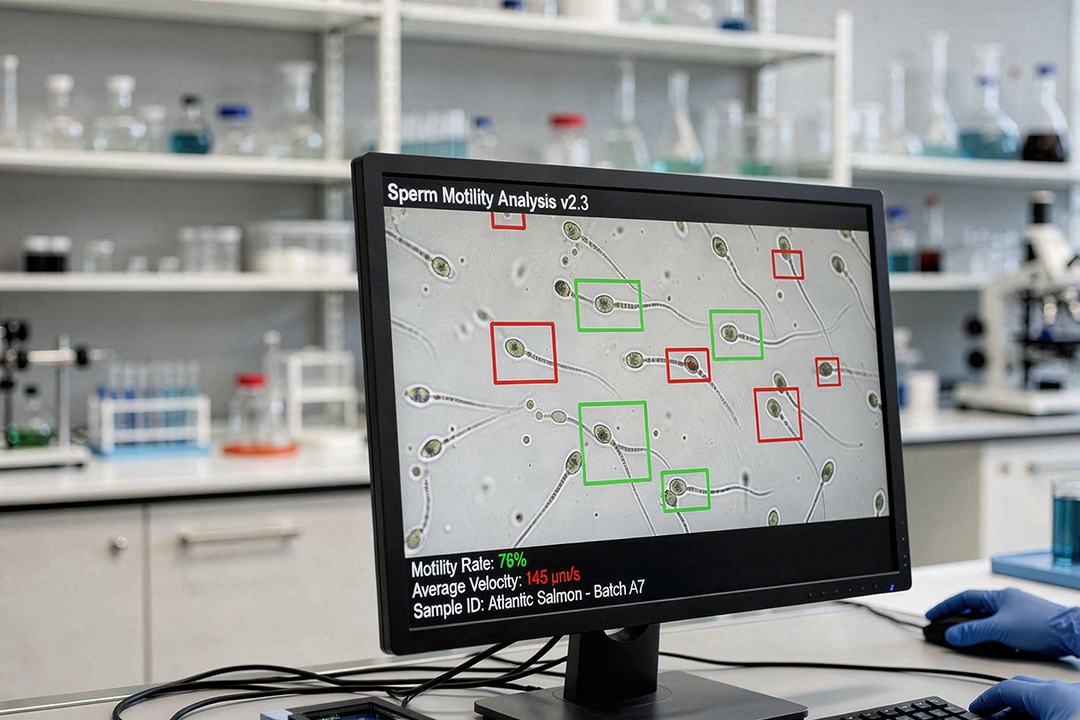
A research team has developed a preliminary sperm screening approach using computer-assisted motility systems (CASA), a laboratory technique that can differentiate male breeders of European seabass, gilthead seabream and Senegalese sole according to the ability of their spermatozoa to maintain motility under conditions associated with climate change, such as rising water temperature and seawater acidification.
The study, published in Aquaculture Reports, proposes an experimental tool with potential relevance for broodstock management in Mediterranean aquaculture, particularly in a context where sea warming and changes in pH may affect key biological processes such as reproduction.
The research was carried out by a team involving the Universitat Politècnica de València, the Institute of Aquaculture Torre de la Sal (IATS-CSIC) and the Institute of Agrifood Research and Technology (IRTA), among other centres.
The species studied are of particular interest for Mediterranean aquaculture, both because of their production importance and their strategic value in breeding and diversification programmes.
The researchers sought to identify males that maintain better sperm quality under climate change scenarios affecting the external fertilisation of marine fish.
To address this question, they evaluated sperm samples using a CASA-Mot system, a computer-assisted analysis technology that measures parameters such as total motility, progressive motility and sperm velocity.
The samples were subjected to three types of challenge test: pH validation, temperature variation and a combination of both.
The most relevant approach was the combined pH and temperature test. In this assay, spermatozoa were activated under conditions simulating current and future environmental scenarios.
By comparing motility variation against the natural reference conditions for each species, the researchers were able to classify males according to the stability of their sperm performance.
In European seabass, males were identified whose sperm showed motility variations below 5-10% compared with natural conditions.
In gilthead seabream, stricter threshold were applied – 2%, 5%, and 10% - due to its greater stability under changes in pH and temperature.
In Senegalese sole, wider threshold of up to 15% were required because of the species’ higher thermal sensitivity.
Overall, gilthead seabream showed greater sperm ability, while European seabass and Senegalese sole were more sensitive to increased temperature.
In Senegalese sole, thermal increase significantly reduced sperm motility and, at pH 7.8, also sperm velocity.
In European seabass, the main effect was observed on total motility under elevated temperature.
The variability observed among species under changing environmental conditions opens the door to the use of functional sperm quality tests as a support tool for broodstock selection and management, especially in hatcheries working with species exposed to heat stress events or changes in water quality.
The screening chart included in the study is particularly illustrative
It shows how variation in sperm motility under different combinations of pH and temperature can distinguish males that maintain stable performance from those whose samples show a sharper decline.
This approach could turn a laboratory measurement into a potentially useful tool for decision-making in broodstock programmes.
However, the authors stress that the approach should be interpreted with caution. The results come from in vitro conditions and do not yet demonstrate, by themselves, that males identified as more resilient will generate higher fertilisation rates, better hatching success or more viable offspring under real production conditions.
The main frontier for this work is to validate whether the laboratory results translate into real reproductive success and whether this capacity is maintained over time.
Even so, the study opens a useful line of work for Mediterranean aquaculture by proposing a preliminary test that could help identify breeders with more stable sperm performance under climate change, without replacing full fertility assessment.

Latest news
-
A sperm test can identify Mediterranean fish breeders more resilient to climate stress
Valencia, Spain, 25 June 2026 |
-
Music emerges as an experimental tool to improve welfare and performance in farmed fish
Global, 25 June 2026 |
-
Countdown to the traceability of plant-based ingredients in aquaculture feeds ahead of EUDR implementation
Brussels, 25 June 2026 | The EU Regulation on Deforestation-free Products will start to apply on 30 December 2026 for large and medium-size operators, while micro and small enterprises will have until 30 June 2027 to adapt