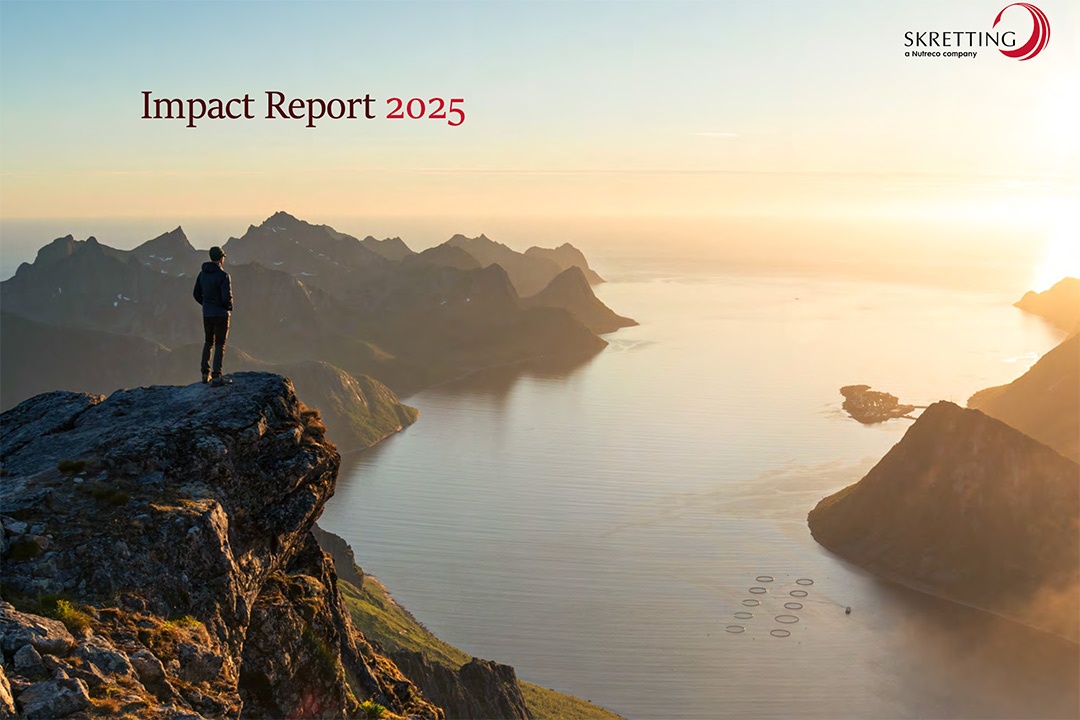
 Skretting | Impact Report 2025
Sustainability in aquafeed is entering a more demanding stage. Circularity, alternative ingredients and emissions reduction are no longer enough as stand-alone narratives unless they are supported by traceability, technical verification, comparable data and productive results.
This is one of the key readings from Skretting’s Impact Report 2025, in which the company presents its progress on ingredients, climate, innovation, animal welfare and collaboration across the value chain.
Skretting’s report notes that ingredients, typically account for between 60% and 90% of the total footprint of an aquaculture product when the full cycle is considered. This makes formulation, raw material origin, certification and supplier data increasingly relevant for producers, buyers and certification bodies.
| Area | 2025 indicator | Editorial reading |
|---|---|---|
| Own operations emissions | 40% reduction in scope 1 and 2 compared with 2018 | Clear progress in efficiency and energy. |
| Value chain emissions | 5% reduction in scope 3 compared with 2018 | Slower progress, influenced by data, suppliers and volumes. |
| Marine ingredients | 88% certified or from a Fishery Improvement Project (FIP) | Certification is gaining weight, but the 100% target remains pending. |
| Soy | 97% aligned with the intermediary target | Progress in compliance, with challenges around stricter traceability. |
| Novel ingredients | 1.5% global inclusion | Scalability remains the main bottleneck. |
| Packaging | 96% easily recyclable | Operational progress towards circularity in packaging. |
One of the most relevant points in the report is the move towards more granular measurement of aquafeed environmental footprint. Skretting has strengthened SKAILA, its automated product footprint tool, to analyse impacts at the level of specific feeds and individual products, with breakdowns by raw materials, inclusion levels, life-cycle stages and emission types.
This approach shifts the discussion from general indicators towards more specific decision on formulation, sourcing and farm management.
However, the company recognises that better data quality does not in itself reduce emissions, although it does make it possible to identify more precisely where action is needed.
The productive dimension is also gaining importance
 Skretting - Necto | Impact Report 2025
In 2025, Skretting launched new nutritional solutions such as NutriPond, Necto, Lorica and Optiline, aimed at improving performance, resilience, animal health and feed efficiency in fish and shrimp.
According to Maarten Bijl, CEO of Skretting, the progress reflected in the report “goes beyond numbers” and is linked to making aquaculture “more resilient, transparent and sustainable”.
The broader reading is that aquafeed is entering a new phase: sustainability is no longer measured only by the circular origin of a raw material or the substitution of ingredients, but by its ability to become integrated into real farm performance and deliver efficiency, resilience and competitiveness for producers.

Latest news
-
The use of the macroalga Ulva ohnoi reduces ozone-produced oxidant in marine RAS
Germany, 27 May 2026 |
-
Aquafeed sustainability enters the phase of technical verification
Global, 27 May 2026 | Skretting’s Impact Report 2025 reflects how the aquafeed industry is moving towards a sustainability model built on traceability, product footprint data, responsible sourcing and measurable farm-level outcomes
-