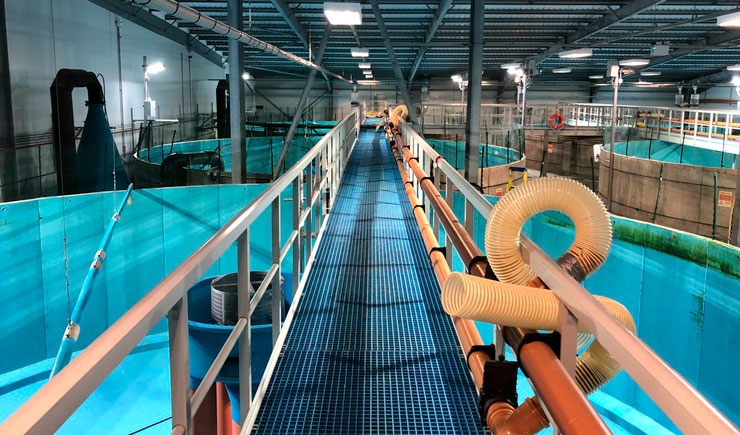
The use of ozone (O3) in marine recirculating aquaculture systems (RAS) continues to gain traction due to its germicidal properties and water-clearing capacity. However, its application in saltwater is hindered by a critical obstacle: the formation of ozone-produced oxidants (OPOs), which are halogenated by-products potentially toxic to cultured organisms.
To address this challenge, a pioneering study published in the Journal of Applied Phycology evaluated the use of the macroalga Ulva ohnoi as a biofilter within an integrated multi-trophic aquaculture (IMTA-RAS) setup cultivating gilthead seabream (Sparus aurata).
The findings demonstrate that while the seaweed acts as an effective biological buffer, it undergoes significant physiological strain caused by oxidative stress.
The system performance and the seaweed’s biological response following the trial are summarised in the technical parameters below:
| Evaluated Parameter | Control System Performance (Without Seaweed) | Impact / Result with Ulva ohnoi |
|---|---|---|
| Outflow OPO concentration | 0.11 mg L-1 in Cl2 equivalents | 0.07 mg L-1 (an additional 11.1% reduction, nearing the safe threshold of 0.06 mg L-1) |
| Biomass growth | Quadrupled its original weight during the trial | An approximate 30% reduction in growth (only tripled its weight) |
| Macroalgae morphology | Smooth, flexible fronds with a light green colouration | Darker green colour, ragged edges and anomalous structural rigidity |
| Biochemical and metabolic profile | Standard baseline values | Heavy accumulation of phenols, flavonoids and soluble sugars, along with amino acids from proline synthesis |
| Structure of the phycosphere | Dominance of the Saprospiraceae family (complex carbohydrate degraders) | Disappearance of complex carbohydrate bacteria and opportunistic dominance of Alphaproteobacteria |
For marine RAS professionals, these data offer a clear takeaway: seaweeds are an excellent functional support for biological safety, but they are not a standalone solution.
Because ozone-produced oxidants gradually degrade the protective biofilm of the alga, filtration efficiency tends to plateau over time, irrespective of an increase in plant biomass.
Consequently, the authors conclude that integrating IMTA and ozonation demands a rigorous technical design that complements – but never entirely replaces – established physical-chemical control technologies such as activated carbon filtration or UV photolysis destruction.
Bibliographic reference:
Weidlich, S., Priemer, C., Aires, T., Brenner, M., Weckwerth, W., Engelen, A., & Kunzmann, A. (2026). Bioremediation of ozone-produced oxidants in marine RAS using Ulva ohnoi: benefits and impacts on seaweed physiology and associated microbiomes. Journal of Applied Phycology. https://doi.org/10.1007/s10811-026-03850-8

Latest news
-
The use of the macroalga Ulva ohnoi reduces ozone-produced oxidant in marine RAS
Germany, 27 May 2026 |
-

Aquafeed sustainability enters the phase of technical verification
Global, 27 May 2026 | Skretting’s Impact Report 2025 reflects how the aquafeed industry is moving towards a sustainability model built on traceability, product footprint data, responsible sourcing and measurable farm-level outcomes
-