
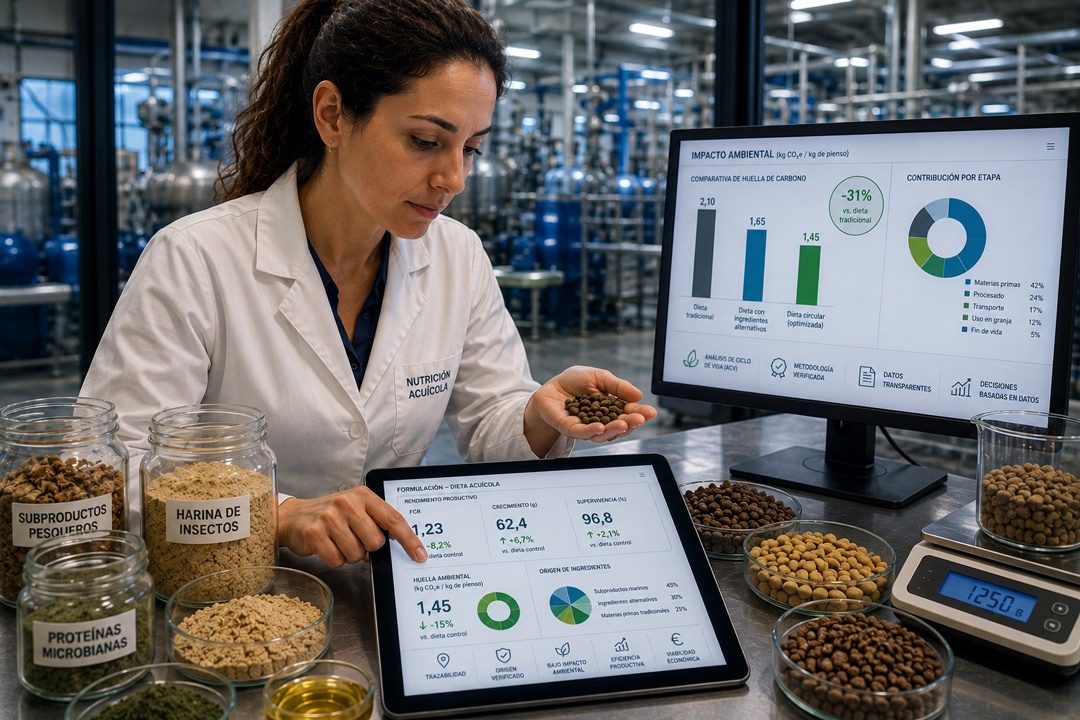
The future of circular aquafeeds will not be decided by their origin, but by their results. In aquaculture, reusing by-products or incorporating alternative ingredients will only have value if it helps maintain productive performance, control feed conversion, reduce verifiable impacts and produce fish in a healthy and competitive way.
The circular economy is gaining importance in aquafeed formulation because of its potential to make better use of resources, reduce losses and ease pressure on primary raw materials.
However, the debate is beginning to move away from the environmental narrative and towards a more demanding question for producers, nutritionists and feed manufacturers: what actually happens when those ingredients reach the fish, the farm and the environmental balance of the production system?
Alternative diets can maintain adequate productive results, but they do not automatically guarantee a lower carbon footprint. This distinction makes it necessary to differentiate between circularity of origin and proven environmental sustainability.
An ingredient may come from a by-product or secondary source and still fail to improve the final impact if processing, transport, digestibility or feed conversion efficiency do not support that outcome.
For the aquaculture sector, this distinction is becoming increasingly relevant. Producers do not simply need feeds with a sustainable narrative, but solutions that can be supported by data on growth, FCR, intestinal health, protein efficiency, traceability, industrial availability and cost per kilo produced.
In a context of tight margins, regulatory pressure and growing market demands, sustainability will only have staying power if it fits within the productive logic of the farm.
This shift towards verification also reaches marine ingredients
Fishmeal and fish oil, traditionally placed at the centre of the debate on raw material substitution, are beginning to claim their role from a more circular perspective when they are produced from fishery by-products and supported by comparable environmental data.
Along these lines, Brett Glencross, Technical Director at IFFO, The Marine Ingredients Organisation, has argued that the use of life cycle assessment methodologies makes it possible to apply a common set of rules and avoid environmental burdens being “simply shifted from one product to another”.
This progress is already beginning to move into the industrial sphere. Austral Group has become the first Peruvian producer to register the life cycle assessment of its fishmeal and fish oil as branded data in the Global Feed LCA Institute, a move that reinforces the idea that the sustainability of marine ingredients will also need to be supported by verifiable metrics.
The next stage of aquaculture nutrition will be shaped by this convergence between circularity, performance and verification, and producers will need to demand that each raw material demonstrates verifiable origin, nutritional functionality, productive efficiency, environmental footprint and economic viability within the final formulation.

Latest news
-
Philosofish accelerates its financial recovery as Greece reorganises its aquaculture industry
Greece, 1 June 2026 | The company has returned to profit after three years of losses and is strengthening its strategy around value-added products, operational integration and export growth
-
Circularity, FCR and environmental footprint: the new equation for aquafeed
Global, 1 June 2026 | The use of by-products and alternative ingredients is gaining ground in aquafeed formulation, but the sector is beginning to demand more than circularity: productive performance, traceability, environmental footprint and economic viability
-
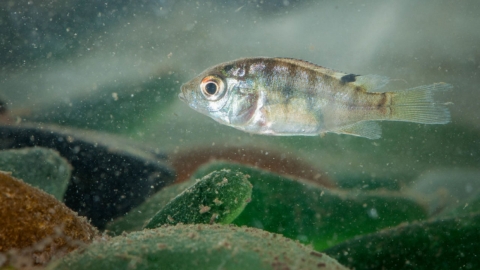
A bacteriophage raises survival of tilapia infected with Aeromonas veronii
China, 29/05/2026 | The phage Avs-1 increased survival from 20% to 70% in experimental trials, reinforcing interest in phage therapy as a biocontrol alternative to antibiotics