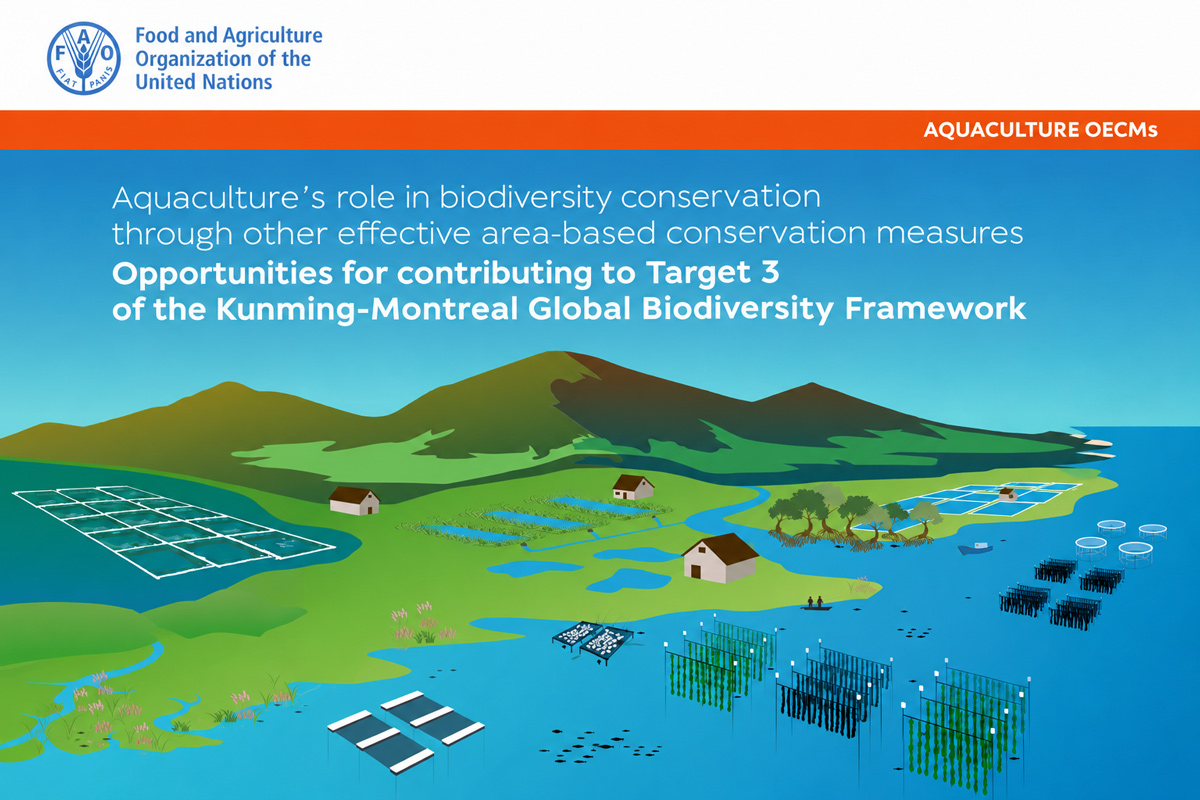
Some aquaculture systems could contribute to international biodiversity targets if, alongside food production, they deliver sustained ecological benefits in the areas where they operate. That is the possibility examined in a new report from the Food and Agriculture Organization of the United Nations (FAO), which considers whether certain aquaculture activities could qualify as other effective area-based conservation measures (OECMs).
OECMs are areas outside formal protected areas that are governed and managed in ways that produce positive, long-term outcomes for biodiversity. Their recognition could contribute to Target 3 of the Kunming-Montreal Global Biodiversity Framework, known as the 30×30 target, which aims to conserve 30% of terrestrial, inland water, marine and coastal areas by 2030.
The report presents seven case studies where evidence points to direct biodiversity benefits: seabed oyster and clam farming; off-bottom mussel and oyster farming; tropical and temperate seaweed cultivation; integrated mangrove-shrimp farming; and rice-fish co-culture.
Aquaculture infrastructure can provide habitat structure and refuge for other species and, in some cases, restrict access by destructive fishing gear, the report says. It also cautions against risks including habitat loss, chemical inputs, disease transmission and the escape of non-native species.
The report does not propose that aquaculture farms should automatically be recognised as conservation areas. Each site would need to be assessed individually and demonstrate long-term benefits, biodiversity monitoring, effective and equitable management, and environmental safeguards. The FAO identifies some non-fed aquaculture, native species and integrated systems such as rice-fish farming as having greater potential.
The report outlines a possible route for some production systems to contribute to conservation, while stressing that outcomes depend on local conditions and must be verifiable.
Latest news
-

Mowi raises 2026 harvest guidance to 620,000 tonnes after record revenue quarter
Bergen, Norway, 4 November 2026 | The company expects to grow by 11% this year, compared with estimated industry growth of 4%
-

BioMar delivers a record third quarter and upgrades its 2026 outlook
Aarhus, Denmark, 4 November 2026 | The company raises its revenue and EBIT targets after a strong performance in the first nine months, while lowering its volume forecast amid expectations of softer demand in some markets in the fourth quarter
-
FAO explores how some aquaculture systems could contribute to the 30×30 target
Rome, 3 November 2026 | A report examines whether certain farms could qualify as other effective area-based conservation measures, provided they demonstrate lasting benefits for biodiversity