


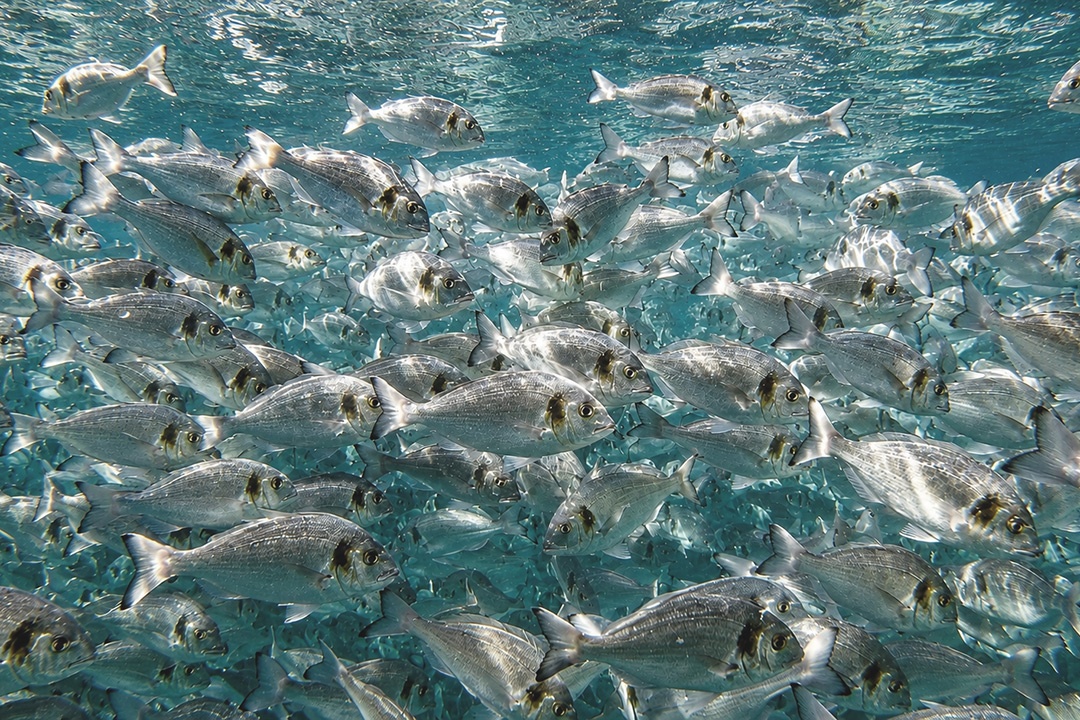
The partial replacement of fishmeal with alternative ingredients has become one of the major areas of work in Mediterranean aquaculture. For producers, however, the decisive question is not only whether an ingredient is more sustainable, but whether it can be incorporated into a commercial diet without penalising growth, feed conversion, product quality or economic margin.
A new study by the University of Messina, carried out under commercial offshore farming conditions in Sardinia, offers a positive, although not definitive, answer. The research evaluated the effect of including 11% defatted Hermetia illucens meal in feeds for gilthead seabream (Sparus aurata), corresponding to approximately 35% replacement of the fishmeal-derived animal protein fraction.
Defatted Hermetia illucens meal can be incorporated into commercial diets for gilthead seabream without compromising growth, feed conversion or the nutritional composition of the fillet.
The study is particularly interesting because it was not limited to a laboratory trial. The experiment was carried out with around 60,000 gilthead seabream distributed across four commercial cages, two for each dietary treatment, over 181 days of farming.
The fish had an initial average weight of approximately 131 grams and were reared at the Maricolture Sarde facility in Sant’Antioco, Sardinia. The experimental diets were formulated to be iso-nitrogenous and iso-lipidic and were produced as extruded pellets by Veronesi.
The main result was that the inclusion of insect meal did not lead to significant differences in the main productive indicators. Final body weight, weight gain, specific growth rate, feed conversion ratio, protein efficiency ratio and somatic indices remained comparable between the control group, fed a fishmeal-based diet, and the group fed the diet containing insect meal.
From a zootechnical perspective, this is a relevant finding. It means that, at this inclusion level, defatted Hermetia illucens meal can be used in a practical diet for gilthead seabream farmed in marine cages without penalising productive performance.
This is an important step, as many trials on alternative ingredients are still carried out under controlled conditions, often far removed from the environmental and operational variability of commercial farms.
Other important aspects of the study
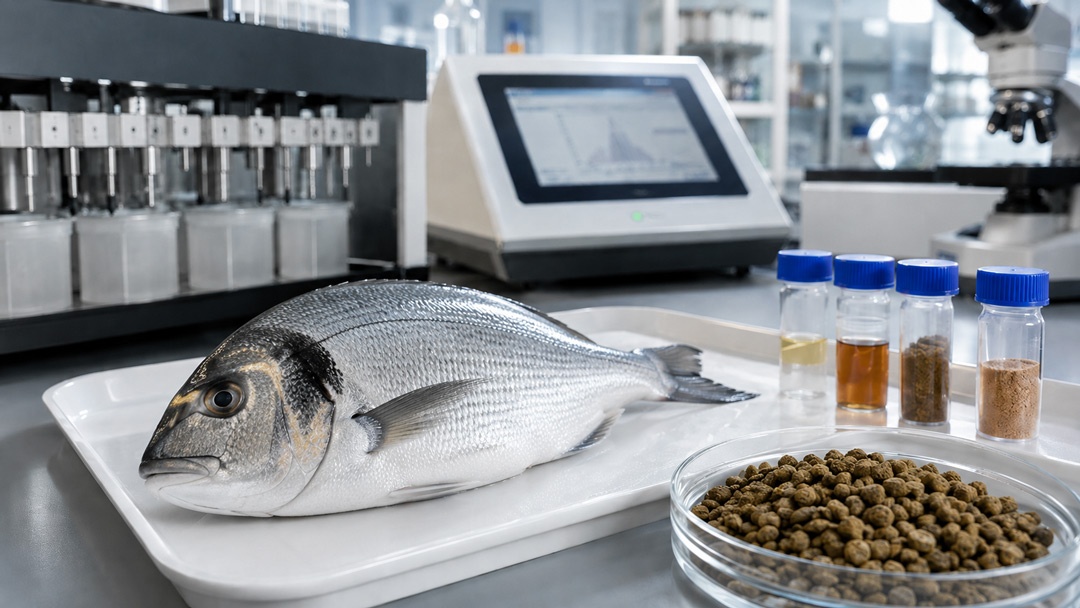
The economic data introduce a necessary note of caution. Although feed conversion ratio did not worsen, the economic conversion ratio was significantly higher in the group fed insect meal. This was not due to lower feed efficiency, but to the higher cost of the formulation: €1.76 per kg of feed for the diet containing Hermetia illucens, compared with €1.36 per kg for the control diet.
In practical terms, the economic conversion cost increased from €1.469 per kg of fish produced in the control group to €2.024 per kg in the group fed insect meal. This shifts the debate from a simple “does it work or not?” to a more industrial question: at what price can it work?
Defatted Hermetia illucens meal can be incorporated into commercial diets for gilthead seabream without compromising growth, feed conversion or the nutritional composition of the fillet.
Fillet quality remained largely stable. Protein, lipid and ash contents did not show significant differences between the two diets, while moisture was only slightly lower in the group fed insect meal.
Visual appearance and aroma were also not substantially modified, according to analyses carried out using an electronic eye and electronic nose.
The electronic tongue, however, detected differences in taste-related compounds, although the study does not establish whether these variations would be perceptible to consumers.
Insect meal therefore appears to modify mainly certain taste-associated aspects, probably through variations in soluble compounds such as amino acids, peptides or nucleotides.
For this reason, market acceptance will not depend only on sustainability or productive performance, but also on the ability to maintain a final product that is stable, recognisable and accepted by consumers.
The study confirms that the use of Hermetia illucens is technically possible in gilthead seabream farmed under commercial conditions: the fish grow, convert feed efficiently and maintain a basic fillet quality comparable to that obtained with a conventional diet.
However, its large-scale adoption remains linked to two decisive tests: the real cost of the ingredient and sensory validation of the final product.
Replacement is therefore technically possible, but not automatically profitable. For the feed sector, the work confirms the potential of insect meal as an alternative ingredient to fishmeal.
For farmers, however, the message is more cautious: before industrial adoption can be discussed, the sector will need competitive ingredients, available volumes, stable formulations and a clear market response.

Latest news
-
Insect meal does not penalise gilthead seabream growth, but profitability remains the key challenge
Messina, Italy, 6 July 2026 | Defatted Hermetia illucens meal can be incorporated into commercial diets for gilthead seabream without compromising growth, feed conversion or the nutritional composition of the fillet.
-
Genetics, water quality, microbiota, nutrition, management and biosecurity define shrimp farming research
Kuala Nerus (Malaysia), 3/07/2026 | A historical review of 10,896 scientific publications on shrimp and prawn aquaculture, published between 1970 and 2024, reads like a strategic map of how the sector’s scientific priorities have evolved
-
Residual CO₂ from RAS can boost natural astaxanthin production with microalgae
Finland, 2 July 2026 | A Finnish study with Haematococcus pluvialis shows improvements in growth biomass and astaxanthin production when using degassing air and effluent water from recirculating aquaculture system, although scalability remain to be demonstrated