
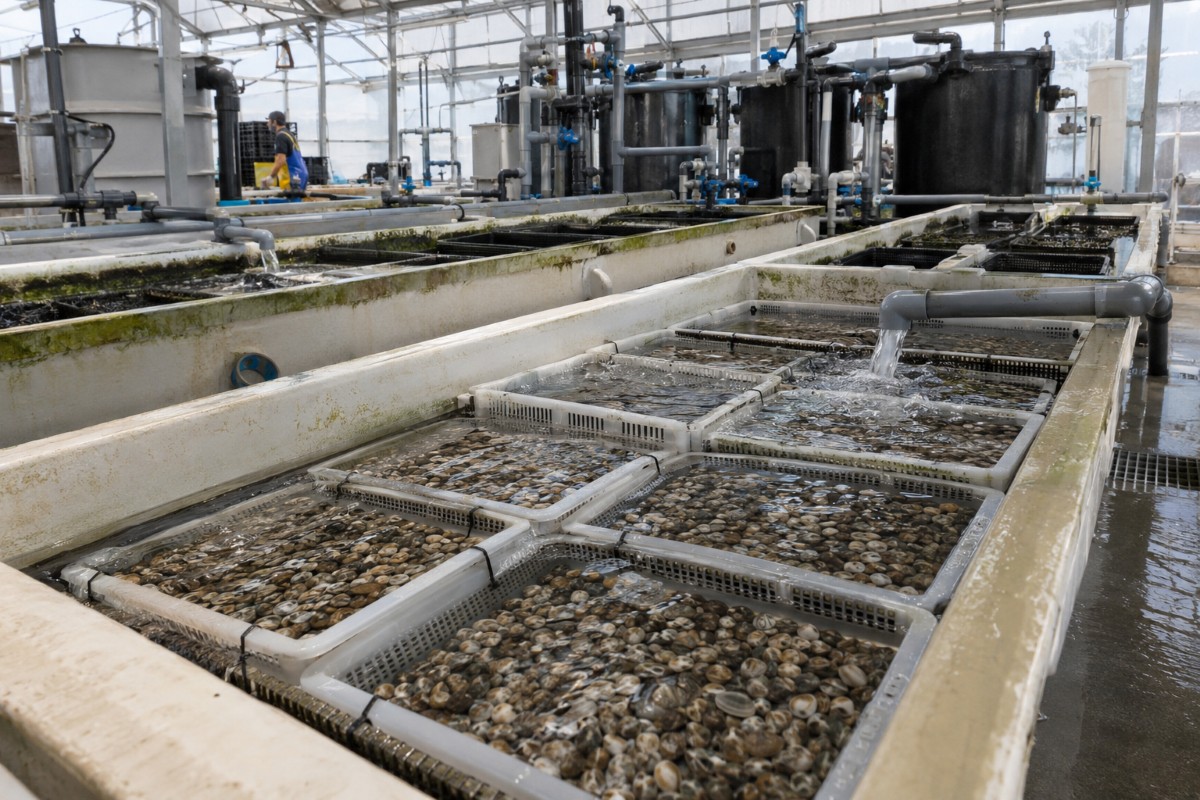
Adapting size and composition of microalgae to the development of the Manila clam (Ruditapes philippinarum) could significantly accelerate juvenile production. This has been demonstrated by researchers from Japan’s National Fisheries University, the Yamaguchi Prefectural Fisheries Research Center, Kibi International University, Kyushu University and the University of Miyazaki.
The researchers enable juvenile clams to grow from approximately 1.5 to 6 millimetres in shell length in just 20 days. Under standard diets with fixed proportions, the same growth took more than 40 days.
Selecting two microalgal species with different cell sizes allowed the researchers to adapt the diet to the juveniles’ filtration capacity as they developed.
The study used the small-called diatom Chaetoceros neogracile and the marine euglenoid Eutreptiella eupharyngea, whose cells are considerably larger.
Initially, the juvenile clams received the diatom exclusively. Once they exceeded 1.5 millimetres, 25% Eutreptiella was introduced into the diet. Upon reaching 3 millimetres, the blend was adjusted to 50% of each species.
Feeding frequency was also increased after the first ten days. The amount supplied was raised by 25% whenever the researchers found that the available feed had been fully consumed.
| Clam shell length | Diet composition |
|---|---|
| Up to 1.5 mm | 100% C. neogracile |
| Between 1.5 and 3.0 mm | 75% C. neogracile and 25% E. eupharyngea |
| Above 3.0 mm | 50% C. neogracile and 50% E. eupharyngea |
The progressive feeding regime produced the greatest final shell length, a size distribution shifted towards larger individuals and a significant higher soft-tissue dry weight than the other strategies.
Survival reached 97.8%, compared with values ranging from 88.9% to 92.2% in the remaining experimental groups.
In addition to optimizing the clams’ filtration capacity, the progressive dietary change reduced the number of particles required to supply an equivalent amount of dry matter.
The two microalgae also provided complementary nutritional profiles. The diatom contained higher concentrations of certain sterols, carotenoids and compounds used as energy sources, while Eutreptiella supplied more DHA and certain omega-3 and omega-6 polyunsaturated fatty acids.
These included arachidonic acid, which was not detected in chaetoceros and was identified by the authors as one possible factor behind the greater growth observed with mixed diets.
From a production perspective, reducing the time required to reach 6 millimetres by more than 20 days could increase tank turnover, reduce the juveniles’ exposure to mortality events and improve the efficiency of seed-production facilities.
The study did not, however, calculate the cost of culturing the two microalgae or the financial savings resulting from the shorter production cycle.
Latest news
-
Matching diets to clam size cuts the pre-growing phase by more than 20 days
Japan, 18 September 2026 | A trial involving juvenile Manila clams reduced the time required to reach 6 millimetres to 20 days, compared with more than 40 days under fixed-composition diets
-
Piszolla invests nearly €4m to move further into value-added trout processing
Piszolla & Eurotrucha is investing close to €4 million in a major upgrade of its processing facility in Alba de Tormes, Spain, adding a new line designed to fillet large trout.
-
Farmed cod takes 72% of Norway’s fresh cod export value as sector gains commercial scale
Norway, 18 September 2026 | Farmed cod sales rose 46% and August exports almost doubled in value, while a move into mainstream grocery retail points to a more regular year-around market for the species