


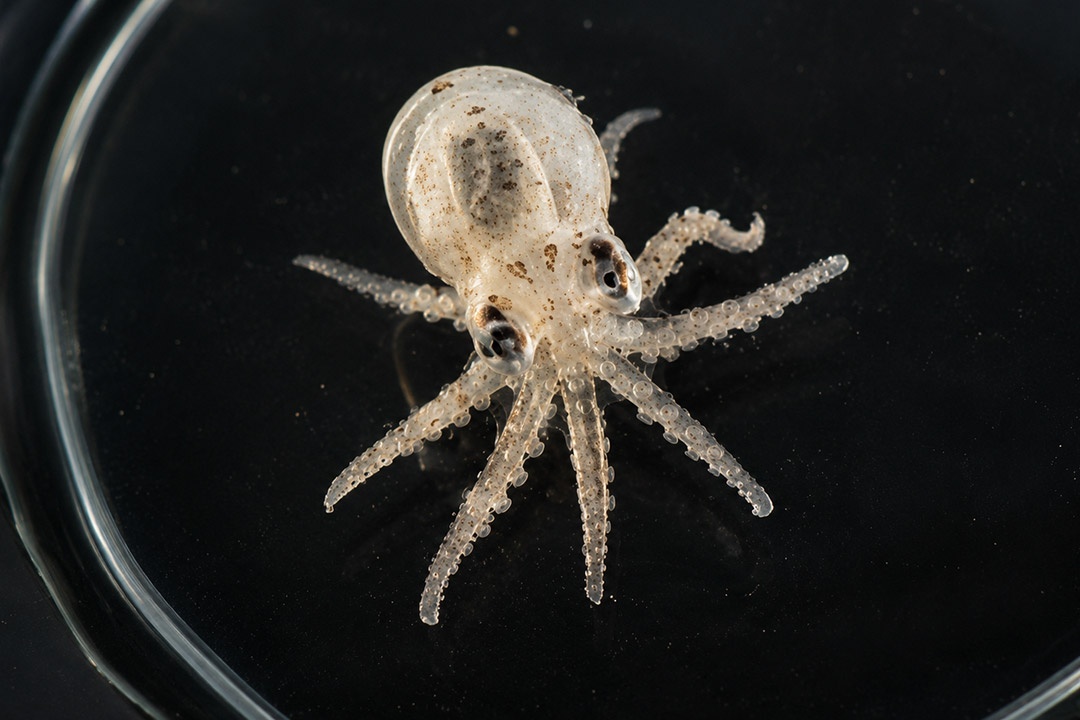
Nueva Pescanova has submitted to the Port Authority of Las Palmas its withdrawal of the concession application to build an octopus farm at the Port of Las Palmas. The port authority will now close the proceedings initiated in May 2021, bringing an end to the project planned for the La Esfinge dock.
The decision applies solely to this specific application and, according to the company, does not constitute a judgement on the potential future viability of other technical, environmental or location alternatives.
The proposal facility involved an investment of approximately €50 million and a projected production capacity of around 3,000 tonnes per year. The application covered 52,691.51 square metres of public port land, as well as 713 square metres of subsurface area and 517.68 square metres of submerged space, according to the notice published by the Port Authority in Spain’s Official Gazette in July 2021.
The initiative was underpinned by Nueva Pescanova’s research into the farming of Octopus vulgaris. In 2019, the company announced that its team had successfully closed the species’ reproductive cycle in captivity, building on work initiated by the Spanish Institute of Oceanography. This achievement advanced knowledge of a species whose cultivation poses major biological challenges and positioned the Pescanova Biomarine Center in O Grove as an international reference in this field of aquaculture research.
Nueva Pescanova attributes its withdrawal to business and regulatory considerations associated with the evolution of the administrative procedures. According to the company, observations submitted by various sectoral authorities and new requirements introduced during the process substantially changed the conditions, scope, timetable and obligations applying to the original proposal.
In light of this new situation, the company concluded that it was no longer appropriate to continue with the application under the terms in which it had originally been submitted.
The proceeding began with a simplified environmental assessment. Following consultations with the relevant public authorities, the Canary Islands Environmental Assessment Commission agreed in 2023 that the project should undergo a full environmental impact assessment.
This was intended to examine in greater detail matters such as water management and treatment, discharges, energy consumption, waste, odours and the facility’s interaction with the marine environment. Moving to this more comprehensive procedure did not constitute an unfavourable environmental impact decision or mean that the project had been declared unviable.
Since its presentation, the initiative had also faced strong opposition from national and international animal welfare organisations, which questioned intensive octopus farming because of the species’ conginitive and behavioural characteristics.
These campaigns increased the project’s public exposure and brought the debate over cephalopod welfare into several political and social arenas.
Nueva Pescanova, however, does not link this opposition to its decision and maintains that its withdrawal was based on business and regulatory considerations associated with the evolution of the administrative process. There is therefore no confirmed evidence that the project was withdrawn because of the animal welfare campaigns.
The closure of the proceedings does not support any general conclusion about the environmental, technological or economic viability of farming octopus at an industrial scale. The project sought to transfer advances achieved through years of research to a commercial facility without precedent, a process requiring biological development, production design, environmental requirements and the administrative framework to converge.
Nueva Pescanova remains open to considering other technological configurations or locations, although it has not announced a new proposal to date.

Latest news
-
New diets containing hydrolysates from animal by-products and insects enter commercial trials with European seabass and gilthead seabream
Faro, Algarve, Portugal, 28 July 2026 | Seaculture will assess over three months under offshore farming conditions whether the improvements in growth and survival observed in laboratory trials can be maintained at production scale
-
Nueva Pescanova withdraw from the Canary Islands octopus farm project
Las Palmas de Gran Canaria, Spain, 28 July 2026 | The company is ending the project planned for the Port of Las Palmas after five years of administrative procedures, having concluded that changes to the conditions and requirements had substantially altered the original proposal
-
Aquaculture calls for inclusion in the EU protein strategy
Brussels, 24 July 2026 | The EUSeA alliance argues that the new EU plan has been designed primarily around agriculture and livestock farming and is calling for the forthcoming Vision for Fisheries and Aquaculture 2040 to include a Blue Foods Action Plan.