
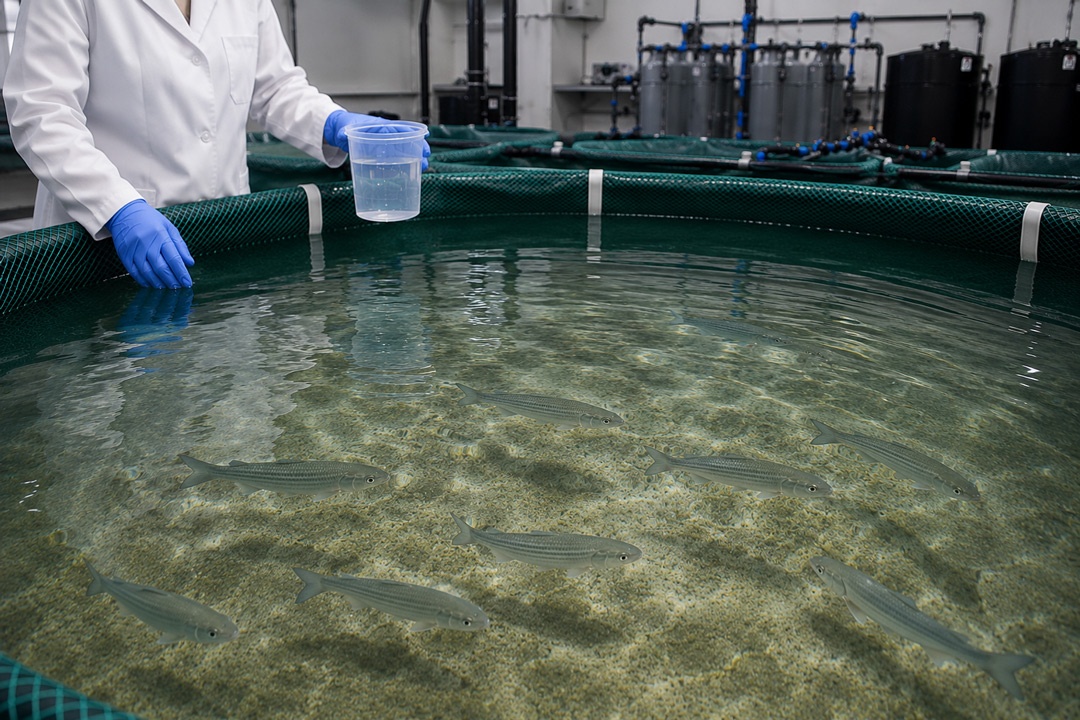
Optimising diets and environmental conditions could become an important tool for improving the growth performance and flathead grey mullet (Mugil cephalus) in aquaculture. A new study by researchers from the University of Bologna, the International Marine Centre (Italy) and the Instituto de Acuicultura Torre de la Sal (IATS-CSIC, Spain), published in Frontiers in Marine Science, investigated the combined effects of two dietary lipid levels (10% and 15%) and two rearing temperatures (22°C and 28°C) on growth, metabolism, gut microbiota and digestive dynamics in flathead grey mullet (Mugil cephalus).
The results showed that temperature was the main production factor. Fish reared at 28ºC achieved higher final weights and higher specific growth rates than those maintained 22ºC. Feed conversion ratios were also more favourable under the warmer conditions, suggesting improved nutrient utilisation.
According to the authors, the higher energy density provided by the 15% lipid diet may have enabled fish to meet their metabolic requirements while consuming less feed, while also allowing dietary protein to be used more efficiently for growth.
The study also described, for the first time, gut evacuation dynamics in grey mullet as a function of temperature and diet. The intestine was almost completely empty around eight hours after feeding, with the exception of fish reared at 22ºC and fed the 15% lipid diet, where digestive transit slowed considerably, extending gut evacuation time to approximately 18 hours.
The gut microbiota was also strongly influenced by temperature, with a higher abundance of Cetobacterium observed at 28ºC. This finding reinforces the idea that thermal conditions can affect not only growth performance but also the digestive and metabolic balance of the species.
For Silvia Natale of the University of Bologna and co-author of the study, grey mullet remains a species whose potential has yet to be fully explored. “I am very pleased to have had the opportunity to work on mullet, a species that is still relatively underexplored and for which several important knowledge gaps remain,” she explained.
However, Natale emphasised that further applied research is still needed before farming performance can be fully optimised. “It is a very interesting and promising species, although it cannot be ignored that feed conversion ratios are still too high to make production fully sustainable. I hope research in this filed will continue so that effective solutions can be identified to improve these parameters.”
Grey mullet is increasingly being considered a low-trophic-level species with significant potential to diversify Mediterranean aquaculture. According to Natale, “looking ahead, and also considering the challenges associated with climate change, mullet could become an excellent candidate for aquaculture, contributing to the sustainable diversification of the sector.”
References
Natale, S., Moroni, F., Domingo-Bretón, R., Pérez-Sánchez, J., Berrettini, M., Ferrari, M.G., Dondi, F., Concu, D., Vallainc, D., Carboni, S., Patarnello, T., Gatta, P.P., Benini, E., Bonaldo, A. & Parma, L. (2026). Dietary lipid utilisation under different thermal conditions in flathead grey mullet (Mugil cephalus). Frontiers in Marine Science, 13:1847546.
DOI: 10.3389/fmars.2026.1847546

Latest news
-

Türkiye consolidates its aquaculture leadership with 626,000 tonnes in 2025
Ankara, 8 June 2026 | Total fisheries production reached 1.02 million tonnes in 2025, with more than 626,000 tonnes coming from aquaculture, driven mainly by trout, European seabass and gilthead seabream
-
Study identifies how to optimise dietary lipid levels and temperature to improve grey mullet growth
Bologna, Italy 8 June 2026 | The combination of a diet containing 15% lipids and a rearing temperature of 28ºC delivered the most favourable results in Mugil cephalus
-
Diet is no longer just feeding fish: it is starting to reconfigure microbiome, stress response and sexual development
Vigo, 4/06/2026 | Two IATS-CSIC studies presented at the XX CNA show how new aquafeed formulations are beginning to modulate complex physiological processes far beyond growth performance