
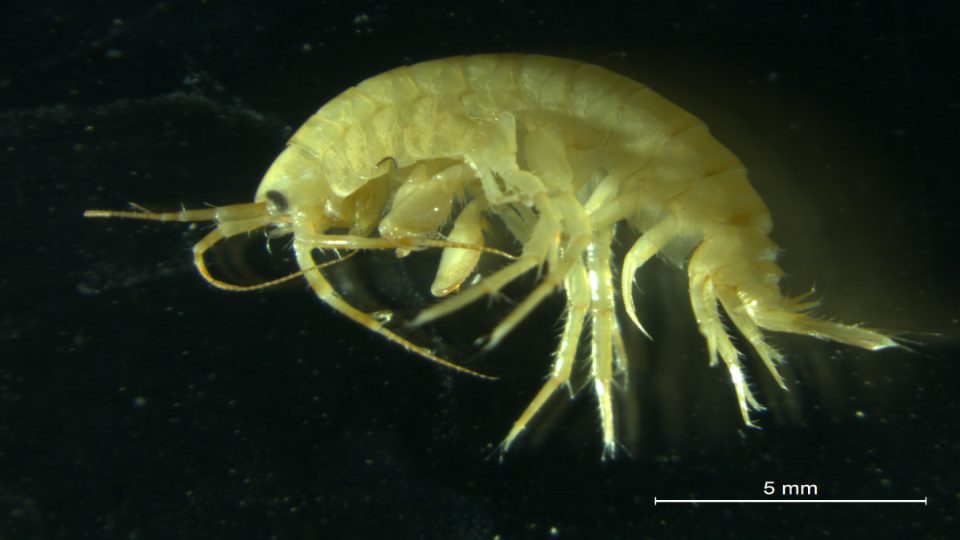
 Gammarus sp |Foto: Marta Castilla
A field study and laboratory experiment conducted by researchers from the A.O. Kovalevsky Institute of Biology of the Southern Seas, in Russia, indicate that the amphipod Gammarus aequicauda can be successfully cultivated in hypersaline conditions and could serve as a high source of polyunsaturated fatty acids and essential amino acids, as ingredients in aquaculture feed.
The study, conducted at Lake Moynaki, a hypersaline lake in Crimea, revealed that this gammarid can thrive in highly saline waters, reaching abundances of up to 89,200 individuals per cubic metre and a biomass of 558 grams per cubic metre during the months of peak activity.
What makes this research particularly valuable is the extreme salinity tolerance of Gammarus aequicauda, a species capable of developing in salinity levels ranging from 45 to 90 grams per litre, much higher than those recorded in most traditional aquaculture systems. This factor not only opens up new opportunities for aquaculture in arid areas where freshwater is scarce but also allows the utilisation of disused hypersaline lakes and salt flats.
The research team also identified that Gammarus aequicauda has an exceptional reproductive capacity, with up to three generations per year. This rapid reproductive cycle could ensure constant production in aquaculture systems, with estimates suggesting the potential to obtain up to 5000 kg of wet weight per hectare per year.
The study is only the beginning of what could be a revolution in aquaculture in regions with limited access to freshwater. As cultivation technology advances and conditions for breeding Gammarus aequicauda are optimised, productivity is expected to increase even further, offering aquaculturists a sustainable and efficient source of feed for their animals.
Additionally, the study has explored sustainable approaches such as integrated multi-trophic aquaculture (IMTA), where this species could play a key role.
The paper includes genetic and ecological studies that support the data obtained on growth, reproduction, and population dynamics.
Gammarids, in general, share many biological and ecological characteristics, such as their ability to adapt to a wide range of salinities and their importance as a food source in aquatic ecosystems. As a result, these findings may inspire other studies on similar species in salt flats.
Reference: Nickolai Shadrin, Vladimir Yakovenko, Polina Drozdova, Alexandra Saranchina, Anastasia Vlasevskaya, Maxim Timofeyev, Elena Anufriieva. Gammarus aequicauda (Amphipoda) as a promising target for hypersaline aquaculture: New data and potential to serve as an aquafeed. Aquaculture.

Related

Latest In-depth
-
Clams more resistant to heat and Perkinsus: research paves the way for selective breeding
Padua, Italy, 16/10/2026 | University of Padua researchers explain to misPeces the findings presented at Aquaculture Europe 2026 and the steps needed to transfer them to hatcheries. Initial applications could emerge within the next two or three years, although the relationship between resistance, growth and other production traits still need to be assessed