
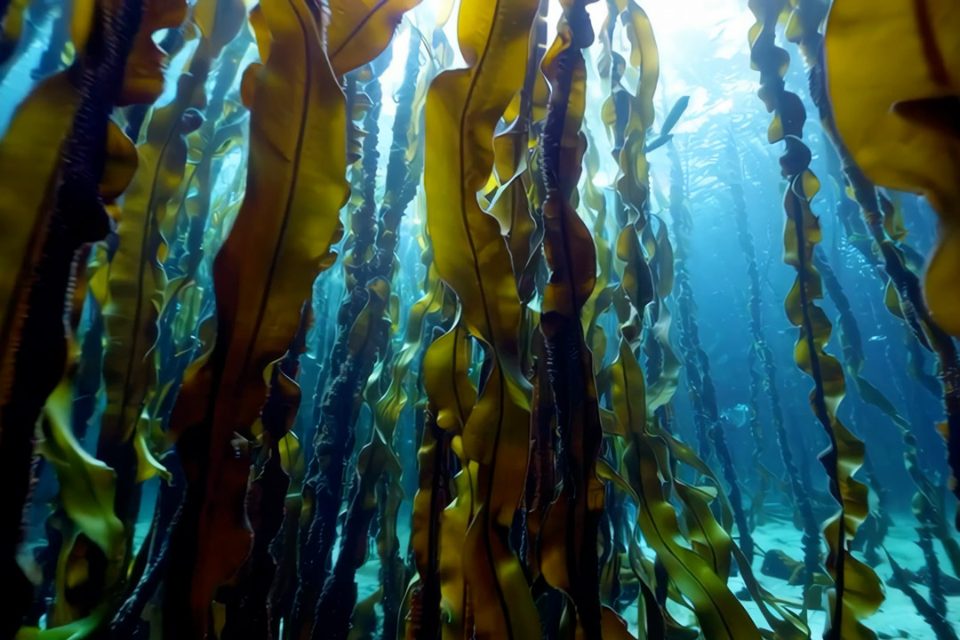
Researchers in Australia have established reproducible hatchery protocols to produce juvenile Durviallea potatorum, a development that could pave the way for the commercial cultivation of this southern hemisphere bull kelp.
The species grows along wave-exposed coastlines in southern Australia, New Zealand and South America and has strong industrial interest due to its high alginate content and its use in agricultural bioestimulants. At present, most of the biomass used by industry is obtained from beach-cast material, which limits the expansion for the sector.
The research, published in the Journal of Applied Phycology, establishes a full hatchery protocol for producing juveniles by addressing key stages of the early life cycle, including gamete release, fertilisation and germling growth.
The results show that the highest fertilisation rates are achieved by holding reproductive tissue overnight and inducing gamete release for 10 minutes at 14ºC. Under these conditions, fertilisation rates close to 90% were recorder.
For early juvenile growth, optimal conditions were identified at around 15ºC and irradiance levels close to 95 µmol photons m⁻² s⁻¹, a moderate light intensity typical of macroalgae hatcheries, corresponding to the amount of photosynthetically active light that reaches the culture surface each second. Under laboratory conditions, germlings reached sizes above 1 mm after roughly 60 days of cultivation.
The study also found that nutrient composition significantly affects early development. The f/2 culture medium supported faster growth, while media containing high ammonium concentrations reduced growth during the earliest developmental stages.
According to the authors, these findings provide a technical framework for hatchery production of Durvillaea juveniles and could support future offshore cultivation of the species.
Global seaweed aquaculture is currently dominated by Asian countries, which account for around 97% of total production. However, interest in developing locally adapted seaweed aquaculture species is increasing in regions such as Australia, Europe and North America.
In this context, the development of hatchery techniques for species such as Durvillaea potatorum represents an important step towards diversifying seaweed aquaculture and scaling up sustainable macroalgae production.

Related

Latest In-depth
-
Clams more resistant to heat and Perkinsus: research paves the way for selective breeding
Padua, Italy, 16/10/2026 | University of Padua researchers explain to misPeces the findings presented at Aquaculture Europe 2026 and the steps needed to transfer them to hatcheries. Initial applications could emerge within the next two or three years, although the relationship between resistance, growth and other production traits still need to be assessed