Certification can demonstrate that famed shrimp meet certain environmental and social criteria, but it does not in itself guarantee that the market will reward this effort with a higher price.
A study by José Manuel Fernández Polanco, José Luis Fernández Sánchez and Luciano Vílchez-Gómez, based on products offered by five Spanish retail chains, concludes that the Aquaculture Stewardship Council (ASC) label had no statistically significant effect on supermarket prices.
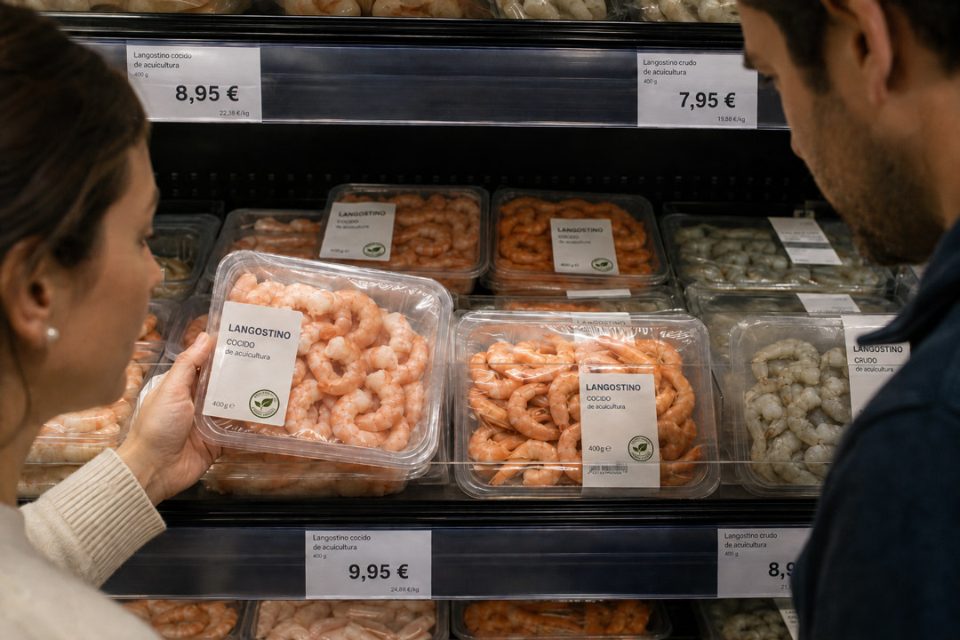
The researchers analysed 662 product listings and prices during the Christmas season, one of the periods of highest shrimp consumption in Spain. The results show that retailers made limited use of voluntary information to differentiate products.
Only 32.7% of listing highlighted information about the production method, while the species was mentioned in 15.8% and the country origin in just 7.4%. These percentages do not refer to mandatory labelling requirements, but to additional attributes given commercial prominence.
Under these conditions, consumers primarily make their decisions using more visible and recognisable cues, including size, presentation, brand, price and whether the product is identified as wild-caught. The analysis confirms that the latter attribute is associated with higher prices, showing that the market responds more readily to an easily understood characteristic than to a certification whose meaning may be unfamiliar.
The study nevertheless reveals that sustainable farmed shrimp have a potential value that is not currently being reflected in their price. In a choice experiment involving 218 consumers, replacing the certification logo with the explicit wording “sustainable aquaculture” increased the product’s perceived value and produced a stated willingness to pay approximately €1.38 more per kilogram.
This figure was similar to the premium attributed to a well-known brand, estimated at €1.26 per kilogram, although it remained below the approximately €3.49 associated with wild-caught origin.
The authors stress that these figures come from an experiment and do not represent premiums observed in actual sales. They therefore indicate a potential value that could only be captured if sustainability were communicated clearly and understandably.
“Certification can become merely a requirement for market access, without generating greater value for the product, if the value chain fails to communicate clearly what the ecolabel certifies.”
As the study’s lead researcher, José Manuel Fernández Polanco, explains, the results raise an important issue for aquaculture companies. Even when producers bear the costs of adapting their processes, passing audits and maintaining certification, there is a risk that certification will become merely a requirement for market access, without generating greater value for the product.
Ecolabels have the potential to differentiate aquaculture products, but their effectiveness is reduced when the value chain fails to explain what they certify. If retailers simply display a logo that many shoppers do not recognise, the differentiation achieved at farm level loses strength when the product reaches the supermarket shelf.
Certification must be accompanied by information that enables consumers to understand what it guarantees and why it should matter to them. Linking the label to concepts such as responsible farm management, environmental impact control, traceability and working conditions could help turn a technical attribute into a tangible reason to buy.
The problem, therefore, does not appear to be a lack of interest in sustainability, but rather the gap between what certification demonstrates and what shoppers understand when choosing a product. For sustainable farmed shrimp to generate greater value, producers, certification bodies, brand and retailers must share not only the label, but also the responsibility for explaining what it means.
ReferenceFernández Polanco, J.; Fernández Sánchez, J. L.; Vílchez-Gómez, L. (2026). Effectiveness of ecolabels in markets with imperfect transparency. A case study of sustainable farmed shrimp in Spanish retailing. Marine Policy, 193, 107229. https://doi.org/10.1016/j.marpol.2026.107229

Related
Latest In-depth
-
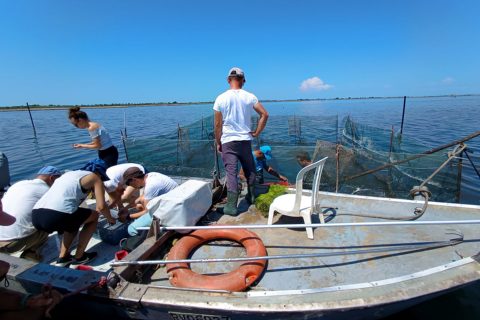
Clams more resistant to heat and Perkinsus: research paves the way for selective breeding
Padua, Italy, 16/10/2026 | University of Padua researchers explain to misPeces the findings presented at Aquaculture Europe 2026 and the steps needed to transfer them to hatcheries. Initial applications could emerge within the next two or three years, although the relationship between resistance, growth and other production traits still need to be assessed