

The accumulation of algae, barnacles and other organisms on submerged surfaces is a recurring problem for marine aquaculture facilities. Biofouling increases cleaning and maintenance requirements, adds weight to structures and can alter water flow conditions.
Conventional approaches to controlling this problem include antifouling coatings containing biocides, such as certain copper compounds, and periodic cleaning operations.
As an alternative to these methods, a team of Japanese researchers has proposed a biological approach after experimentally demonstrating that cultivating sterile Ulva Lactuca seaweed can considerably reduce the attachment of marine organisms to certain surfaces.
The study conducted by Shin Hirayama and colleagues at Saga University’s Institute of Ocean Energy and published in Frontiers in Marine Science, originated from an observation made during cultivation of the seaweed: surfaces in contact with Ulva remained almost free of fouling organisms, while other surfaces exposed to the same seawater accumulated biological deposits.
To investigate this phenomenon, the researchers first conducted land-based tank experiments over 85 days, followed by two trials in the marine environment of Imari Bay, using floating aluminium vessels equipped with seawater circulation and aeration.
In one 32-day marine trial, they found that the inner surfaces in contact with Ulva lactuca accumulated 31.5 times less fouling material that the outer surfaces of the same vessel.
By contrast, in vessels without the seaweed, accumulation was virtually identical on the inner and outer surfaces. These findings support the antifouling effect of Ulva under the experimental conditions investigated.
The mechanism responsible for this reduction has not yet been identified. The researchers suggest that it could be associated with the surface characteristics of the seaweed or bioactive substances released into the water.
The results indicate that the effect is unlikely to be explained solely by agitation and physical contact between the seaweed and the vessel walls, although further experiments are needed to distinguish between these mechanisms. This is important in determining whether protection requires living seaweed to remain in contact with the structures or whether it could be achieved using compounds extracted from the algae.
Based on their findings, the authors propose a conceptual system involving the establishment of sterile Ulva Lactuca cultivation areas around marine structures, using nets to contain the seaweed and aeration or agitation devices to encourage contact with the surfaces requiring protection.
The approach could be of interest for floating aquaculture facilities, but questions remain regarding scalability, energy consumption, maintenance and long-term effectiveness. The researchers themselves aknowledge the need to establish which fouling organisms are affected and whether the effect can be sustained over longer periods.
Another possibility would be to incorporate seaweed extracts into antifouling coatings, an approach the authors consider potentially more practical and commercially viable than maintaining live seaweed cultures around marine structures.
However, it will first be necessary to demonstrate that these compounds retain their effectiveness when incorporated into coatings and provide durable, safe and economically viable protection under real operating conditions.
For now, the research opens up a new possibility for biological biofouling control, but it has not yet demonstrated that the technology can reduce cleaning costs or replace conventional treatments in commercial aquaculture operations.
Scientific reference: Hirayama, S., Urata, K., Kusumoto, M. & Ikegami, Y. (2026). Bio-based antifouling strategy using sterile Ulva lactuca cultivation for marine structures. Frontiers in Marine Science, 13, 1970848. DOI: 10.3389/fmars.2026.1970848

Related

Latest In-depth
-
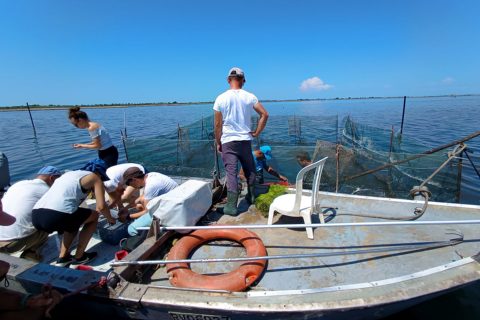
Clams more resistant to heat and Perkinsus: research paves the way for selective breeding
Padua, Italy, 16/10/2026 | University of Padua researchers explain to misPeces the findings presented at Aquaculture Europe 2026 and the steps needed to transfer them to hatcheries. Initial applications could emerge within the next two or three years, although the relationship between resistance, growth and other production traits still need to be assessed