
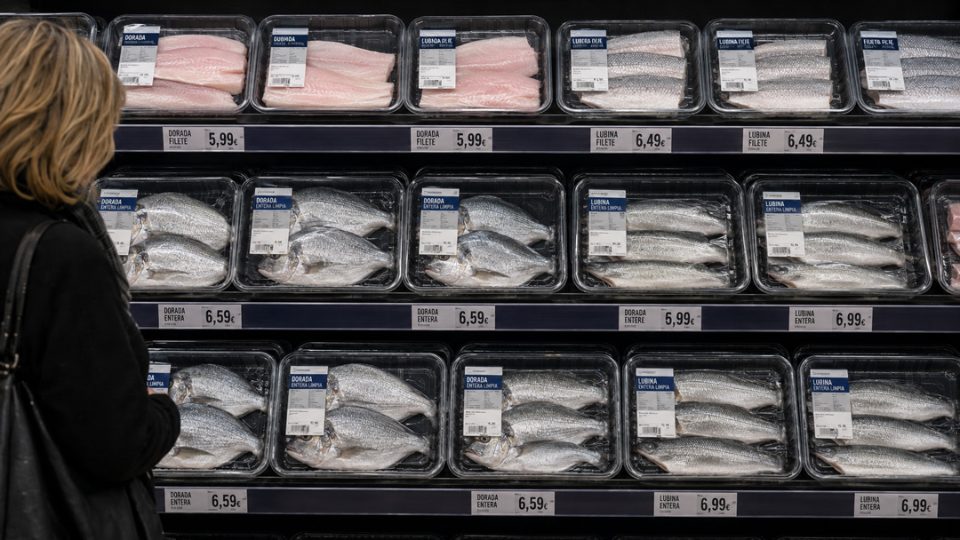
Apparent consumption of fisheries and aquaculture products in the European Union fell to 10.25 million tonnes live weight equivalent in 2023, its lowest level in a decade. This represents a 21% decline from the 12.94 million tonnes estimated in 2014.
Apparent per capita consumption also decreased, although less sharply, from 25.5 to 22.9 kilograms. The trend was not uniform: Spain and France remained among the largest markets but continued on a downward trajectory, while Italy, Poland, Romania and Slovakia recorded increases or showed greater resilience.
EUMOFA interprets this development as more complex than a simple loss of demand. The clearest change is a decline in consumption frequency, particularly at home. Between 2016 and 2024, the proportion of Europeans reporting that they ate fisheries and aquaculture products at home at least once a week fell from 40% to 29%.
This transformation is associated with younger generations having less familiarity with cooking fish, less time to prepare meals and higher expectations of convenience. Demand is therefore increasing for portioned, packaged, cleaned and ready-to-cook or ready-to-eat products. This favours species with predictable supplies and a broad range of product formats, including salmon, tuna and shrimp.
Convenience, however, is also standardising the range of products available. Supermarkets and hypermarkets increased their market penetration from 73% in 2016 to 79% in 2024, while traditional markets lost 12.3 percentage points and accounted for around 14%. Large retail chains tend to prioritise species that offer stable supplies, manageable prices and sufficient volumes for promotions and continuous distribution.
This structure helps explain why the European market is becoming increasingly dependent on a limited number of imported or farmed species. Around 70% of the products consumed in the EU come from imports. Between 2014 and 2023, combined EU fisheries and aquaculture production fell by 37%, while imports declined by only 4%.
The gap between consumption and domestic production is particularly pronounced among the leading species. EU self-sufficiency stands at approximately 1% for salmon, 0% for Alaska pollock, 5% for cod and 11% for shrimp. By contrast, it reaches 74% for mussels and gilthead seabream, 84% for trout and 87% for mackerel. Nevertheless, five of the six most widely consumed species remain highly dependent on external supplies, with mussels the only exception.
Price became the most frequently mentioned purchasing criterion in 2024, cited by 55% of consumers, ahead of appearance and freshness at 52% and origin at 46%. Ease of preparation was mentioned by 25%, while environmental, social and ethical considerations accounted for 17%.
Nevertheless, the increase in fish and seafood prices since 2015 was similar to that recorded for meat: around 45% in both categories up to 2025, compared with 49% for milk, cheese and eggs. This supports EUMOFA’s conclusion that price is important but does not provide a complete explanation. Relatively expensive products such as salmon continue to attract strong demand when they combine a healthy image, consistent availability, ease of use and a permanent presence in retail outlets.
There is also a gap between stated preferences and actual purchasing behaviour. In 2024, 36% of consumers said they preferred wild-caught products, 31% expressed no preference and only 8% explicitly chose farmed products. However, several aquaculture species occupy central positions in European consumption, indicating that availability, format and price may outweigh preferences expressed in surveys.
The study does not establish a single causal relationship. It combines apparent consumption balances, national statistics, four Eurobarometer surveys, a literature review and 28 interviews conducted in six Member States. Its findings identify consistent trends, but some explanations — such as the substitution of fish with chicken among price-sensitive consumers — are based mainly on consultations with market operators and have more limited support in the academic literature.
The business implication is that the market will not recover through generic campaigns encouraging people to eat more fish alone. Producers and distributors will need to reduce practical barriers, preserve product diversity, offer understandable prices and portion sizes, and prevent convenience from concentrating all future growth around a small number of global species.

Related

Latest In-depth
-
Clams more resistant to heat and Perkinsus: research paves the way for selective breeding
Padua, Italy, 16/10/2026 | University of Padua researchers explain to misPeces the findings presented at Aquaculture Europe 2026 and the steps needed to transfer them to hatcheries. Initial applications could emerge within the next two or three years, although the relationship between resistance, growth and other production traits still need to be assessed