
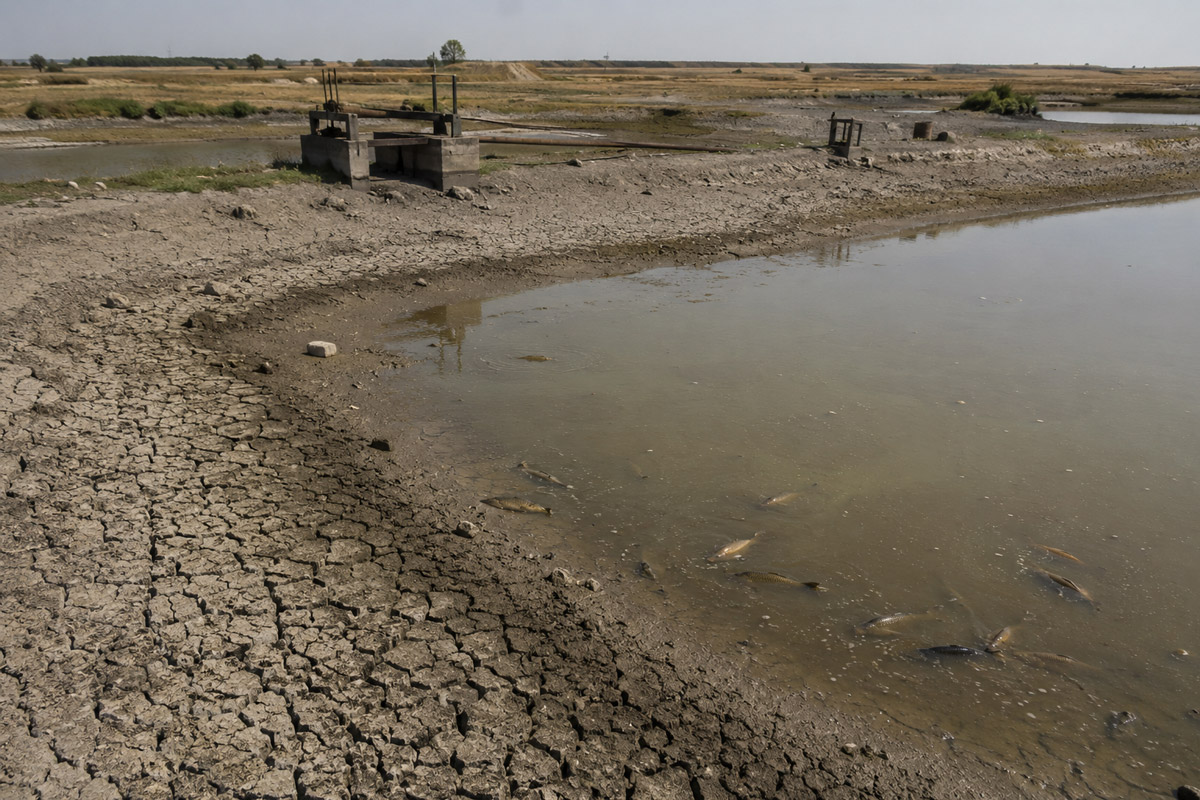
Persistent drought and extreme heat are turning access to water into a direct production risk for European freshwater aquaculture. Falling water levels, rising temperatures and oxygen depletion have affected pond and flow-through farms across Central and Eastern Europe, exposing a vulnerability that emergency aeration, reduced feeding and fish transfers can mitigate, but cannot resolve without longer-term water management.
In Hungary, around 1,588 hectares of fish ponds have dried out and nearly 280 tonnes of fish have died across 20 farms, according to figures reported by the country’s Ministry of Agriculture and Food Economy.
The resulting revenue loss has been estimated at HUF 1.3 billion, equivalent to approximately EUR 3.3 million, while producers warn that replacing lost stocks and rebuilding production cycles could take several years.
The damage is particularly significant because Hungary’s aquaculture is strongly dependent on earthen ponds. The country has approximately 27,000 hectares of fish ponds, and pond farming accounts for 75% of national aquaculture output.
These extensive and semi-intensive systems, used mainly for common carp and other freshwater species, rely on sufficient water not only to maintain pond volume, but also to control temperature, oxygen availability and water quality.
At the Rétimajor fish-farming complex, one of the country’s largest, around 150 hectares had completely dried out by August, while fish remained confined to only 30–40 centimetres of water across another 400 hectares.
The farm attributes the losses to insufficient water supply and competition with upstream irrigation, whereas the regional water authority argues that exceptional evaporation and oxygen depletion, rather than irrigation withdrawals, were the determining factors.
The disagreement highlights a broader issue: how water should be allocated between crops, livestock, aquaculture, ecosystems and other users during prolonged shortages.
Similar pressures are emerging elsewhere in Europe. Romanian carp producers warn that drought damage can remain visible for three or four years because of the length of the production cycle.
Farms in the Czech Republic have reduced or suspended feeding, increased aeration and, where necessary, drained ponds, while trout farms in Bosnia and Herzegovina have resorted to costly oxygenation as water temperatures rise. These responses can reduce immediate mortality but also increase costs, slow growth and reduce the biomass available for future harvests.
The current crisis suggests that drought preparedness can no longer be treated solely as an emergency protocol. Water storage, retention within the landscape, revised stocking densities, aeration and oxygenation capacity, temperature monitoring and clearer allocation rules will increasingly form part of production planning.
For European freshwater aquaculture, water security is becoming as important as feed, health and energy: without reliable access to water of sufficient quantity and quality, productive capacity itself can no longer be taken for granted.

Related

Latest In-depth
-
Clams more resistant to heat and Perkinsus: research paves the way for selective breeding
Padua, Italy, 16/10/2026 | University of Padua researchers explain to misPeces the findings presented at Aquaculture Europe 2026 and the steps needed to transfer them to hatcheries. Initial applications could emerge within the next two or three years, although the relationship between resistance, growth and other production traits still need to be assessed