
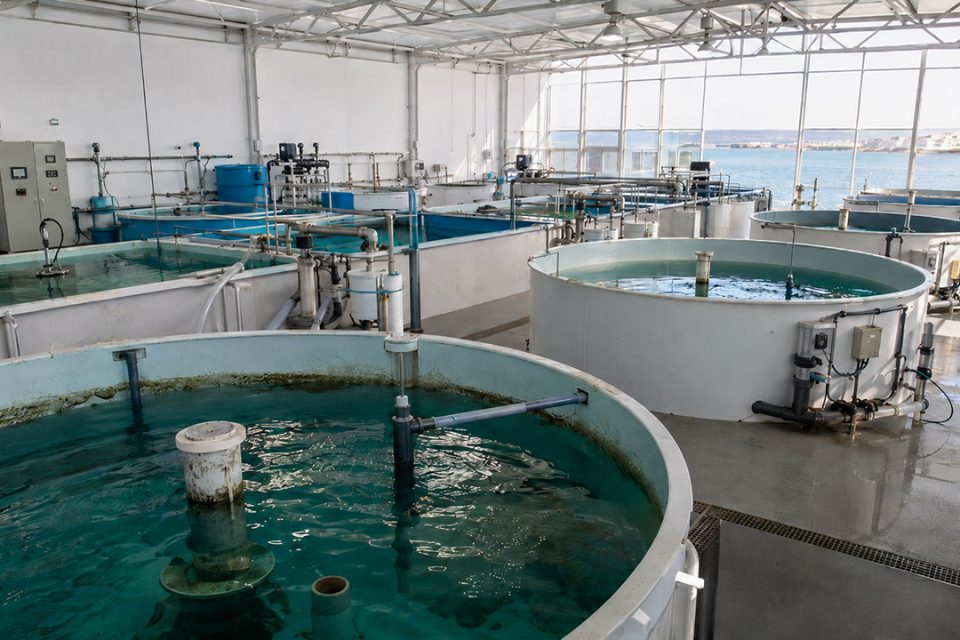
Researchers and companies can receive European funding to access the facilities and services of more than 40 institutions to develop and test innovations in aquaculture, fisheries, ecological restoration and the blue economy.
The opportunity is offered through AQUASERV, a European project with a budget of more than €14 million coordinated by Portugal’s Centre of Marine Sciences (CCMAR).
This programme brings together six major European research infrastructures and more than 30 scientific institutions. Its catalogue includes experimental aquaculture facilities, laboratories, analytical platforms, organism collection and technological services that can be accessed on-site, remotely or virtually, depending on the requeriments of each project.
For aquaculture, these facilities can support research into feed, health and disease control, reproduction, selective breeding, welfare, behaviour and the responses of aquatic organisms to different environmental conditions. They can also be used to test farming technologies, recirculating aquaculture systems, scale-up processes, and monitoring and analytical tools.
The aim is to enable a research team or company to validate a new solution without having to own all the required facilities, equipment and specialist expertise. Selected projects may receive access for up to three months, with the costs associated with using the infrastructure covered and, depending on the applicable conditions, support for consumables, travel and accommodation.
The call is open to PhD students, researchers, engineers and other professionals affiliated with a university, research organisation, non-profit body or registered company. Proposals must justify the need to use a facility located in another country and demonstrate their scientific quality, technical feasibility and potential contribution to more sustainable aquaculture.
Although the thematic call dedicated specifically to aquaculture closed on 31 march 2026, AQUASERV’s general call will remain open until the end of 2028. Applications can be submitted on a rolling basis and are assessed during several evaluation rounds each year.
To receive a decision in the November 2026 round, applicants are advised to submit their proposals by 21 August.
The European Marine Biological Resource Centre (EMBRC), one of the participant research infrastructures, contributes biological resources, experimental facilities, analytical platforms and access to marine organisms. In its industrial strategy, EMBRC has identified aquaculture as one of its three technological priorities, alongside marine biotechnology and ocean observation.
The initiative seeks to overcome one of the recurring barriers to aquaculture innovation: limited access to sufficiently specialised experimental facilities in which new ingredients, treatments, equipment and production systems can be tested before progressing towards commercial application.
By sharing infrastructure and expertise across countries, AQUASERV aims to accelerate scientific validation while reducing the costs and risks associated with technological development.
Further information and applications: AQUASERV Transational Access open call and AQUASERV on CORDIS

Related

Latest In-depth
-
Clams more resistant to heat and Perkinsus: research paves the way for selective breeding
Padua, Italy, 16/10/2026 | University of Padua researchers explain to misPeces the findings presented at Aquaculture Europe 2026 and the steps needed to transfer them to hatcheries. Initial applications could emerge within the next two or three years, although the relationship between resistance, growth and other production traits still need to be assessed