European aquaculture has increasingly sophisticated tools to determine where it can expand, but identifying suitable areas does not guarantee access to space for production. This gap between spatial planning and production capacity remains one of the challenges facing the sector’s growth in the European Uion, where site availability also depends on administrative decisions, compatibility with other maritime activities and legal certainty for investors.
Allocated Zones for Aquaculture (AZA), integrated into Maritime Spatial Planning (MSP), help identify areas with production potential by considering not only environmental conditions but also different levels of governance, competing uses of marine space, biodiversity conservation and climate change adaptation. Their main contribution is to embed aquaculture within a broader framework of spatial planning.
Among the studies presented at Aquaculture Europea 2026, MEDIGREEN stands out for its analysis of how AZAs can be integrated into Mediterranean maritime planning and the tools available to identify priority areas with high aquaculture potential. Meanwhile, AZA4ICE, which involves Spanish partners, is developing multi-criteria methodologies to identify zones for circular aquaculture, incorporating environmental, economic and social factors alongside stakeholder participation.
Research focusing on Sardinia also offers approaches for the adaptive management of aquaculture zones.
However, these advances raise a question that remains insufficiently answered from a production perspective: how many hectares identified as suitable are ultimately authorised and brought into use? The studies provide a better understanding of site selection and planning procedures, but do not offer comparable data tracing the progression from potentially suitable areas to allocated zones, granted licences, implemented projects and actual production.
This distinction is crucial for aquaculture businesses. An environmentally suitable area may remain unavailable for new developments because of regulatory restrictions, conflicts with other users or uncertainty over licensing timescale.
Even when an area is included in maritime spatial plans, turning it into production capacity requires legal and economic conditions that give businesses the confidence to commit to long-term investment, while maintaining environmental safeguards.
The findings presented at AE2026 show that Europe is making progress in identifying areas for aquaculture development, but the extent to which these tools are facilitating new farming operations remains to be demonstrated.
Assessing their effectiveness would require indicators covering hectares effectively made available for aquaculture, licensing timescales, investment undertaken and additional production capacity brought online.
The challenge is no longer simply to determine where aquaculture could develop, but to ensure that suitable space can actually be brought into production.

Related
Latest In-depth
-
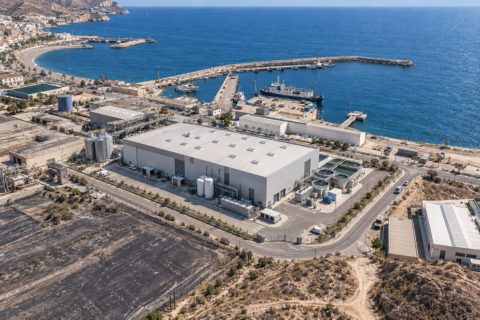
Ocean Aquaculture begins work on Spain hatchery designed to produce eight million greater amberjack juveniles a year
Almería, Spain, 9 September 2026 | The first phase will involve an investment of around €15 million and is expected to begin production in January 2028, supplying both the group’s future offshore farms and other Mediterranean producers