
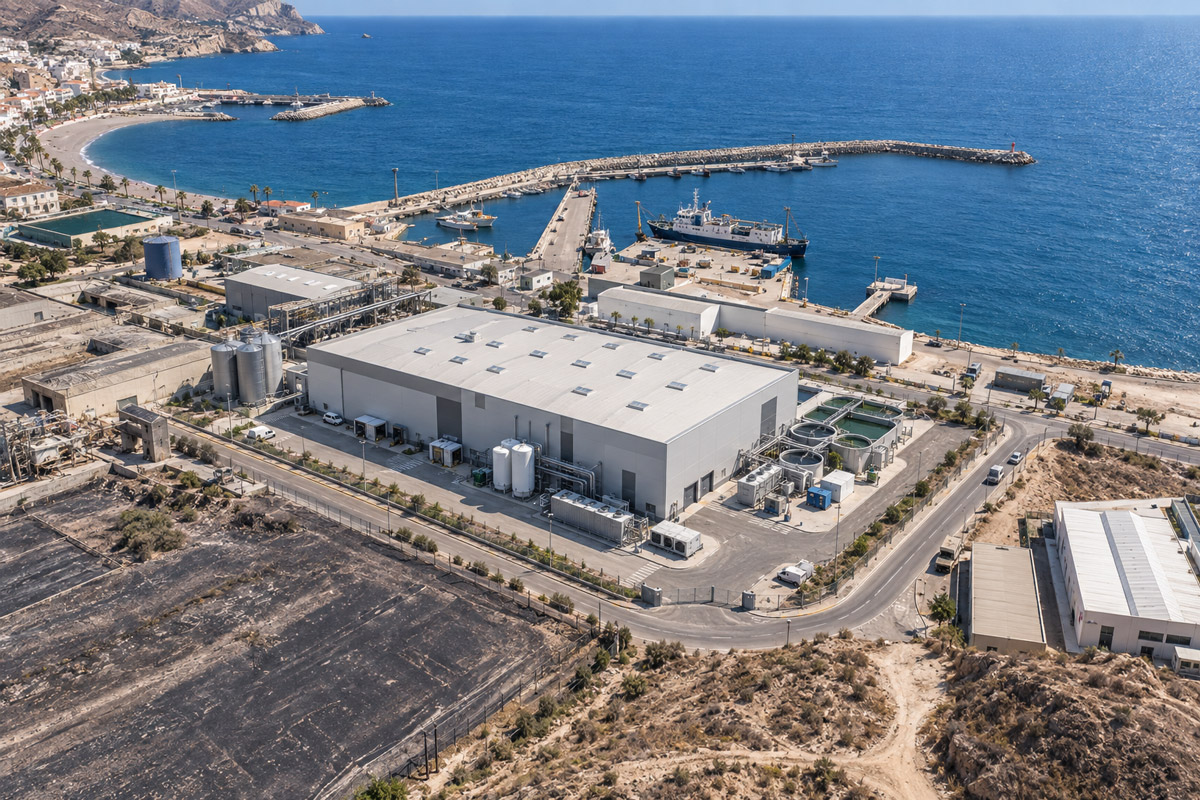
 AI recreation of a future hatchery in Carboneras. © misPeces, 2026
Ocean Aquaculture Hatchery is preparing to begin construction this September on a recirculating aquaculture system (RAS) hatchery for greater amberjack at the side of Endesa’s former thermal power plant in Carboneras, Almería.
The first phase will be designed to produce up to eight million juveniles weigning approximately 10 grams each year. The company expects its first production batch in January 2028.
Ocean Aquaculture says it has obtained the permits required to undertake this initial stage, with construction scheduled for completion in December 2027. The planned investment amounts to around €15 million, including items additional to the budget submitted under the public funding call.
The European Maritime, Fisheries and Aquaculture Fund (EMFAF) resolution recognises eligible expenditure of €12.79 million and awards €5.28 million in public funding, equivalent to 41.3% of the approved amount.
The recirculating system account for €6.08 million of the investment and will be divided into separate circuits for broodstock, incubation, larval rearing, rotifer and Artemia production, and weaning. A further €5.57 million has been allocated to civil works, alongside seawater intake systems, electrical installations, laboratory equipment and phytoplankton production facilities.
A hatchery serving both the group and third-party producers
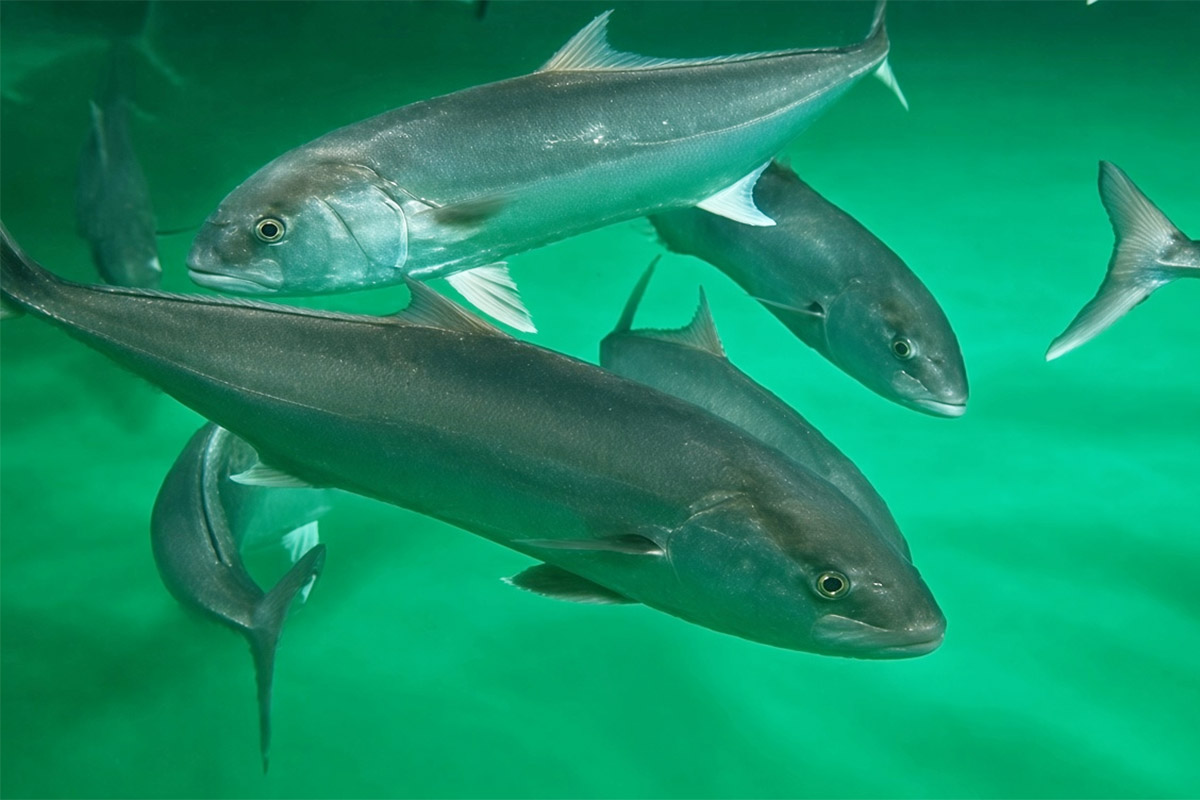 Greater amberjack broodstock | IEO Murcia
The hatchery’s business plan is not limited to supplying the group’s own operations. Juan Manuel Fernández Aldana representant of the group told misPeces that the juveniles will be destined both for Ocean Aquaculture’s future marine farms and for external producers, in response to growing demand for greater amberjack juveniles across the Mediterranean.
Opening production to third parties will allow the hatchery to “operate as an independent business unit, without being financially dependent on the timetable of the offshore protects.”
A second phase, for which no definite date has yet been established, envisages a further investment of €5 million to produce up to seven million juveniles weighing approximately 40 grams.
According to Ferández Aldana, supplying fish at this large size would mean that they had already completed an additional pre-growing stage, reducing some of the biological risk and the time required before their transfer to marine farming facilities.
The first component of a broader offshore aquaculture plan
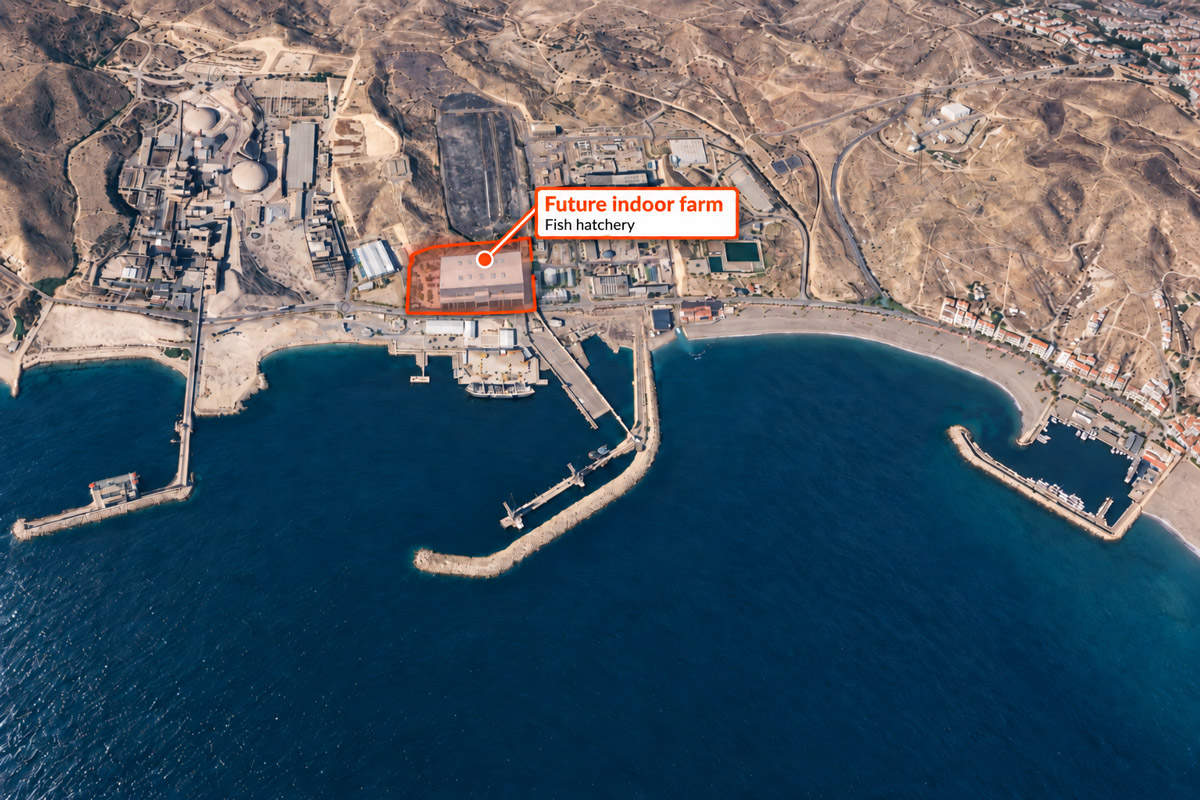 OAC hatchery's location in Carboneras (Spain)
The hatchery is the first component of a wider strategy promoted by Ocean Aquaculture Global, combining juvenile production with the grow-out of greater amberjack in open waters.
The project’s principal investor is the Dutch family-owned group INDOFIN. Its operations are structured through Ocean Aquaculture Hatchery in Carboneras, Ocean Aquaculture Andalusia in Almería and Ocean Aquaculture Murcia in the Region of Murcia.
The company has applied for two licences to develop marine farms: one off the Almería coast, near Adra, and another in the Mazarrón area. However, the authorisation process for these farms is progressing more slowly than that of the hatchery.
“It is a very solid project, but we are moving forward one step at a time,” said Fernández Aldana, who considers administrative hurdles to remain one of the main constraints on the development of offshore aquaculture.
Semi-submersible cages before large offshore platforms
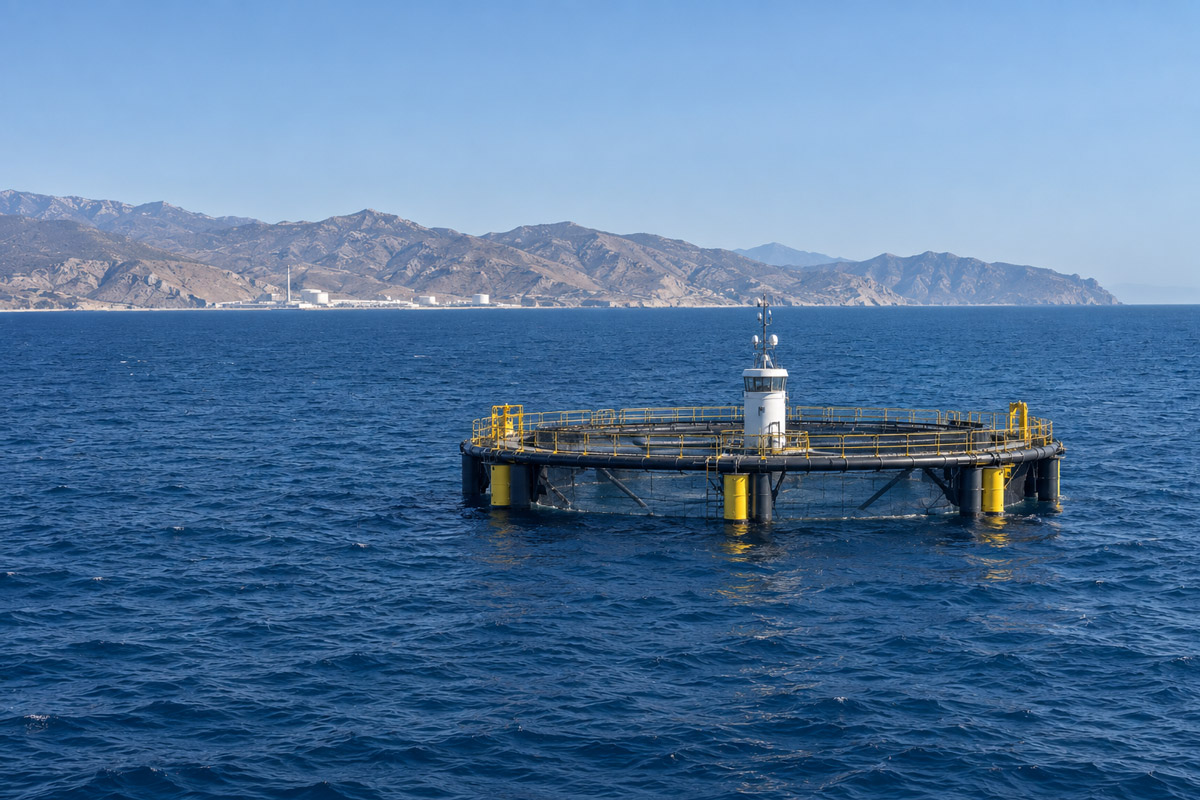
The original proposal envisaged large semi-submersible floating platforms, whose construction would require agreements with specialist shipyards several years in advance. Geopolitical tensions and the current difficulties involved in commissioning this type of infrastructure have led the group to revise the planned sequence.
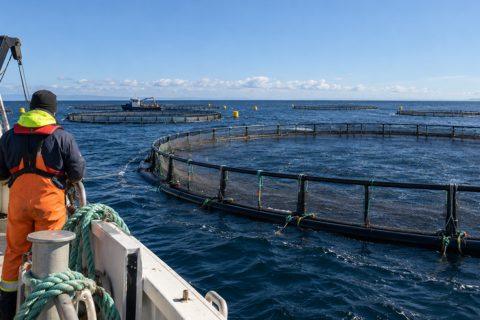
Initial marina production will therefore take place in circular semi-submersible cages, while the deployment of large offshore platforms has been postponed until a later stage.
The updated timetable envisages the first offshore stocking and production activities beginning in 2028, followed by production scale-up during 2029 and stable output from 2030 onwards.
According to Fernández Aldana, the large offshore platform model has not been abandoned. It has instead been reserved for the period after 2030, when the company expects to have the necessary licences, operational experience and industrial agreement in place.
Greater amberjack as a high-value Mediterranean species
The choice of greater amberjack reflects the productive and commercial potential that the company sees in this emerging warm-water aquaculture species.
Ocean Aquaculture believes that greater amberjack can complement, rather than replace, the Mediterranean supply of gilthead seabream, European seabass and meagre. The species can also reach a relatively large market size and target higher-value markets.
Fernández Aldana said that the investors are approaching the initiative “with a long-term perspective and without demanding an immediate return”.
The Carboneras location offers proximity to the sea, access to good-quality well water and the availability of a jetty that could facilitate the transport of juveniles and future marine logistics.
The project was selected under Futur-e Litoral, Endesa’s programme to attract new industrial activities and employment to land released following the closure and dismantling of the Carboneras thermal power plant.
By starting with the hatchery, Ocean Aquaculture is bringing forward the part of its strategy that can operate and generate revenue independently of the marine-farm licences.
The decisive test will come from 2028 onwards: demonstrating that the facility can consistently produce millions of uniform, high-quality greater amberjack juveniles at competitive cost, while the group progresses from its semi-submersible cages towards its longer-term objective of developing aquaculture further offshore.
Related

Latest news
-
Financial model projects a 19.4% internal rate of return for an offshore European seabass farm off France
France, 23 October 2026 | The hypothetical operation would require nearly $40 million investment and produce 5,220 tonnes a year at full capacity. The projected return depends on assumptions that have yet to be tested at commercial scale
-
FEAP calls for binding fish farming production targets in EU's Vision 2040
Brussels, 22/10/2026 | European fish farmers welcome the Commission's plans to simplify aquaculture licensing but call for measurable growth targets, national commitments and a regulatory framework that supports investment
-
A rapid test for tilapia lake virus moves closer to on-farm diagnosis
Thailand, 22 October 2026 | A lateral flow test correctly identifies 60 out of 61 tilapia samples, offering a potential tool for preliminary virus detection, although further validation is needed to establish its ability to identify early-stage infections