
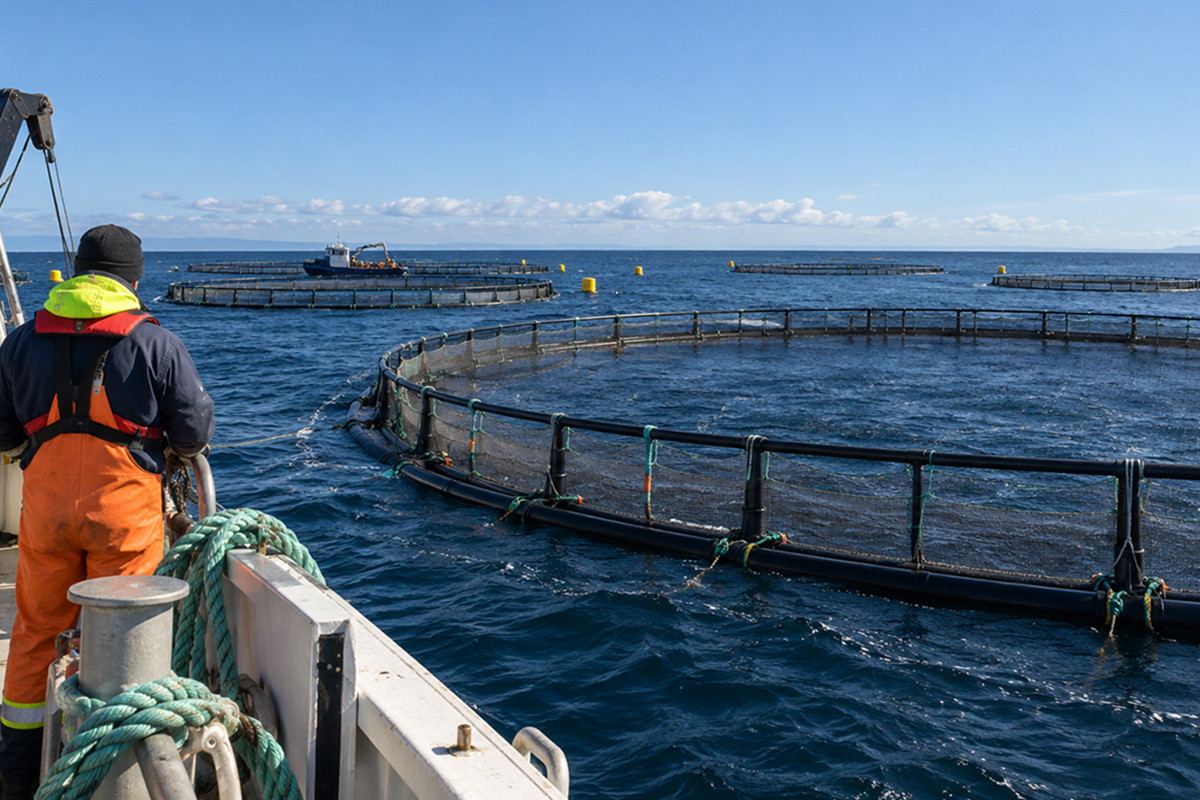
A financial model of a hypothetical European seabass farm in the French Mediterranean estimates an internal rate of return (IRR) of 19.43% over 15 years. The proposed operation would use submersible net pens and reach an annual production capacity of 5,220 tonnes in its 11th year.
The model puts the initial investment at almost $40 million. It also reports a project net present value (NPV) of $166.1 million. That figure includes a horizon value of $111.7 million; the NPV of the projected cash flows alone is $54.4 million.
The researchers based the projections on a sale price of $11.245 per kilogram, annual price inflation of 2%, a 90% survival rate and a feed conversion ratio of 1.8. The model also factors in sensors, cameras and other digital systems intended to improve biomass monitoring, reduce feed waste and support farm operations.
The projected return is sensitive to the selling price. A scenario with a 10% lower price reduced the modelled IRR to 15.94%. Feed accounts for 55% of production costs, but the published sensitivity analysis tests changes in selling price and fry costs rather than a comparable rise in feed costs.
The authors stress that the results are projections, not evidence from an operating farm. The model assumes competent management, a reliable supply of juveniles, access to capital and no major production disruptions. The site suitability analysis was also based on spatial data and was not validated through on-site work.
The study published in the Journal of Ocean and Coastal Economics, draws on cost estimates from potential suppliers and industry experience. One of its authors is employed by Innovasea, which provided data for the research; the paper declares this relationship.
The findings offer a financial scenario for offshore seabass production, but do not establish that a farm of this scale would achieve the projected returns in commercial operations.

Related

Latest In-depth
-
Clams more resistant to heat and Perkinsus: research paves the way for selective breeding
Padua, Italy, 16/10/2026 | University of Padua researchers explain to misPeces the findings presented at Aquaculture Europe 2026 and the steps needed to transfer them to hatcheries. Initial applications could emerge within the next two or three years, although the relationship between resistance, growth and other production traits still need to be assessed