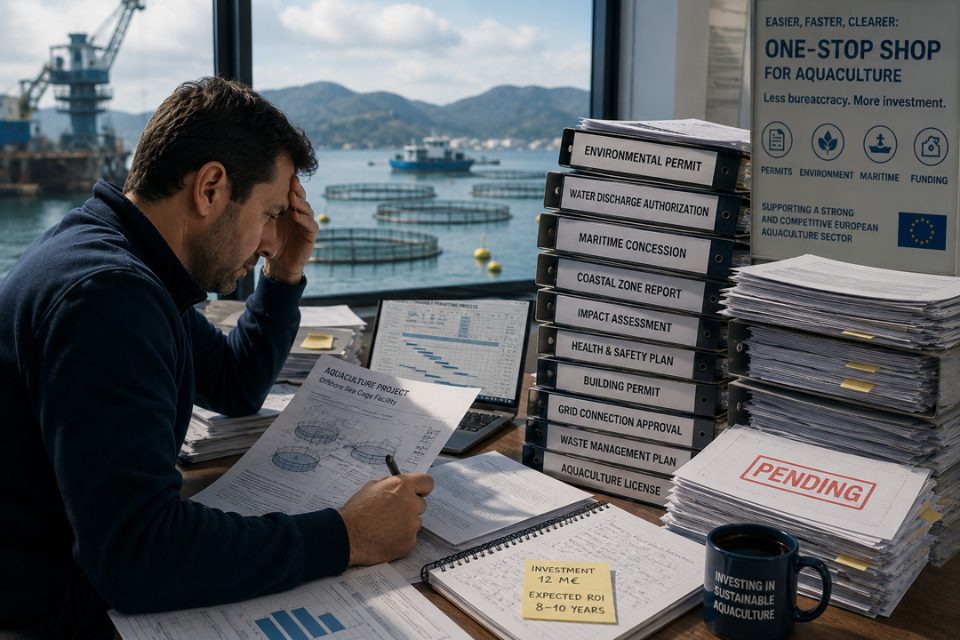
European aquaculture continues to struggle to transform technically viable projects into executable investments. Regulatory fragmentation, procedural complexity and the lack of predictability in approval timelines continue to slow down both the development of new facilities and the expansion of existing operations.
In this context, the European Union’s Aquaculture Advisory Council (AAC) has recently proposed that Member States move towards “single-window” systems capable of centralising in one place procedures related to licences, renewals, environmental permits and access to public funding.
The proposal aims to reduce administrative fragmentation and facilitate a more direct relationship between companies, investors and public authorities. However, the debate is beginning to move beyond the single-window concept as a standalone solution.
According to Diego Mendiola, an aquaculture professional in Spain, single-window systems “have been a known procedure for practically 15 years or more”, and their effectiveness has varied depending on the Autonomous Community.
The issue, therefore, is not only about concentrating procedures within the same administrative gateway, but about genuinely simplifying the regulatory framework behind those procedures.
Omnibus packages aimed at cross-cutting regulatory simplification
Mendiola points out that since 2025 the European Commission has been working on omnibus packages designed to address several regulatory areas simultaneously, potentially offering a more structural route to reducing administrative burdens, shortening timelines and improving legal certainty.
Applied to aquaculture, this approach could prove more relevant than a traditional single-window system. According to Mendiola, many delays are not caused solely by poor coordination between administrations, but by the accumulation of regulations, reports, overlapping competences, territorial interpretations and duplicated procedures.
As he explains, a single-window system may organise the process, but it does not necessarily simplify it. If the same requirements, reports and bottlenecks remain behind that window, the impact on investment will be limited.
As argued by the Advisory Council, the aquaculture sector does not only need better administrative channels, but also more predictable and less redundant regulatory frameworks capable of supporting investments with high upfront costs and long payback periods, such as offshore projects, RAS systems and production capacity expansions.
Mendiola supports this approach and compares it to recent experiences in Spain linked to PERTE programmes and Next Generation funds, where different administrative and financial instruments were coordinated to accelerate funding and facilitate the execution of strategic projects.
The difference, he warns, is that this type of simplification should become a structural policy rather than an exceptional response.
The challenge is moving from theory to practical implementation
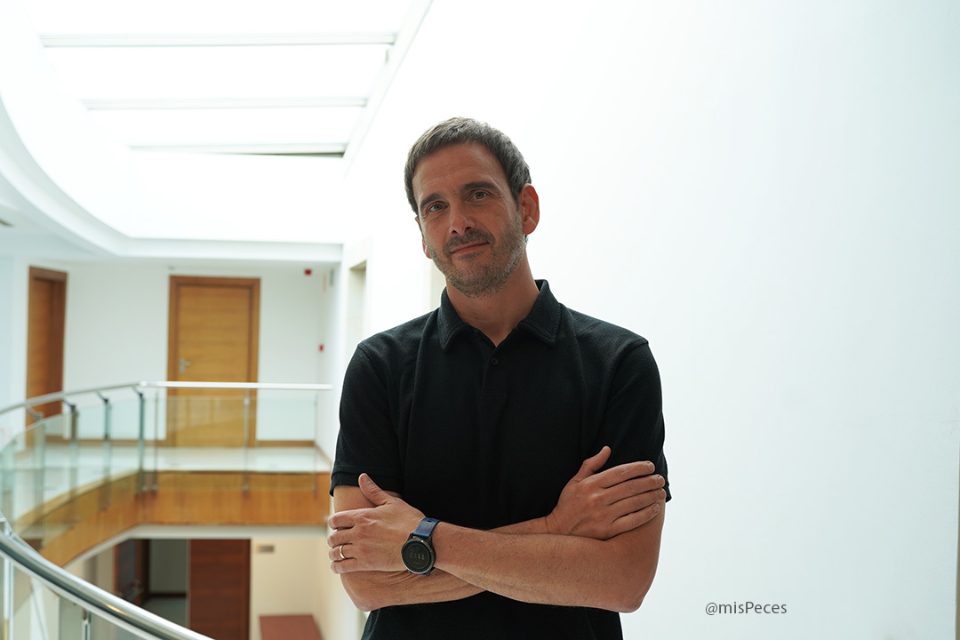 Diego Mendiola |@misPeces
The challenge now lies in transferring this European simplification agenda to the aquaculture sector and to Member States. In Spain’s case, practical implementation could require regulatory developments through decrees capable of adapting European principles to national and regional procedures.
For banks, investment funds and investors, this evolution is far from minor. Regulatory uncertainty remains one of the main factors penalising the financing of new aquaculture projects in Europe. Reducing timelines, clarifying competences and avoiding administrative duplication could have a direct impact on risk perception.
In a sector competing against third countries with more agile regulatory frameworks, the difference between organising procedures and actually removing obstacles could determine Europe’s real capacity to recover investment, production and food autonomy.

Related
Latest In-depth
-
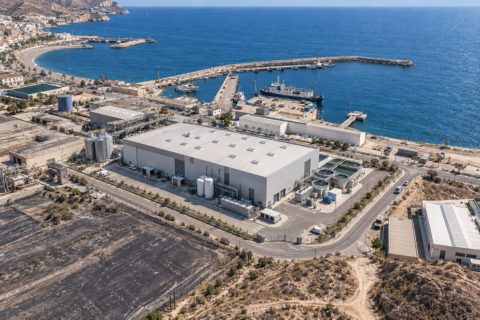
Ocean Aquaculture begins work on Spain hatchery designed to produce eight million greater amberjack juveniles a year
Almería, Spain, 9 September 2026 | The first phase will involve an investment of around €15 million and is expected to begin production in January 2028, supplying both the group’s future offshore farms and other Mediterranean producers